

Introduction: The Foundation of Modern Automation
In a world increasingly driven by automation, robotics, and precision manufacturing, the ability to create smooth, accurate, and reliable linear motion is fundamental. At the core of this capability lies the linear rail carriage (often called a “block” or “runner”)—a seemingly simple but ingeniously engineered component that transforms rigid guide rails into high-performance motion systems. Far more than just a bearing, the carriage is the critical interface between a machine’s moving platform and its stationary structure, dictating the system’s load capacity, accuracy, speed, and longevity. This article explores the design, function, types, and applications of the linear rail carriage, illuminating its pivotal role in modern engineering.
1. Anatomy of a Linear Rail Carriage: Deconstructing the Component
A linear rail carriage is a compact, sealed unit that houses the rolling elements and provides mounting points for the load. Its key components are:
- Housing (Block Body): Typically a high-grade, hardened steel casting or forging. It is the main structural element, designed to withstand high loads and moments. It features precision-machined mounting holes (tapped or through-holes) for attaching tools, slides, or actuators.
- End Seals (Wipers): Made of elastomers like polyurethane or nitrile rubber, these are mounted at both ends of the carriage. Their primary function is to prevent contaminants (dust, chips, coolant) from entering the carriage and to retain lubrication within.
- Internal Seals (Scraper Seals / Grease Nipples): Further protect the internal recirculating ball or roller path. Many carriages include integrated lubrication ports (grease nipples or oil holes) for routine maintenance.
- Ball/ Roller Retainer: A plastic or metal cage that spaces and guides the rolling elements, preventing them from contacting each other and ensuring smooth recirculation.
- Recirculating Rolling Elements: The heart of the system. These are precisely graded balls or cylindrical rollers that circulate in an endless loop within the carriage, bearing the load as they contact the raceways of the rail.
- End Cap: Covers the recirculation channel at the ends of the carriage, often containing the ball/roller return path. It may be marked with manufacturer and part number information.
2. Core Function & Operating Principle: The Recirculation Concept
Unlike a simple bushing, a linear rail carriage is based on a recirculating bearing principle. This is what allows for virtually unlimited travel length. The process works as follows:
- Load Zone: As the carriage moves along the rail, the rolling elements in the bottom (load-bearing) section carry the applied forces (vertical, horizontal, moment) from the carriage housing to the rail’s raceways.
- Recirculation: After exiting the load zone, the balls or rollers enter a return channel built into the carriage (or sometimes the rail). This channel, often a plastic or stamped metal guide, directs them back to the start of the load zone.
- Continuous Loop: This creates a continuous, endless train of rolling elements, allowing the carriage to travel any distance along the rail without the component length being a limiting factor.
This design minimizes friction, reduces wear, and enables high speeds and accelerations with exceptional smoothness and precision.
3. Types of Linear Rail Carriages & Their Rails
Carriages are defined by the type of rolling element and rail profile they are designed for, each offering distinct performance characteristics.
3.1. Ball-Type Linear Carriages
- Principle: Use spherical balls as the rolling element.
- Characteristics:
- Lower Friction & Smoother Motion: Ideal for high-speed applications.
- Quieter Operation: Generates less noise.
- Good Accuracy: Suitable for most precision tasks.
- Moderate Load Capacity: Contact is point-contact, limiting static load ratings compared to rollers.
- Typical Rails: Profiled linear guides (e.g., Hiwin, THK, IKO styles), round shaft guides with ball bushings.
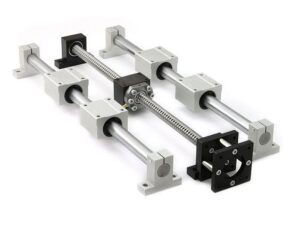
3.2. Roller-Type Linear Carriages
- Principle: Use cylindrical or barrel-shaped rollers.
- Characteristics:
- Very High Load Capacity: Line-contact between rollers and raceways distributes load over a larger area. Can handle 2-3 times the load of a similarly sized ball carriage.
- High Stiffness & Rigidity: Minimal deflection under heavy loads or moments.
- Higher Friction: Slightly less suited for the very highest speeds.
- Typical Rails: Profiled linear guides with matching roller raceways. Often used in heavy machine tools (gantry mills, EDM machines) and high-load automation.
3.3. Carriage Configuration Variations
- Flanged vs. Square: Flanged carriages are the most common, offering four mounting holes on top. Square carriages have a wider, more square footprint for higher moment load resistance.
- Preload Classes: Carriages are manufactured with internal preload (the deliberate application of internal force to the rolling elements). Grades include:
- C0 (Zero Clearance / Light Preload): For high-precision, smooth motion with minimal vibration.
- C1 (Medium Preload): General-purpose, balances rigidity and smoothness.
- C2 / C3 (Heavy Preload): For maximum rigidity and minimal deflection under heavy cutting forces or high moment loads.
4. Key Performance Characteristics
Selecting a carriage involves evaluating its specifications against application requirements:
- Load Ratings: Dynamic Load Rating (C) is the load at which 90% of a group of identical carriages will achieve a travel life of 100 km. Static Load Rating (Co) is the maximum load that can be applied without permanent deformation. Ratings are given for radial, reverse-radial, and lateral directions.
- Moment Load Capacity (Mx, My, Mz): The carriage’s ability to resist tipping or rocking forces applied around the X, Y, and Z axes. Critical for gantry and cantilevered applications.
- Stiffness: The resistance to elastic deformation under load. Higher preload and roller elements increase stiffness.
- Accuracy Grades: Defined by the running parallelism of the carriage along the rail. Common grades (from lowest to highest precision): Normal (N), High (H), Precision (P), Super Precision (SP), Ultra Precision (UP).
- Travel Life (L10): The expected distance (usually in km or miles) that 90% of a batch of carriages will travel before showing signs of fatigue failure (flaking/spalling), under specified load conditions. Calculated using the dynamic load rating and applied load.
5. Critical Applications Across Industries
The linear rail carriage is ubiquitous in high-performance machinery:
- Machine Tools: CNC machining centers (milling, turning), EDM machines, grinders. Carriages provide the precise, rigid motion for tool heads and worktables.
- Semiconductor & Electronics Manufacturing: Wafer steppers, PCB assembly robots, wire bonders. Ultra-high precision (UP/SP grade) and cleanroom-compatible carriages are essential.
- Industrial Robotics: Articulated arm joints, gantry pick-and-place systems, Cartesian robots. Enable fast, repeatable, and smooth motion.
- Automated Manufacturing & Logistics: Linear actuators, palletizers, automated guided vehicles (AGVs), and high-speed sorting systems.
- Medical & Laboratory Automation: MRI scanners, DNA sequencers, automated sample handlers. Require smooth, quiet, and reliable motion.
- Packaging Machinery: Fillers, cappers, labelers. Demand high speed and durability in often harsh environments.
- Additive Manufacturing (3D Printing): High-end SLA, SLS, and metal 3D printers use linear guides for precise layer-by-layer positioning of lasers and print heads.
6. Selection, Installation, and Maintenance
Selection Criteria: Engineers must consider required load capacity (including moments), precision/rigidity needs, travel speed, operating environment (clean, dusty, corrosive), available space, and cost.
Installation is Critical: A carriage’s performance is only as good as its installation. Key steps include:
- Ensuring the mounting surface is flat, straight, and properly aligned.
- Using the correct torque sequence on mounting bolts to avoid distorting the carriage or rail.
- Carefully cleaning the rail and carriage before assembly.
- Using alignment tools (like a dial indicator) to ensure parallelism.
Maintenance: Primarily involves regular lubrication. Sealed carriages are often “lubricated-for-life” for light-duty applications, but most industrial uses require periodic re-lubrication via grease nipples or oil lines. Regularly inspecting and cleaning seals is also vital for longevity in contaminated environments.
Conclusion: The Unsung Enabler of Precision
The linear rail carriage is a masterpiece of mechanical engineering miniaturization—a self-contained, recirculating bearing system that delivers extraordinary performance in a small package. It is the unsung enabler behind the speed of a modern factory, the precision of a microchip, and the capabilities of a surgical robot. As automation pushes toward higher speeds, greater loads, and nanoscale accuracy, the evolution of the linear rail carriage—with advanced materials, smarter lubrication, and integrated sensors—will continue to be a driving force in the advancement of technology itself. In the linear world of modern machinery, the carriage is the indispensable workhorse, quietly and reliably carrying the load.