

Introduction
In linear motion systems, not every application requires extreme rigidity or ultra-high precision. In many machines, what matters most is smooth movement, ease of installation, flexibility, and cost efficiency. This is where the round linear rail stands out as a widely used and highly practical solution.
Round linear rails are commonly found in CNC routers, automation equipment, packaging machines, and laboratory devices. Thanks to their simple structure and proven performance, they remain one of the most popular linear motion components in both industrial and light-duty applications.
This article provides a comprehensive explanation of what a round linear rail is, how it works, its types, advantages, applications, and how to choose the right one for your system.
What Is a Round Linear Rail?
A round linear rail is a cylindrical shaft designed to guide linear motion using a matching linear bearing or bushing. Unlike profile (square) linear rails, round rails use a circular cross-section, which allows for flexible mounting and simpler alignment.
A typical round linear rail system includes:
Round Rail (Shaft): Precision-ground steel or stainless steel rod
Linear Bearing or Bushing: Slides or rolls along the rail
Housing or Carriage: Holds the bearing and connects to the moving load
Support (Optional): Shaft supports for long spans or heavy loads
Together, these components enable smooth, controlled linear movement along a straight path.
How a Round Linear Rail Works
Round linear rails guide motion through either rolling contact or sliding contact:
The round rail is mounted horizontally or vertically
A linear bearing or bushing is installed onto the rail
The bearing moves along the rail, supporting the applied load
Friction is minimized through rolling balls or low-friction liners
Motion remains smooth and repeatable over the travel length
Because the rail is round, the system can tolerate slight misalignment better than profiled rails, making installation easier.
Main Types of Round Linear Rails
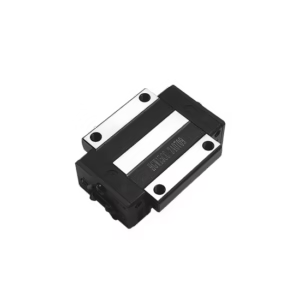
1. Ball Bushing Round Linear Rail
Uses recirculating steel balls
Very smooth and low-friction motion
Higher precision than sliding bushings
Typical Applications: CNC machines, automation systems, measuring equipment
2. Sliding (Plain) Bushing Round Rail
Uses polymer or bronze bushings
Simple, quiet, and cost-effective
Requires less maintenance
Typical Applications: Packaging machinery, conveyors, light-duty automation
3. Supported Round Linear Rail
Rail is mounted on an aluminum support base
Increased rigidity and load capacity
Reduced shaft deflection over long spans
Typical Applications: CNC routers, woodworking machines, gantry systems
4. Unsupported Round Linear Rail
Rail is mounted only at the ends
Lightweight and low cost
Suitable for short travel distances
Typical Applications: Small machines, compact automation devices
5. Stainless Steel Round Linear Rail
Corrosion-resistant material
Suitable for humid or washdown environments
Typical Applications: Food processing, medical equipment, cleanroom systems
Materials and Surface Treatment
Round linear rails are manufactured with high attention to surface quality:
Hardened Carbon Steel: High wear resistance and strength
Stainless Steel: Excellent corrosion resistance
Chrome-Plated Surface: Reduced friction and longer service life
Precision Grinding: Ensures consistent diameter and smooth motion
The quality of surface finish directly affects bearing life and motion smoothness.
Advantages of Round Linear Rails
Simple and Proven Design
Easy Installation and Alignment
Lower Cost Compared to Profile Rails
Smooth Linear Motion
Flexible Mounting Options
Good Performance for Light to Medium Loads
These advantages make round linear rails especially attractive for cost-sensitive and space-limited applications.
Common Applications of Round Linear Rails
Round linear rails are widely used across many industries:
CNC Routers and Engraving Machines
Industrial Automation Equipment
Packaging and Filling Machines
3D Printers and Desktop CNC Machines
Medical and Laboratory Devices
Inspection and Measuring Systems
They are ideal where moderate precision, smooth motion, and affordability are key requirements.
Round Linear Rail vs Profile Linear Rail
| Feature | Round Linear Rail | Profile Linear Rail |
|---|---|---|
| Cross Section | Circular | Rectangular / Square |
| Precision | Medium | High |
| Load Capacity | Light to medium | Medium to heavy |
| Rigidity | Moderate | High |
| Installation | Easy | Requires precise alignment |
| Cost | Lower | Higher |
Round linear rails are often chosen for general-purpose motion systems, while profile rails are preferred for high-precision machine tools.

How to Choose the Right Round Linear Rail
1. Load Capacity
Consider both static and dynamic loads.
2. Rail Diameter
Larger diameters offer higher stiffness and load capacity.
3. Travel Length
Longer travel may require supported rails.
4. Bearing Type
Ball bushings for precision; sliding bushings for quiet, low-maintenance use.
5. Environment
Use stainless steel or coated rails in corrosive conditions.
Installation and Maintenance Tips
Mount rails on flat, rigid surfaces
Use proper shaft supports for long spans
Lubricate ball bushings regularly
Keep rails clean from dust and debris
Inspect bearings periodically for wear
Proper installation and routine maintenance significantly extend service life.
Frequently Asked Questions (FAQs)
1. What is a round linear rail used for?
It is used to guide linear motion in machinery and automation systems with smooth and controlled movement.
2. Are round linear rails accurate enough for CNC machines?
Yes, for light to medium-duty CNC machines and routers, round rails perform very well.
3. What is the difference between supported and unsupported round rails?
Supported rails offer higher rigidity and load capacity, while unsupported rails are lighter and cheaper.
4. Do round linear rails need lubrication?
Ball bushing systems require lubrication; some sliding bushings are self-lubricating.
5. How long do round linear rails last?
With proper maintenance, they can operate reliably for many years.
Conclusion
The round linear rail remains a reliable and cost-effective solution for linear motion across a wide range of applications. While it may not match the rigidity of profile linear rails, it excels in simplicity, flexibility, ease of installation, and affordability.
By selecting the appropriate rail diameter, bearing type, and support structure, engineers and manufacturers can achieve smooth, stable, and long-lasting linear motion that meets both performance and budget requirements.