

Introduction
In modern machinery, smooth and accurate linear movement is not optional—it is essential. From CNC machines and automation systems to robotics and material handling equipment, motion accuracy directly affects productivity, quality, and service life. One of the most critical components enabling this performance is the linear bearing track.
A linear bearing track provides a controlled path for linear bearings or carriages, allowing loads to move precisely along a straight line with minimal friction. Whether used in light-duty automation or demanding industrial environments, linear bearing tracks play a foundational role in linear motion systems.
This article explains what a linear bearing track is, how it works, its types, materials, advantages, applications, and how to choose the right track for your system.
What Is a Linear Bearing Track?
A linear bearing track is a precision-machined rail or guide surface designed to work with linear bearings, allowing smooth and repeatable linear motion. It serves as the running surface for rolling or sliding elements inside a linear bearing.
A typical linear bearing track system includes:
Track (Rail): The fixed guiding surface
Linear Bearing or Carriage: The moving component containing balls, rollers, or bushings
Mounting Base: The machine frame or structure
Lubrication and Sealing Elements: Reduce wear and contamination
The bearing moves along the track while maintaining alignment, load stability, and motion accuracy.
How a Linear Bearing Track Works
Linear bearing tracks function using either rolling contact or sliding contact principles:
The track is securely mounted to a rigid base
A linear bearing or carriage is installed onto the track
Rolling elements (balls or rollers) or sliding bushings contact the track surface
Friction is minimized while loads are evenly distributed
The bearing travels smoothly along the length of the track
The precision of the track surface directly affects motion smoothness, load capacity, and bearing lifespan.
Main Types of Linear Bearing Tracks
1. Profiled Linear Bearing Track
Rectangular or square cross-section
Hardened and ground raceways
Designed for recirculating ball or roller bearings
Applications: CNC machines, machining centers, industrial automation
2. Round Shaft Bearing Track
Cylindrical shaft used as the bearing track
Works with linear bushings or ball bearings
Easier installation and alignment
Applications: Light CNC machines, laboratory equipment, automation systems
3. Supported Linear Bearing Track
Track mounted on an aluminum or steel support base
Reduces deflection over long spans
Higher load capacity
Applications: CNC routers, gantry systems, woodworking machines
4. Aluminum Linear Bearing Track
Lightweight aluminum extrusion with integrated guide surfaces
Often anodized for wear resistance
Suitable for medium loads
Applications: Robotics, modular automation frames, packaging equipment
5. Sliding Bearing Track
Uses polymer or metal sliding bushings
No rolling elements
Quiet operation and low maintenance
Applications: Conveyors, packaging machinery, low-speed automation
Materials Used in Linear Bearing Tracks
Material choice directly impacts performance and durability:
Hardened Alloy Steel: High load capacity and wear resistance
Stainless Steel: Corrosion resistance for harsh environments
Aluminum Alloy: Lightweight and corrosion-resistant
Surface Treatments: Chrome plating, black oxide, anodizing
Precision grinding and surface finishing ensure consistent bearing contact and long service life.
Key Advantages of Linear Bearing Tracks
High Precision: Maintains accurate linear motion
Low Friction: Rolling or sliding contact minimizes resistance
Load Stability: Supports radial, axial, and moment loads
Long Service Life: Hardened raceways resist wear
Versatility: Suitable for many industries and applications
Scalability: Easy to configure with multiple bearing blocks
These advantages make linear bearing tracks essential in precision motion systems.

Applications of Linear Bearing Tracks
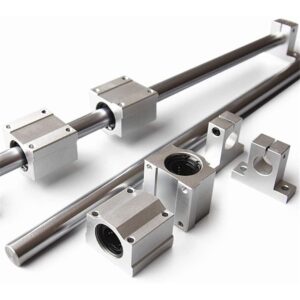
Linear bearing tracks are widely used across industries:
CNC Machines: Guiding cutting tools and worktables
Industrial Automation: Assembly lines and pick-and-place systems
Robotics: Linear axes and positioning systems
Packaging Equipment: Smooth product handling
Medical Devices: Imaging and diagnostic machines
Semiconductor Manufacturing: High-precision motion platforms
They provide the stability and accuracy required for repeatable motion.
Linear Bearing Track vs Linear Slide
| Feature | Linear Bearing Track | Linear Slide |
|---|---|---|
| Motion Type | Bearing-guided | Often sliding-based |
| Precision | Medium to very high | Low to medium |
| Friction | Very low | Higher |
| Load Capacity | Medium to high | Light to medium |
| Maintenance | Periodic lubrication | Minimal |
Linear bearing tracks are preferred for precision and durability, while slides are often used for simpler motion tasks.
How to Choose the Right Linear Bearing Track
When selecting a linear bearing track, consider the following:
1. Load Requirements
Evaluate static load, dynamic load, and moment forces.
2. Accuracy and Repeatability
CNC and precision equipment require high-grade tracks.
3. Travel Length
Longer strokes may require supported tracks.
4. Operating Environment
Dust, moisture, and chemicals influence material selection.
5. Speed and Acceleration
High-speed systems benefit from rolling bearing tracks.
Installation Best Practices
Mount tracks on flat, rigid surfaces
Ensure proper alignment and parallelism
Follow recommended bolt torque values
Use matched bearings and tracks
Apply suitable lubrication
Proper installation significantly improves performance and lifespan.
Maintenance and Service Life
To extend service life:
Keep tracks clean from debris and contaminants
Lubricate bearings according to manufacturer guidelines
Inspect raceways and bearings for wear
Replace worn components promptly
With correct care, linear bearing tracks can operate reliably for many years.
Frequently Asked Questions (FAQs)
1. What is a linear bearing track used for?
It guides linear bearings to provide smooth, accurate linear motion in machinery and automation systems.
2. Are linear bearing tracks suitable for heavy loads?
Yes, especially profiled and roller-type tracks designed for industrial applications.
3. Do linear bearing tracks require lubrication?
Rolling bearing tracks require lubrication; some sliding systems are self-lubricating.
4. What is the difference between a rail and a bearing track?
The track is the guiding surface, while the bearing is the moving component that runs on it.
5. How long does a linear bearing track last?
With proper installation and maintenance, it can last many years, even under continuous operation.
Conclusion
A linear bearing track is a critical component in any system that requires smooth, accurate, and reliable linear motion. By providing a precision guiding surface for linear bearings, it enables high performance in CNC machines, automation equipment, robotics, and industrial machinery.
Choosing the right track type, material, and configuration ensures optimal accuracy, long service life, and reduced maintenance costs, making linear bearing tracks a smart investment for modern motion systems.