

Introduction
In modern machinery, precision motion is no longer a luxury—it is a necessity. From CNC machine tools and industrial automation to robotics and semiconductor equipment, motion accuracy directly affects productivity, quality, and equipment lifespan. At the heart of these motion systems are linear guide rail bearings.
Linear guide rail bearings are designed to move smoothly along a guide rail while supporting loads with minimal friction. They provide high rigidity, excellent repeatability, and long service life, making them essential components in precision linear motion systems.
This article explores what linear guide rail bearings are, how they work, their types, materials, advantages, applications, and how to choose the right bearing for your system.
What Are Linear Guide Rail Bearings?
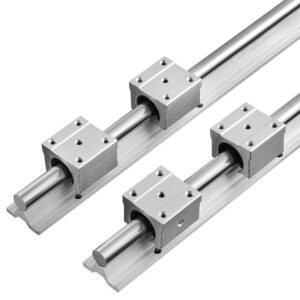
Linear guide rail bearings are mechanical bearing units that travel along a linear guide rail to support and guide linear motion. They typically consist of a bearing block (also called a carriage) containing rolling elements that circulate along precision raceways on the rail.
A complete linear guide rail bearing system includes:
Linear Guide Rail: Precision-machined rail fixed to the machine base
Bearing Block (Carriage): Houses balls or rollers and moves along the rail
Rolling Elements: Steel balls or cylindrical rollers
Seals and Wipers: Prevent dust and contaminants from entering
Lubrication System: Ensures low friction and long service life
Together, these components enable controlled, accurate, and repeatable linear movement.
How Linear Guide Rail Bearings Work
Linear guide rail bearings operate on the principle of rolling contact:
The rail is mounted to a rigid, flat surface
The bearing block is installed onto the rail
Rolling elements circulate inside the bearing block
Load is distributed across multiple contact points
Friction is minimized, allowing smooth and precise movement
The recirculating design allows continuous motion while maintaining consistent load support and accuracy.
Main Types of Linear Guide Rail Bearings
1. Ball-Type Linear Guide Rail Bearings
Use recirculating steel balls
Low friction and smooth motion
High speed and positioning accuracy
Applications: CNC machines, automation equipment, robotics, laser cutting machines
2. Roller-Type Linear Guide Rail Bearings
Use cylindrical rollers instead of balls
Higher load capacity and rigidity
Better resistance to shock and vibration
Applications: Heavy-duty machine tools, gantry systems, industrial machining centers
3. Standard Bearing Blocks
Balanced load capacity and rigidity
Suitable for most industrial applications
Applications: General automation and CNC machinery
4. Low-Profile Bearing Blocks
Compact height for space-limited designs
Slightly lower load capacity
Applications: Compact machines, precision instruments
5. Flanged Bearing Blocks
Flange design allows easy mounting
Improves positioning stability
Applications: Vertical installations and modular systems
Load Capacity and Performance Characteristics
Linear guide rail bearings are engineered to support:
Radial loads (vertical forces)
Lateral loads (horizontal forces)
Moment loads (pitch, yaw, and roll)
Key performance factors include:
Dynamic load rating: Determines service life under motion
Static load rating: Resistance to deformation when stationary
Rigidity: Ability to maintain accuracy under load
Roller bearings generally provide higher rigidity, while ball bearings offer smoother motion and higher speeds.
Accuracy and Precision Grades
Linear guide rail bearings are available in different accuracy grades, typically defined by:
Rail straightness
Parallelism
Height and width tolerance
Higher accuracy grades are essential for:
CNC machining centers
Semiconductor equipment
Precision measurement systems
Lower grades are suitable for general automation where ultra-high precision is not required.
Materials and Surface Treatments
High-quality linear guide rail bearings are made from:
Hardened alloy steel: High strength and wear resistance
Stainless steel: Corrosion resistance for harsh environments
Induction-hardened raceways: Extended service life
Surface coatings: Black oxide, chrome plating, or special anti-corrosion treatments
Material selection affects durability, maintenance frequency, and operating environment suitability.
Advantages of Linear Guide Rail Bearings
High Precision and Repeatability
Low Friction and Smooth Motion
High Load Capacity
Excellent Rigidity
Long Service Life
Compact Design
Standardized and Interchangeable Sizes
These benefits make linear guide rail bearings the preferred choice for modern precision machinery.
Applications of Linear Guide Rail Bearings
Linear guide rail bearings are widely used across industries:
CNC Machines: Tool movement and worktable positioning
Industrial Automation: Assembly lines and pick-and-place systems
Robotics: Linear axes and positioning modules
Packaging Equipment: Accurate product handling
Semiconductor Manufacturing: Ultra-precise motion platforms
Medical Equipment: Imaging, diagnostics, and laboratory automation
Their versatility makes them suitable for both light-duty and heavy-duty applications.
Linear Guide Rail Bearings vs Sliding Bearings
| Feature | Linear Guide Rail Bearings | Sliding Bearings |
|---|---|---|
| Motion Type | Rolling contact | Sliding contact |
| Friction | Very low | Higher |
| Precision | High | Medium |
| Speed | High | Low to medium |
| Maintenance | Lubrication required | Often self-lubricating |
| Load Capacity | Medium to high | Light to medium |
Rolling linear guide rail bearings are preferred for precision, speed, and durability.
How to Choose the Right Linear Guide Rail Bearing
When selecting linear guide rail bearings, consider:
Load and Moment Requirements
Required Accuracy and Repeatability
Operating Speed and Acceleration
Environmental Conditions (dust, moisture, chemicals)
Installation Space and Mounting Style
Maintenance and Lubrication Needs
Choosing the correct bearing ensures optimal performance and reduced downtime.
Installation and Maintenance Best Practices
Mount rails on flat, rigid surfaces
Align rails precisely to prevent uneven wear
Use recommended mounting torque
Lubricate bearings regularly
Keep rails clean and protected from debris
Proper installation and maintenance significantly extend bearing life.
Frequently Asked Questions (FAQs)
1. What are linear guide rail bearings used for?
They support and guide precise linear motion in CNC machines, automation systems, and industrial equipment.
2. Are roller bearings better than ball bearings?
Roller bearings offer higher load capacity and rigidity, while ball bearings provide smoother motion and higher speed.
3. Do linear guide rail bearings need lubrication?
Yes, rolling bearings require periodic lubrication to maintain performance and longevity.
4. How accurate are linear guide rail bearings?
They can achieve very high accuracy, depending on the manufacturing grade and installation quality.
5. How long do linear guide rail bearings last?
With proper maintenance, they can operate reliably for many years under continuous use.
Conclusion
Linear guide rail bearings are essential components in modern precision motion systems. Their ability to provide smooth movement, high rigidity, and excellent accuracy makes them indispensable in CNC machines, automation equipment, and advanced industrial applications.
By understanding their types, performance characteristics, and selection criteria, engineers and manufacturers can design motion systems that deliver long-term reliability, precision, and efficiency.