

Introduction
As industrial machines continue to demand higher speeds, heavier loads, and longer service life, traditional sliding or ball-type linear motion components are sometimes no longer sufficient. This is where the linear guide roller becomes a critical solution.
Linear guide rollers are rolling elements designed to travel along linear guide rails or tracks, offering high load capacity, excellent rigidity, and smooth linear motion. They are widely used in heavy-duty automation, CNC equipment, gantry systems, and material handling machinery where durability and stability are essential.
This article explains what linear guide rollers are, how they work, their types, advantages, applications, and how to choose the right roller for your linear motion system.
What Is a Linear Guide Roller?
A linear guide roller is a rolling element—typically cylindrical or needle-shaped—used to support and guide linear motion along a rail, track, or guiding surface. Unlike ball bearings that contact the rail at a point, rollers make line contact, allowing them to carry significantly higher loads.
A typical linear guide roller system includes:
Guide Rail or Track: The fixed guiding surface
Roller Bearings: Cylindrical rollers that travel along the rail
Carriage or Roller Block: Holds and aligns the rollers
Axles or Pins: Support roller rotation
Seals and Lubrication System: Protect against wear and contamination
Together, these components provide precise and robust linear motion.
How Linear Guide Rollers Work
Linear guide rollers operate on the principle of rolling line contact:
The guide rail is mounted on a rigid structure
Rollers are installed inside a carriage or directly on axles
As the carriage moves, the rollers rotate along the rail surface
Load is distributed across the roller length
Friction remains low while stiffness and stability are maintained
This design significantly reduces surface stress and improves resistance to shock and vibration.
Types of Linear Guide Rollers
1. Cylindrical Linear Guide Rollers
Straight cylindrical rolling elements
High load capacity and rigidity
Excellent for heavy and impact loads
Applications: CNC gantries, industrial presses, machine tool axes
2. Needle Roller Guide Rollers
Small diameter, long rollers
High load capacity in compact designs
Limited speed compared to cylindrical rollers
Applications: Compact automation systems, heavy-load positioning units
3. V-Groove Guide Rollers
V-shaped outer profile
Runs on matching V-tracks or rails
Self-aligning and debris-resistant
Applications: Linear tracks, transport systems, gantry robots
4. Cam Follower Rollers
Integrated bearing and mounting stud
Easy installation and alignment
High load-bearing capability
Applications: Conveyor systems, packaging machinery, automated lines
5. Cross-Roller Guide Rollers
Rollers arranged in alternating directions
Supports loads from multiple directions
High precision and rigidity
Applications: Precision positioning systems, inspection equipment
Materials and Surface Treatments
Linear guide rollers are engineered for durability:
Hardened Alloy Steel: High strength and wear resistance
Stainless Steel: Corrosion resistance in harsh environments
Case-Hardened Raceways: Extended service life
Surface Coatings: Black oxide, chrome plating, anti-corrosion treatments
Material and surface finish quality directly affect performance and longevity.
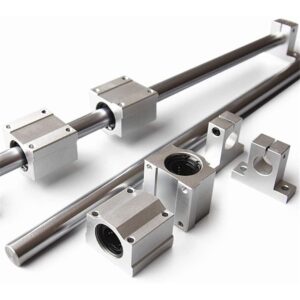
Advantages of Linear Guide Rollers
High Load Capacity: Line contact distributes force evenly
Excellent Rigidity: Maintains accuracy under heavy loads
Low Friction: Smooth rolling motion
Long Service Life: Reduced surface stress and wear
Shock and Vibration Resistance: Ideal for industrial environments
Flexible Configurations: Can be used in various rail designs
These advantages make linear guide rollers a preferred solution for demanding linear motion applications.
Applications of Linear Guide Rollers
Linear guide rollers are widely used across industries:
CNC Machines: Gantry axes and heavy moving tables
Industrial Automation: Assembly lines and transfer systems
Material Handling Equipment: Conveyors and lifting platforms
Gantry Robots: Long-travel, high-load motion systems
Packaging Machinery: Repetitive motion under load
Machine Tools: Heavy-duty linear positioning
They are particularly well-suited for systems where strength, durability, and stability are more important than ultra-high speed.
Linear Guide Rollers vs Ball Guide Bearings
| Feature | Linear Guide Rollers | Ball Guide Bearings |
|---|---|---|
| Contact Type | Line contact | Point contact |
| Load Capacity | High | Medium |
| Rigidity | Very high | Medium |
| Shock Resistance | Excellent | Moderate |
| Speed | Medium | High |
| Precision | High | Very high |
Roller systems are chosen when load capacity and rigidity are critical.
How to Choose the Right Linear Guide Roller
When selecting linear guide rollers, consider:
Load Requirements: Static, dynamic, and impact loads
Rail Type: Flat rail, V-track, or profiled rail
Precision Needs: Roller type and arrangement
Operating Speed: Roller bearings handle moderate to high speeds
Environment: Dust, moisture, temperature, and corrosion
Maintenance Requirements: Lubrication and sealing options
Correct selection ensures stable motion and long service life.
Installation and Maintenance Best Practices
Mount rails on rigid, accurately machined surfaces
Ensure proper roller alignment to avoid uneven wear
Use recommended mounting torque for studs or axles
Lubricate rollers regularly unless sealed for life
Inspect rollers and rails for surface damage
Proper installation and maintenance significantly improve reliability and performance.
Frequently Asked Questions (FAQs)
1. What is a linear guide roller used for?
It supports and guides linear motion in heavy-duty machinery and automation systems.
2. Are linear guide rollers better than ball bearings?
For high loads and rigidity, yes. Ball bearings are better for high speed and ultra-precision.
3. Do linear guide rollers require lubrication?
Most designs require periodic lubrication, though sealed options are available.
4. Can linear guide rollers handle shock loads?
Yes, they are well-suited for applications with vibration and impact forces.
5. How long do linear guide rollers last?
With proper installation and maintenance, they can last many years in industrial environments.
Conclusion
Linear guide rollers are essential components for heavy-duty and high-rigidity linear motion systems. By providing smooth rolling motion, high load capacity, and excellent durability, they enable reliable performance in CNC machines, automation lines, gantry systems, and material handling equipment.
Choosing the right roller type, material, and configuration ensures long-term stability, accuracy, and reduced maintenance, making linear guide rollers a powerful solution for demanding industrial applications.