

Introduction
In today’s industrial and automation environments, precision motion is a necessity. Machines must operate reliably, efficiently, and accurately to meet production, quality, and safety standards. Linear guiding is a core technology that makes this possible.
Linear guiding refers to the use of mechanical components that control and support linear motion in a straight path. It minimizes friction, enhances precision, and ensures stability in applications ranging from CNC machines and robotics to laboratory automation and material handling systems.
This article explores what linear guiding is, how it works, its types, materials, advantages, applications, and guidelines for proper selection.
What Is Linear Guiding?
Linear guiding is a method of providing controlled and precise straight-line movement for machine components. It typically involves:
Guide Rails or Tracks: The fixed path that components travel along
Carriages or Bearing Blocks: Moving elements that hold the load
Rolling Elements or Bushings: Reduce friction between moving and stationary parts
Seals and Lubrication: Protect and maintain performance
Linear guiding ensures smooth motion, high rigidity, repeatability, and long service life, which are essential in modern industrial and automated systems.
How Linear Guiding Works
Linear guiding operates on two primary principles:
Rolling Contact:
Ball or roller bearings circulate within the carriage, rolling along a precision rail. This minimizes friction and allows high-speed, high-precision movement.Sliding Contact:
Low-friction bushings or polymer surfaces slide along the rail. Sliding systems are simpler, quieter, and cost-effective for lighter loads and moderate speeds.
The guiding system distributes loads evenly, reduces wear, and maintains accuracy along the entire travel length.
Types of Linear Guiding Systems
1. Ball-Type Linear Guides
Recirculating steel balls in the carriage
Low friction, smooth motion
High speed and high precision
Applications: CNC machines, automated assembly, robotics
2. Roller-Type Linear Guides
Cylindrical or needle rollers for line contact
Higher load capacity and rigidity than ball guides
Resistant to shock and vibration
Applications: Heavy industrial machinery, gantries, press machines
3. Sliding Linear Guides
Polymer or metal bushings
Simple design and low maintenance
Moderate precision, quiet operation
Applications: Packaging machines, conveyors, laboratory automation
4. Round Shaft Linear Guides
Cylindrical shafts for linear bushings or bearings
Easy to install and cost-effective
Suitable for light- to medium-load applications
Applications: 3D printers, light automation systems, small CNC machines
5. Aluminum Linear Guides
Lightweight rails with anodized surfaces
Medium-load capacity
Corrosion-resistant and ideal for portable or modular systems
Applications: Robotics, automation frames, modular equipment
Materials and Surface Treatments
Linear guiding components are manufactured using:
Hardened Steel: High rigidity and load capacity
Stainless Steel: Corrosion resistance for harsh or humid environments
Aluminum Alloy: Lightweight and flexible design
Surface Treatments: Chrome plating, anodizing, black oxide to increase wear resistance
The quality of materials and finishing determines precision, friction, and lifespan.
Advantages of Linear Guiding
High Precision: Maintains straight-line motion for accurate positioning
Smooth Motion: Rolling elements reduce friction
High Load Capacity: Supports radial, axial, and moment loads
Rigidity: Maintains stability under heavy loads or vibration
Versatility: Works in CNC, robotics, automation, medical, and lab equipment
Long Service Life: Minimal wear with proper lubrication and maintenance
Linear guiding improves overall machine performance and reduces maintenance costs.
Applications of Linear Guiding
Linear guiding is widely used across industries:
CNC Machines: Accurate tool and table movement
Industrial Automation: Assembly lines, pick-and-place robots
Robotics: Linear axes for precise positioning
Packaging Machinery: Smooth, repeatable motion for high-speed operations
Medical and Laboratory Equipment: Sample handling, imaging, and diagnostics
Material Handling: Gantries, conveyors, and lifting systems
Its adaptability makes linear guiding essential for precision and heavy-duty operations.
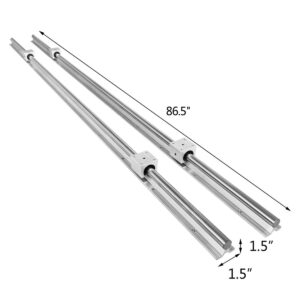
Linear Guiding vs Traditional Sliding Systems
| Feature | Linear Guiding | Traditional Sliding Systems |
|---|---|---|
| Friction | Very low | High |
| Precision | High | Medium |
| Load Capacity | High | Limited |
| Speed | High | Low to medium |
| Maintenance | Low (lubrication required) | Moderate to high |
| Service Life | Long | Moderate |
Linear guiding systems provide greater efficiency, precision, and durability compared to conventional sliding systems.
How to Select a Linear Guiding System
Key factors to consider when selecting a linear guiding system:
Load Capacity: Static, dynamic, and moment loads
Accuracy Requirements: Precision level for the application
Travel Distance: Stroke length and rail configuration
Speed and Acceleration: High-speed applications benefit from rolling guides
Environmental Factors: Dust, moisture, and chemical exposure
Installation Space: Miniature or aluminum guides for compact setups
Maintenance Needs: Lubrication and sealing options
Proper selection ensures smooth operation, reduced wear, and reliable performance.
Installation and Maintenance Tips
Mount rails on flat, rigid surfaces
Ensure proper alignment and parallelism
Use correct torque for mounting bolts
Lubricate according to manufacturer specifications
Inspect seals, bearings, and rails regularly
These practices maximize accuracy and extend the lifespan of linear guiding systems.
Frequently Asked Questions (FAQs)
1. What is linear guiding used for?
Linear guiding provides controlled and precise straight-line motion in CNC machines, robotics, automation, and industrial machinery.
2. What is the difference between linear guiding and sliding guides?
Linear guiding uses rolling elements or low-friction surfaces for smooth, precise motion, while sliding guides rely on surface contact, which generates more friction.
3. Can linear guiding handle heavy loads?
Yes, roller-type and heavy-duty guides are designed to carry significant loads and resist vibration.
4. Do linear guiding systems require lubrication?
Yes, rolling-element guides need regular lubrication, though sealed or self-lubricating types require minimal maintenance.
5. How accurate are linear guiding systems?
They can achieve high precision, often within microns, depending on the guide type and installation.
Conclusion
Linear guiding is essential in modern machinery, enabling smooth, precise, and reliable linear motion. With a variety of designs—ball, roller, sliding, round shaft, and aluminum guides—linear guiding systems can meet the needs of CNC machines, automation equipment, robotics, packaging machinery, and laboratory equipment.
Selecting the right type, material, and configuration ensures high accuracy, durability, and long service life, making linear guiding a cornerstone of industrial motion systems.