

Introduction
In modern mechanical engineering and industrial automation, bearing rails play a critical role in delivering smooth, accurate, and reliable linear motion. These rails serve as the guiding foundation for bearings, sliders, and carriages, ensuring precise movement while supporting heavy loads with minimal friction.
Bearing rails are widely used in CNC machines, industrial robots, packaging equipment, automated production lines, medical devices, and material handling systems. Their ability to maintain alignment, absorb loads, and operate consistently over long service lives makes them essential in precision motion applications.
This article provides a comprehensive overview of bearing rails, covering their structure, working principles, types, materials, advantages, applications, selection criteria, and maintenance best practices.
What Are Bearing Rails?
Bearing rails are precision-machined linear tracks designed to work with linear bearings or carriages. They guide motion along a straight path while supporting loads and reducing friction. When combined with rolling elements such as balls or rollers, bearing rails form a complete linear motion guide system.
Their main functions include:
Guiding linear movement with high accuracy
Supporting radial, axial, and moment loads
Reducing friction and wear
Maintaining system alignment and stability
Bearing rails are fundamental components in any system that requires controlled, repeatable linear motion.
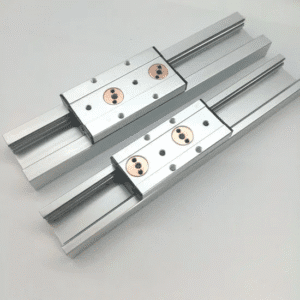
Main Components of a Bearing Rail System
1. Bearing Rail (Guide Rail)
Precision-ground or machined track
Provides a rigid and accurate motion path
Typically mounted to a machine frame or base
2. Linear Bearing / Carriage
Moves along the rail while carrying the load
Contains rolling elements for low-friction movement
3. Rolling Elements
Steel balls or cylindrical rollers
Distribute loads evenly and minimize friction
4. Seals and Wipers
Prevent dust, debris, and contaminants from entering the system
Improve reliability and service life
5. Lubrication System
Ensures smooth operation and reduces wear
May include grease ports or automatic lubrication options
How Bearing Rails Work
Bearing rails operate on the principle of rolling contact rather than sliding contact:
The rail is fixed securely to a rigid surface.
The bearing or carriage moves along the rail.
Rolling elements circulate between the rail and the bearing.
Friction is minimized, enabling smooth and precise motion.
Loads are distributed across multiple contact points, improving durability and accuracy.
This design allows bearing rails to handle high loads, high speeds, and precise positioning simultaneously.
Types of Bearing Rails
1. Profile Bearing Rails
Rectangular cross-section with raceways
High rigidity and precision
Widely used in CNC machines and automation equipment
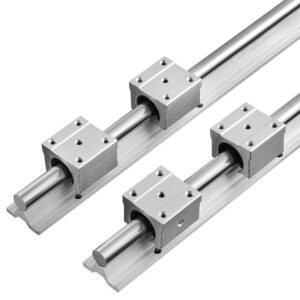
2. Round Bearing Rails
Cylindrical shafts with linear bearings
Cost-effective and easy to install
Suitable for light to medium loads
3. Roller Bearing Rails
Use cylindrical rollers instead of balls
Higher load capacity and stiffness
Ideal for heavy-duty industrial machinery
4. Miniature Bearing Rails
Compact size for limited installation space
Used in medical devices, electronics, and laboratory automation
5. Aluminum Bearing Rails
Lightweight and corrosion-resistant
Common in robotics, 3D printers, and portable systems
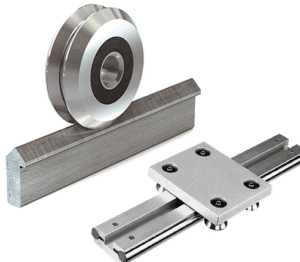
Materials Used in Bearing Rails
Hardened Carbon Steel – High strength and wear resistance
Stainless Steel – Corrosion resistance for harsh or clean environments
Aluminum Alloy – Lightweight and easy to machine
Surface-Treated Rails – Black oxide, chrome plating, or anti-corrosion coatings
Material selection depends on load requirements, environmental conditions, and precision needs.
Advantages of Bearing Rails
High Precision and Repeatability
Low Friction and Smooth Motion
Excellent Load-Bearing Capacity
High Rigidity and Stability
Long Service Life
Reduced Maintenance Requirements
Versatile Application Range
These advantages make bearing rails a preferred choice for precision engineering and automated systems.
Applications of Bearing Rails
Bearing rails are used across many industries, including:
CNC Machine Tools – Milling, turning, grinding
Industrial Automation – Assembly lines and robotic systems
Packaging Machinery – Filling, labeling, sorting
Medical Equipment – Imaging systems and diagnostic devices
Semiconductor Manufacturing – Wafer handling and inspection stages
Material Handling Systems – Conveyors and transfer units
3D Printing and Additive Manufacturing
How to Choose the Right Bearing Rails
When selecting bearing rails, consider the following factors:
Load Capacity – Static, dynamic, and moment loads
Precision Requirements – Accuracy and repeatability levels
Travel Length – Total stroke of the motion system
Operating Environment – Dust, moisture, chemicals, temperature
Speed and Acceleration – Motion dynamics
Mounting Conditions – Flatness and rigidity of the installation surface
Maintenance Expectations – Lubrication intervals and accessibility
Choosing the correct rail ensures optimal performance and long-term reliability.
Installation Best Practices
Ensure mounting surfaces are flat and rigid
Align rails carefully to avoid binding
Use recommended tightening torque for fasteners
Apply proper lubrication before operation
Avoid uneven or excessive loads
Correct installation is critical for maintaining precision and service life.
Maintenance and Care
Clean rails regularly to remove debris
Re-lubricate according to manufacturer recommendations
Inspect for wear, corrosion, or misalignment
Replace worn bearings promptly
Routine maintenance significantly extends the operational life of bearing rails.
Future Trends in Bearing Rail Technology
Smart Bearing Rails with integrated sensors
Predictive Maintenance Systems using IoT technology
Advanced Surface Coatings for reduced friction and wear
Lightweight Composite Designs
Maintenance-Free and Sealed Rail Systems
These innovations support the growing demand for high-efficiency and intelligent automation.
Frequently Asked Questions (FAQs)
1. What is the purpose of bearing rails?
Bearing rails guide linear motion while supporting loads and reducing friction.
2. What is the difference between bearing rails and linear shafts?
Bearing rails offer higher rigidity, precision, and load capacity than round shafts.
3. Can bearing rails handle heavy loads?
Yes, especially roller-type and profile bearing rails.
4. Do bearing rails require lubrication?
Yes, proper lubrication is essential for smooth motion and long service life.
5. Where are bearing rails most commonly used?
They are widely used in CNC machines, robotics, automation equipment, and packaging machinery.
Conclusion
Bearing rails are a fundamental component in precision linear motion systems, providing smooth movement, high load capacity, and exceptional accuracy. Their robust design and versatility make them indispensable in industries ranging from CNC machining and robotics to medical and semiconductor equipment.
By selecting the right bearing rail type, material, and configuration—and following proper installation and maintenance practices—manufacturers can achieve long-term reliability, improved efficiency, and superior motion performance.