

In the world of mechanical engineering, automation, and precision manufacturing, the ability to achieve smooth, accurate, and reliable linear motion is essential. At the heart of this capability lies the linear guide bearing—a critical component that supports and guides moving parts along a straight path with minimal friction.
From CNC machines and industrial robots to 3D printers and medical devices, linear guide bearings are indispensable for applications requiring high rigidity, repeatability, and long service life. In this comprehensive, SEO-optimized article, we’ll explore what a linear guide bearing is, how it works, its types, components, advantages, applications, selection criteria, and future trends.
What Is a Linear Guide Bearing?
A linear guide bearing is a mechanical element that enables linear motion by supporting a load and guiding it along a fixed axis. Unlike rotary bearings, which allow spinning movement, linear guide bearings are designed specifically for back-and-forth (reciprocating) motion.
They consist of a rail and a slider (block) that contains rolling elements—typically balls or rollers—that run along the raceways of the rail. This configuration distributes loads evenly, reduces friction, and ensures high positional accuracy.
Linear guide bearings are also known as linear guides, linear motion bearings, or linear slide bearings, depending on the context and region.
How Does a Linear Guide Bearing Work?
The operation of a linear guide bearing is based on the principle of rolling contact rather than sliding contact:
- Load SupportThe slider is attached to the moving component (e.g., a machine table or robotic arm), while the rail is fixed to the base.
- Rolling ElementsBalls or rollers inside the slider circulate within the raceways of the rail, converting sliding friction into much lower rolling friction.
- Motion GuidanceAs the drive system (ball screw, belt, or linear motor) moves the slider, the rolling elements ensure smooth, straight-line travel with minimal deviation.
- Preload AdjustmentIn some designs, preload is applied to eliminate clearance (play) between the slider and rail, enhancing rigidity and precision.
Key Components of a Linear Guide Bearing
Component | Function |
|---|---|
Rail | Fixed track with raceways; provides the path for linear motion. |
Slider (Block) | Houses rolling elements; moves along the rail. |
Rolling Elements | Balls or rollers that reduce friction and support loads. |
Retainer | Keeps rolling elements evenly spaced and prevents them from falling out. |
Seals/Grease Nipples | Protect against contamination and ensure lubrication. |
Mounting Holes | Allow secure attachment to machine frames or moving parts. |
Types of Linear Guide Bearings
1. Ball-Type Linear Guides
- Use recirculating steel balls.
- Advantages: Low friction, quiet operation, high speed.
- Best For: CNC machines, semiconductor equipment, 3D printers.
2. Roller-Type Linear Guides
- Use cylindrical rollers instead of balls.
- Advantages: Higher load capacity, better stiffness, improved moment resistance.
- Best For: Heavy-duty presses, machine tools, large gantries.
3. Miniature Linear Guides
- Compact design for small-scale applications.
- Advantages: Space-saving, lightweight, precise.
- Best For: Medical devices, optical instruments, small robotics.
4. Profile Rail Guides
- Feature a U-shaped or rectangular rail profile.
- Advantages: High rigidity, self-aligning, easy to install.
- Best For: General industrial automation, conveyors, packaging machines.
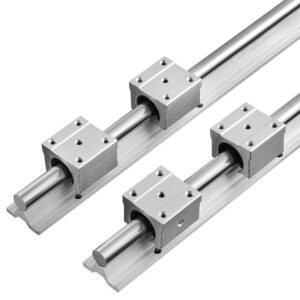
5. Round Rail Guides
- Use a round shaft and linear bushings.
- Advantages: Simple, cost-effective, corrosion-resistant options available.
- Best For: Low-precision tasks, food processing, material handling.
Advantages of Linear Guide Bearings
1. High Rigidity & Load Capacity
Distributes weight across multiple rolling elements, enabling heavy loads without deflection.
2. Precision & Repeatability
Delivers micron-level accuracy and consistent positioning over millions of cycles.
3. Low Friction & Smooth Motion
Rolling contact minimizes wear and energy consumption.
4. Long Service Life
High-quality materials and proper lubrication extend operational life.
5. Quiet Operation
Ball and roller systems produce less noise than sliding mechanisms.
6. Modular & Easy to Install
Interchangeable components simplify maintenance and upgrades.
7. Dust & Contamination Resistance
Seals and wipers protect internal components from particles and moisture.
Applications of Linear Guide Bearings
- CNC Machining Centers – Guide tool heads and tables with sub-micron precision.
- Industrial Robots – Enable linear axes in articulated arms and gantry systems.
- 3D Printers & CNC Routers – Provide smooth, accurate movement for print heads and cutters.
- Medical Equipment – Used in MRI scanners, surgical robots, and lab automation.
- Packaging & Conveying – Drive linear actuators in filling, labeling, and sorting machines.
- Aerospace & Defense – Position antennas, satellite components, and flight simulators.
- Renewable Energy – Guide solar panel tracking systems and wind turbine blade adjustments.
How to Choose the Right Linear Guide Bearing
- Load RequirementsDetermine radial, axial, and moment loads (static and dynamic).
- Accuracy GradeChoose from precision (P), high precision (H), or standard grades based on application needs.
- Speed & AccelerationEnsure the bearing can handle peak speeds without resonance or excessive wear.
- Travel LengthMatch rail length to required stroke distance.
- Environmental ConditionsConsider temperature extremes, dust, moisture, and chemical exposure.
- Preload & ClearanceDecide between zero clearance (high rigidity) or slight clearance (smooth running).
- Mounting ConfigurationSelect flange, block, or custom mounting styles for easy integration.
- Certifications & StandardsLook for ISO, ABEC, or JIS compliance for guaranteed performance.
Maintenance Tips for Linear Guide Bearings
- Regular Lubrication – Apply recommended grease or oil to reduce friction and wear.
- Cleanliness – Keep rails and sliders free from dust, chips, and debris.
- Inspection – Check for unusual noise, vibration, or play during operation.
- Preload Adjustment – Re-tighten or re-adjust if clearance develops over time.
- Replacement – Replace worn sliders or rails to maintain accuracy and prevent damage.
Future Trends in Linear Guide Bearing Technology
- Smart Bearings – Integrated sensors for real-time load, temperature, and wear monitoring.
- Hybrid Materials – Use of ceramic balls and lightweight alloys for higher speed and corrosion resistance.
- Eco-Friendly Lubrication – Biodegradable greases and dry-running coatings.
- Miniaturization – Smaller, more compact guides for micro-mechatronics and medical implants.
- Additive Manufacturing – 3D-printed custom rails and housings for specialized applications.
Conclusion
The linear guide bearing is a fundamental enabler of precision motion in countless modern technologies. By combining high rigidity, low friction, and exceptional accuracy, these components ensure the smooth, reliable operation of everything from factory robots to medical instruments.
Choosing the right linear guide bearing—based on load, precision, environment, and lifecycle needs—can dramatically improve machine performance and longevity. As innovation continues, linear guides will become smarter, more durable, and even more integral to the future of automation and precision engineering.