

1. Introduction
A linear rail carriage is a critical component in linear motion systems, enabling precise, smooth, and controlled movement along a linear rail or guideway. Linear rail carriages are widely used in automation, CNC machines, robotics, 3D printers, industrial machinery, and precision measurement devices.
The linear rail carriage, also called a linear guide block or slide block, works in combination with a linear rail to provide low-friction, high-accuracy, and load-bearing motion. Its design ensures both stability under load and smooth travel along a straight path.
2. Importance of Linear Rail Carriages
Linear rail carriages are essential in modern machinery because they:
Enable high-precision linear motion
Support heavy loads while minimizing friction
Maintain alignment and rigidity in automated systems
Reduce wear and maintenance costs
Improve machine speed, repeatability, and efficiency
By distributing loads evenly and controlling motion accurately, linear rail carriages contribute to the reliability and performance of precision equipment.
3. Components of a Linear Rail Carriage
A typical linear rail carriage consists of:
Carriage Block (Slide Block) – The main body that moves along the rail.
Recirculating Ball or Roller Bearings – Reduce friction between the carriage and the rail.
End Caps – Contain the balls or rollers and guide them back into the circulation path.
Lubrication Ports – Allow grease or oil to reduce wear and extend service life.
Seals and Wipers – Prevent dust, debris, and contaminants from entering the bearing system.
The carriage and rail are often manufactured from high-strength steel or hardened stainless steel for durability and corrosion resistance.
4. Working Principle
The linear rail carriage works on a rolling motion principle:
Balls or rollers circulate inside the carriage along the rail groove.
When the carriage moves, the balls/rollers roll between the rail and the carriage, creating low-friction motion.
The recirculation system ensures that the balls/rollers continuously move along the same path, allowing continuous, smooth linear motion.
This design allows the carriage to bear loads in multiple directions—vertical, horizontal, and moment loads—while maintaining high positional accuracy.
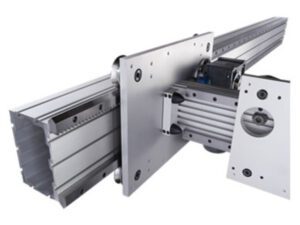
5. Types of Linear Rail Carriages
5.1 Ball-Type Linear Rail Carriage
Uses steel balls as the rolling element.
Provides smooth and precise motion.
Best suited for light to medium loads.
Applications: CNC machines, 3D printers, precision automation equipment.
5.2 Roller-Type Linear Rail Carriage
Uses cylindrical rollers instead of balls.
Can support heavier loads and higher rigidity.
Slightly less smooth than ball-type but stronger under stress.
Applications: Industrial presses, heavy-duty machinery, robotic arms.
5.3 Miniature Linear Rail Carriage
Compact design for small-scale applications.
Lightweight and precise for electronics and medical devices.
Applications: Micro-positioning systems, optical instruments, 3D printing.
6. Specifications and Key Features
When selecting a linear rail carriage, consider:
Load Capacity: Static and dynamic load ratings.
Accuracy and Repeatability: Precision required for positioning.
Travel Length: Maximum distance the carriage moves.
Speed and Acceleration: Motion performance requirements.
Lubrication Type: Grease, oil, or self-lubricating options.
Sealing: Protection against dust and contaminants.
Material: Stainless steel, hardened steel, aluminum, or polymer coatings.
7. Advantages of Linear Rail Carriages
High-precision, low-friction motion
Smooth linear travel even under heavy loads
High rigidity and stability
Multi-direction load support
Reduced wear and maintenance requirements
Easy installation and replacement
8. Applications of Linear Rail Carriages
Linear rail carriages are used in a wide variety of applications, including:
CNC milling, cutting, and engraving machines
3D printers and additive manufacturing equipment
Robotics and automation systems
Medical imaging and laboratory instruments
Semiconductor manufacturing equipment
Packaging and material handling machinery
Optical inspection and measuring devices
9. Maintenance and Safety Tips
Regular lubrication to prevent wear and corrosion
Clean rails and carriages to remove dust and debris
Check for alignment to avoid uneven wear
Replace worn balls, rollers, or seals
Avoid overloading beyond manufacturer specifications
Proper maintenance ensures longer life, higher accuracy, and consistent performance.
10. Conclusion
A linear rail carriage is a fundamental component in modern precision machinery. It provides smooth, accurate, and rigid linear motion while supporting complex loads. Selecting the right type of carriage—ball-type, roller-type, or miniature—depends on load capacity, motion precision, space constraints, and application requirements. With proper installation and maintenance, linear rail carriages enhance productivity, reduce maintenance costs, and improve overall equipment performance.