

Outline for “Linear Motion Rail Guide”
| Section Title | Description / Focus |
|---|---|
| Introduction | Overview and importance of linear motion rail guides |
| What Is a Linear Motion Rail Guide? | Definition and basic concept |
| The Role of Linear Motion Rail Guides in Modern Machinery | Why they are essential for precision motion |
| Core Components of a Linear Motion Rail Guide System | Rails, blocks, rolling elements, and lubrication |
| How a Linear Motion Rail Guide Works | The principle of rolling motion and linear travel |
| Types of Linear Motion Rail Guides | Ball-type, roller-type, and miniature guides |
| Material Composition and Manufacturing | Common materials and production processes |
| Linear Motion Rail Guide Design and Geometry | Contact angles, rigidity, and structure |
| Preload and Friction Management | Balancing performance and smoothness |
| Accuracy and Repeatability | Ensuring consistent, precise linear motion |
| Load Capacity and Performance | Static and dynamic loading characteristics |
| Speed and Travel Length Capabilities | How fast and how far they can move |
| Installation Guidelines | Proper alignment, torque, and setup |
| Maintenance and Lubrication | Ensuring long-lasting performance |
| Troubleshooting Common Issues | Misalignment, noise, and contamination |
| Advantages of Linear Motion Rail Guide Systems | Efficiency, durability, and precision |
| Applications Across Industries | CNC, robotics, automation, and more |
| Use in CNC Machines | Enhancing machining accuracy |
| Use in Robotics and Automation | Improving flexibility and motion control |
| Environmental and Operational Factors | Temperature, humidity, and debris management |
| How to Select the Right Linear Motion Rail Guide | Factors to consider before purchase |
| Cost vs. Value Considerations | Balancing performance and budget |
| Future Trends and Innovations | Smart sensors, coatings, and self-lubrication |
| FAQs | Common questions answered |
| Conclusion | Final insights and takeaways |
Linear Motion Rail Guide
In the rapidly advancing world of industrial automation, robotics, and precision engineering, the linear motion rail guide has emerged as a cornerstone technology. It provides the foundation for precise, stable, and frictionless linear movement—an essential requirement in systems where every millimeter of motion counts. Whether you’re machining aircraft parts or assembling microchips, linear motion rail guides deliver the performance and consistency modern manufacturing demands.
What Is a Linear Motion Rail Guide?
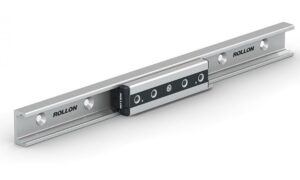
A linear motion rail guide is a mechanical system that allows a moving part to travel smoothly along a straight path with minimal friction. It consists of a rail (the stationary track) and a guide block (the moving element) supported by rolling components such as balls or rollers.
Unlike traditional sliding mechanisms that create resistance through direct surface contact, a linear motion rail guide relies on rolling motion. This not only improves smoothness but also significantly enhances accuracy and load-bearing capacity.
The Role of Linear Motion Rail Guides in Modern Machinery
In modern industries, precision and efficiency are no longer optional—they’re essential. Linear motion rail guides ensure the seamless movement of mechanical parts in machines that demand high accuracy and repeatability. From semiconductor fabrication to industrial 3D printing, these systems are key to achieving consistent quality and performance.
By reducing friction, they also lower power consumption and wear, extending machine life while improving output.
Core Components of a Linear Motion Rail Guide System
Every linear motion rail guide consists of several fundamental parts:
Rail: The hardened and precision-ground path on which the guide block travels.
Guide Block (Carriage): The moving component that carries the load.
Rolling Elements: Steel balls or rollers that circulate between the rail and block.
Return Channels: Allow continuous circulation of rolling elements.
End Caps and Seals: Protect the internal components from dust and debris.
Lubrication System: Supplies grease or oil to reduce friction and wear.
Each component is engineered to micrometer precision, ensuring flawless motion over long periods of operation.
How a Linear Motion Rail Guide Works
The working principle of a linear motion rail guide revolves around rolling contact. As the guide block moves along the rail, the rolling elements circulate through internal return channels, maintaining consistent contact between the rail and block surfaces.
This rolling action minimizes friction—up to 50 times lower than in sliding mechanisms—resulting in exceptionally smooth motion even under heavy loads. The uniform distribution of load also reduces deformation and enhances stability.
Types of Linear Motion Rail Guides
Depending on the application, linear motion rail guides come in various designs:
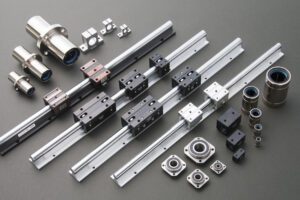
Ball-Type Linear Rail Guides: Utilize precision steel balls for smooth, low-friction motion. Best for high-speed, high-precision systems.
Roller-Type Linear Rail Guides: Use cylindrical rollers for increased load capacity and rigidity. Ideal for heavy-duty applications.
Miniature Linear Guides: Compact designs used in medical instruments, micro-automation, and electronics.
Wide and Flat Types: Designed for applications with limited space or specific mounting needs.
Each type offers unique benefits tailored to its performance and environmental demands.
Material Composition and Manufacturing
The performance and longevity of a linear motion rail guide depend largely on its material and manufacturing precision.
High-Carbon Bearing Steel: Offers high strength and wear resistance.
Stainless Steel: Provides corrosion resistance in harsh or cleanroom environments.
Aluminum Alloys: Lightweight and suitable for portable or small-scale machinery.
Composite Coatings: Minimize friction and enhance durability.
Precision grinding and heat treatment ensure tight tolerances, flatness, and smooth raceways for consistent motion.
Linear Motion Rail Guide Design and Geometry
The geometry of a linear motion rail guide determines its performance characteristics. Rails are designed with precise grooves (raceways) that match the curvature of rolling elements. The contact angle—typically between 45° and 90°—affects how loads are distributed.
Carriages can be flanged or slimline, depending on installation requirements, and multiple carriages can be mounted on a single rail for greater stability.
Preload and Friction Management
Preload is applied during assembly to eliminate internal clearance between the rail and block. This enhances stiffness, reduces vibration, and improves positional accuracy.
However, excessive preload can increase friction and wear, so manufacturers carefully calibrate preload levels to balance rigidity and smooth operation.
Accuracy and Repeatability
Accuracy defines how closely a motion rail follows its intended path, while repeatability measures how consistently it can return to the same position. Linear motion rail guides achieve exceptional precision—often within microns—making them essential in high-end CNC machines, measuring instruments, and robotics.
Load Capacity and Performance
Linear motion rail guides support both static loads (stationary weight) and dynamic loads (forces during motion). Their load capacity depends on the size and type of rolling element, rail cross-section, and material strength.
High-rigidity designs with roller elements can support multi-directional loads—radial, lateral, and moment—ensuring reliable performance under demanding conditions.
Speed and Travel Length Capabilities
Modern linear rail guides can achieve travel speeds exceeding 5 meters per second while maintaining minimal vibration. Travel length is determined by rail size and system configuration, with some setups supporting continuous motion over several meters.
Installation Guidelines
For optimal performance, installation must be done with precision:
Prepare the Mounting Surface: Ensure it’s flat, clean, and free of burrs.
Align Rails: Use alignment tools to maintain parallelism.
Secure Rails: Tighten bolts evenly in a cross-pattern.
Install the Carriage: Slide gently to avoid impact damage.
Lubricate: Apply compatible grease through designated ports.
Even small misalignments can lead to uneven wear or reduced lifespan.

Maintenance and Lubrication
Maintenance is critical for extending system life. Follow these steps:
Regularly inspect rails and seals for contamination.
Re-lubricate periodically using manufacturer-approved grease.
Replace worn components promptly.
Keep the environment free from debris and moisture.
Proper care ensures consistent performance for thousands of operational hours.
Troubleshooting Common Issues
| Issue | Possible Cause | Solution |
|---|---|---|
| Jerky motion | Misalignment or debris | Clean and realign system |
| Noise or vibration | Insufficient lubrication | Reapply grease |
| Uneven wear | Excessive load or poor preload | Adjust load/preload settings |
| Corrosion | Exposure to moisture | Use stainless steel or coated rails |
| Reduced accuracy | Bearing or rail damage | Replace affected parts |
Early intervention prevents costly breakdowns and downtime.
Advantages of Linear Motion Rail Guide Systems
High Precision: Maintains consistent positioning accuracy.
Low Friction: Smooth, energy-efficient operation.
Excellent Rigidity: Handles heavy loads without deflection.
Compact Design: Saves space in complex machinery.
Long Service Life: Durable materials and self-lubrication options.
Quiet Operation: Ideal for clean and noise-sensitive environments.
These benefits make linear motion rail guides a preferred choice across diverse industrial sectors.
Applications Across Industries
Linear motion rail guides are used extensively in:
CNC Machining Centers – Ensuring accurate cutting paths.
Industrial Robotics – Supporting smooth robotic arm motion.
3D Printing Systems – Maintaining precise print head positioning.
Medical Devices – Enabling clean, accurate, and quiet movement.
Semiconductor Equipment – Providing ultra-precise motion for micro-fabrication.
Packaging Machinery – Facilitating fast, repetitive linear motion.
Use in CNC Machines
In CNC machines, the linear motion rail guide guarantees smooth, rigid, and repeatable tool movement. The low-friction rolling mechanism minimizes backlash and ensures superior surface finishes during high-speed cutting, drilling, or engraving operations.
Use in Robotics and Automation
In robotics, linear motion rail guides allow precise positioning of end-effectors, arms, and platforms. Their compact form, rigidity, and smooth movement enhance accuracy in assembly, welding, and inspection systems, where repeatability is key.
Environmental and Operational Factors
Linear rail guides must withstand harsh operational environments. Protective features such as end seals, wipers, and corrosion-resistant coatings ensure consistent performance in conditions with dust, coolant, or chemicals. In cleanroom applications, lubricant-free or vacuum-compatible versions are preferred.
How to Select the Right Linear Motion Rail Guide
When choosing a linear motion rail guide, consider:
Load Requirements: Static, dynamic, and moment loads.
Accuracy Needs: Based on application tolerances.
Operating Environment: Temperature, dust, or humidity.
Speed and Stroke Length: To match system requirements.
Maintenance Preferences: Manual vs. automatic lubrication systems.
Choosing the correct model ensures performance stability and longevity.
Cost vs. Value Considerations
While high-precision linear rail guides may cost more initially, they offer better reliability, longer life, and reduced maintenance. Over time, they deliver superior value through increased uptime and product quality—crucial for competitive manufacturing environments.
Future Trends and Innovations
The evolution of linear motion rail guide technology continues with new developments:
Smart Sensors: Monitor vibration, temperature, and load in real time.
Self-Lubricating Systems: Reduce maintenance intervals.
Advanced Surface Coatings: Minimize wear and corrosion.
Lightweight Composite Designs: Improve energy efficiency.
Such innovations are reshaping motion control technology, paving the way for intelligent, maintenance-free systems.
FAQs
What is a linear motion rail guide used for?
It enables precise and frictionless movement along a straight path in machinery and automation systems.
What’s the difference between ball and roller guides?
Ball guides offer smoother, faster motion, while roller guides provide higher rigidity and load capacity.
Do linear motion rails need lubrication?
Yes. Lubrication minimizes friction and prolongs the system’s lifespan.
Can they operate vertically?
Yes, with proper preload and lubrication management.
How long do linear motion rail guides last?
With correct maintenance, they can operate efficiently for tens of thousands of hours.
What causes noise in linear guides?
Noise often results from contamination, misalignment, or insufficient lubrication.
Conclusion
The linear motion rail guide is the backbone of modern precision machinery, ensuring accurate, efficient, and long-lasting linear movement. Its combination of high rigidity, smooth performance, and adaptability makes it a cornerstone of automation technology. With ongoing innovations like smart sensors and self-lubricating materials, linear motion rail guides are set to play an even more vital role in shaping the future of intelligent motion systems.
Suggested Inbound Links
CNC precision guide systems
Linear bearing maintenance checklist
Motion control engineering basics
Suggested Outbound Links
ISO linear guide design standards
Advanced lubrication technology for industrial systems