

In the world of mechanical design, automation, and precision manufacturing, the demand for smooth, accurate, and reliable linear motion has never been greater. From CNC machines and industrial robots to 3D printers and medical devices, the linear rail slide stands as a critical component that makes such performance possible.
A linear rail slide is a pre-engineered system that combines a high-precision guide rail with a moving carriage (or block) to support and direct motion along a straight path. This article provides a deep dive into the technology, applications, benefits, and future of linear rail slides, structured to inform engineers, designers, and procurement professionals alike.
What Are Linear Rail Slides?
A linear rail slide is a complete linear motion assembly consisting of:
- A linear guide rail — a rigid, straight track with precision-machined raceways.
- A slide (carriage) — a block that travels along the rail via rolling elements such as balls or rollers.
Together, these components create a low-friction pathway for controlled movement, offering superior rigidity and positional accuracy compared to simpler shaft-and-bushing arrangements.
Unlike standalone rails or bearings, linear rail slides arrive as integrated units ready for mounting, simplifying design and speeding up implementation in machinery and equipment.
How Do Linear Rail Slides Work?
The operation of linear rail slides relies on rolling contact mechanics:
- Rail InstallationThe rail is securely mounted to a stationary base or frame.
- Slide AttachmentThe carriage is fixed to the moving load — such as a machine table, robotic arm, or gantry.
- Rolling Element MotionInside the carriage, balls or rollers circulate along the raceways in the rail. This transforms sliding friction into rolling friction, minimizing energy loss and wear.
- Drive System IntegrationA motor-driven mechanism — such as a ball screw, timing belt, or linear servo motor — actuates the carriage along the rail, producing precise linear displacement.
- Load HandlingForces acting on the slide — radial, axial, or moment loads — are distributed evenly across multiple rolling elements, preventing deflection and maintaining accuracy.
Key Components of Linear Rail Slides
Component | Function |
|---|---|
Guide Rail | Fixed track with precision raceways; defines the motion path. |
Slide (Carriage) | Houses rolling elements and mounts to the moving load. |
Rolling Elements | Balls or rollers that minimize friction and support loads. |
Recirculation System | Routes rolling elements continuously through the carriage. |
Seals & Wipers | Block contaminants like dust, dirt, and liquids from entering the system. |
Grease Nipple | Allows lubrication to reduce friction and prolong service life. |
Mounting Holes | Facilitate secure attachment to machine frames and moving structures. |
Types of Linear Rail Slides
1. Ball Rail Slides
- Use recirculating steel balls.
- Advantages: Smooth, quiet motion; suitable for moderate-speed applications.
- Applications: CNC routers, 3D printers, automated assembly machines.
2. Roller Rail Slides
- Employ cylindrical rollers instead of balls.
- Advantages: Higher load capacity, increased rigidity, better resistance to moments.
- Applications: Heavy-duty machine tools, industrial presses, large gantry systems.
3. Miniature Linear Rail Slides
- Compact dimensions for tight spaces.
- Advantages: Lightweight, precise, cost-effective for small-scale systems.
- Applications: Medical devices, optical equipment, small robotics.
4. Profile Rail Slides
- Feature a U-shaped or rectangular cross-section.
- Advantages: Self-aligning, high stiffness, easy to install.
- Applications: Packaging lines, material handling, general automation.
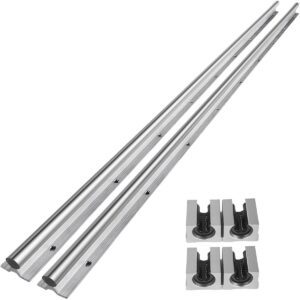
5. Round Rail Slides
- Use a round shaft with linear bushings.
- Advantages: Simple, economical, corrosion-resistant variants available.
- Applications: Low-precision systems, food processing, conveyors.
Advantages of Linear Rail Slides
1. Exceptional Rigidity & Load Capacity
Designed to support heavy payloads without flexing, even under high moment loads.
2. High Accuracy & Repeatability
Capable of micron-level precision, essential for applications like CNC machining and metrology.
3. Low Friction & Efficient Motion
Rolling contact ensures smooth travel with minimal energy consumption and wear.
4. Long Operational Life
Constructed from hardened steel or aluminum with durable seals and lubricants for extended service.
5. Contamination Resistance
Integrated seals and wipers protect internal mechanisms from dust, coolant, and debris.
6. Easy Integration & Maintenance
Modular design allows quick installation and replacement; lubrication points simplify upkeep.
Applications Across Industries
- CNC Machinery – Guides cutting tools and workpiece tables with sub-micron precision.
- Industrial Robotics – Provides linear axes for articulated arms, SCARA robots, and Cartesian bots.
- Additive Manufacturing – Enables precise movement for 3D printer extruders and resin jetting systems.
- Medical Technology – Supports diagnostic equipment, surgical robots, and laboratory automation.
- Packaging & Conveying – Powers actuators for sorting, labeling, and filling machines.
- Aerospace & Defense – Positions antennas, optics, and flight simulation components.
- Renewable Energy – Drives linear actuators in solar tracking systems and turbine blade pitch controls.
How to Choose the Right Linear Rail Slide
- Load RequirementsAssess radial, axial, and moment loads — both static and dynamic — to match slide capacity.
- Accuracy GradeChoose from standard, high precision, or ultra-precision grades depending on tolerance needs.
- Speed & AccelerationEnsure the slide can handle peak speeds without resonance or excessive wear.
- Travel LengthSelect rail length to cover the required stroke, accounting for overhang and support spacing.
- Environmental FactorsConsider temperature range, humidity, dust, chemical exposure, and washdown conditions.
- Preload & PlayOpt for zero-clearance (preloaded) systems for high rigidity or slight clearance for smoother travel.
- Mounting CompatibilityEnsure the slide’s mounting pattern fits your machine design.
- Certifications & StandardsLook for compliance with ISO, ABEC, or JIS standards for guaranteed performance.
Maintenance Best Practices
- Regular Lubrication – Apply manufacturer-recommended grease or oil to minimize friction.
- Keep It Clean – Remove chips, dust, and debris using compressed air or lint-free cloths.
- Monitor Noise & Vibration – Unusual sounds may indicate wear or misalignment.
- Check Preload – Periodically verify preload settings to maintain stiffness.
- Replace Worn Parts – Promptly swap out damaged carriages or rails to prevent cascading failures.
Future Trends in Linear Rail Slide Technology
- Smart Rail Slides – Integration of sensors for real-time load, temperature, and wear monitoring.
- Hybrid & Composite Materials – Use of ceramic balls, stainless alloys, and carbon-fiber-reinforced plastics for lighter, stronger systems.
- Eco-Friendly Designs – Adoption of biodegradable greases and recyclable components.
- Miniaturization – Development of micro-linear slides for medical implants and nano-positioning stages.
- Additive Manufacturing – Custom rail and slide geometries produced via 3D printing for specialized applications.
Conclusion
Linear rail slides are the workhorses of modern motion control, enabling precise, reliable, and efficient linear movement across a vast range of industries. By understanding their design, benefits, and selection criteria, engineers and designers can optimize performance, reduce downtime, and enhance the longevity of their equipment.
As technology advances, linear rail slides will continue to evolve—becoming smarter, more durable, and even more integral to the future of automation and precision engineering.