

Modern industrial machinery depends on smooth, accurate, and reliable movement to achieve maximum productivity and performance. Among the most important motion control components are guide rails and rollers, which work together to provide controlled linear movement while supporting heavy loads and minimizing friction.
From CNC machining centers and industrial automation systems to warehouse logistics and material handling equipment, guide rails and rollers are widely used wherever precise motion and long-term durability are required.
In this comprehensive guide, we’ll explore how guide rails and rollers function, their advantages, common applications, key selection factors, and maintenance best practices.
What Are Guide Rails and Rollers?
Guide rails and rollers are linear motion components designed to guide moving parts along a defined path while reducing friction and maintaining alignment.
A typical system includes:
- Precision guide rail
- Roller carriage or roller assembly
- Rolling elements
- Lubrication system
- Mounting hardware
- Protective seals
The combination of rails and rollers creates a highly efficient motion system capable of supporting substantial loads with minimal resistance.
How Guide Rails and Rollers Work
The system operates by allowing rollers to move along specially designed guide rail surfaces.
Guide Rails
Guide rails provide:
- Structural support
- Directional guidance
- Precision alignment
The rail serves as the foundation of the motion system.
Rollers
Rollers move along the rail while carrying loads.
Their rolling action:
- Reduces friction
- Improves efficiency
- Minimizes wear
Compared to sliding systems, rollers provide smoother operation and longer service life.
Load Distribution
One major advantage of guide rails and rollers is their ability to distribute loads evenly across the motion system.
This improves:
- Stability
- Rigidity
- Durability
Lubrication and Sealing
Proper lubrication helps reduce wear and maintain smooth movement.
Seals protect components from:
- Dust
- Dirt
- Coolants
- Moisture
Key Benefits of Guide Rails and Rollers
1. Low Friction Motion
Rolling contact dramatically reduces friction compared to sliding systems.
Benefits include:
- Lower power consumption
- Reduced wear
- Smoother movement
2. High Load Capacity
Guide rails and rollers can support:
- Radial loads
- Axial loads
- Moment loads
This makes them suitable for demanding industrial environments.
3. Excellent Rigidity
Roller-based systems provide exceptional structural stability.
4. High Precision
Precision-machined rails ensure accurate and repeatable positioning.
5. Long Service Life
Reduced friction and even load distribution increase durability.
6. Smooth Operation
Rollers minimize vibration and noise.
7. High-Speed Performance
Suitable for fast-moving automation systems.
8. Improved Productivity
Reliable motion contributes to greater operational efficiency.
9. Reduced Maintenance Costs
Durable components require less frequent replacement.
10. Versatile Applications
Guide rails and rollers can be adapted to countless industries and machine designs.
Types of Guide Rails and Rollers
Ball Bearing Guide Rail Systems
Use recirculating steel balls.
Advantages
- Low friction
- High speed
- Excellent precision
Applications
- CNC machinery
- Packaging systems
- Automation equipment
Roller Guide Rail Systems
Use cylindrical rollers.
Advantages
- Higher rigidity
- Greater load capacity
- Better shock resistance
Applications
- Heavy-duty CNC machines
- Industrial robotics
- Manufacturing systems
Track Roller Systems
Use rollers running on hardened tracks.
Applications
- Material handling
- Conveyor systems
- Industrial transport equipment
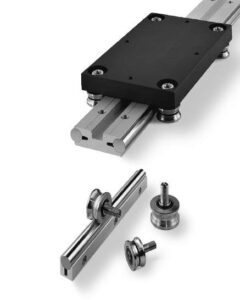
Heavy Duty Guide Rails and Rollers
Designed for demanding industrial conditions.
Features
Explore industrial-grade solutions:
👉 https://yhlinear.com/product
Applications of Guide Rails and Rollers
CNC Machinery
Guide rails and rollers are used in:
- CNC milling machines
- CNC routers
- Machining centers
- Laser cutting systems
They ensure precise axis movement and machining accuracy.
Industrial Automation
Applications include:
- Assembly lines
- Packaging machinery
- Pick-and-place systems
- Material transfer equipment
Robotics
Robotic systems use guide rails and rollers for:
Material Handling Equipment
Applications include:
- Warehouse automation
- Conveyor systems
- Loading equipment
Manufacturing Systems
Guide rails and rollers help improve productivity and precision across various industrial processes.
How to Choose the Right Guide Rails and Rollers
Load Requirements
Evaluate:
- Static loads
- Dynamic loads
- Shock loads
Choose components with appropriate load ratings.
Accuracy Requirements
Higher precision applications require tighter tolerances and premium-grade rails.
Travel Distance
Long travel systems may require:
- Additional support
- Larger rail profiles
- Multiple roller carriages
Speed Requirements
Consider:
- Maximum velocity
- Acceleration
- Operating cycle
Environmental Conditions
Assess exposure to:
- Dust
- Moisture
- Chemicals
- Metal chips
Protective features may be required.
Installation Best Practices
Use Precision Mounting Surfaces
Mounting surfaces should be:
- Flat
- Clean
- Structurally rigid
Ensure Proper Alignment
Poor alignment can lead to:
- Increased wear
- Reduced accuracy
- Premature failure
Apply Correct Fastening Torque
Follow manufacturer guidelines during installation.
Lubricate Before Operation
Proper lubrication extends service life and improves performance.
Maintenance Tips for Guide Rails and Rollers
Regular maintenance helps maximize reliability.
Recommended tasks:
- Clean rail surfaces
- Inspect rollers
- Reapply lubrication
- Check mounting hardware
- Monitor movement quality
Preventive maintenance reduces downtime and repair costs.
Guide Rails and Rollers vs Sliding Systems
| Feature | Guide Rails and Rollers | Sliding Systems |
|---|---|---|
| Friction | Low | High |
| Precision | High | Moderate |
| Speed | High | Lower |
| Load Capacity | High | Moderate |
| Service Life | Long | Shorter |
Internal Links
Explore more linear motion products and solutions:
Linear Motion Products
👉 https://yhlinear.com/product
Linear Guide Category
👉 https://yhlinear.com/product-category/linear-guide
YH Linear Homepage
For maximum SEO value, connect this article with related pages covering roller guides, linear bearings, and guide rail systems.
External Resources
For additional technical information:
These industry-leading manufacturers provide valuable engineering resources related to guide rail and roller technologies.
FAQs About Guide Rails and Rollers
What are guide rails and rollers used for?
They provide smooth and accurate linear motion in CNC machines, automation systems, robotics, and material handling equipment.
How do guide rails and rollers work?
Rollers move along precision guide rails, reducing friction and supporting loads while maintaining alignment.
What are the advantages of roller-based guide systems?
They offer higher load capacity, better rigidity, smoother movement, and longer service life.
Are guide rails and rollers suitable for CNC machinery?
Yes. They are widely used in CNC equipment because of their precision and durability.
Do guide rails and rollers require maintenance?
Regular lubrication and cleaning help ensure long service life and optimal performance.
Where can I buy guide rails and rollers?
Browse industrial-grade linear motion products here:
👉 https://yhlinear.com/product
Conclusion
Guide rails and rollers are essential components in modern linear motion systems. Their ability to deliver smooth movement, high load capacity, excellent rigidity, and long-term reliability makes them ideal for CNC machinery, industrial automation, robotics, and material handling applications.
For premium-quality guide rail and roller solutions, visit:
👉 https://yhlinear.com/product
You can also explore additional motion control products at: