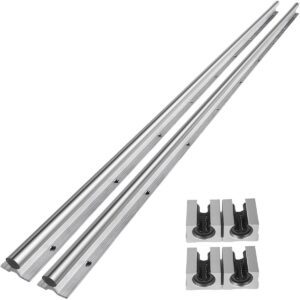
Linear motion bearings are fundamental mechanical components that enable smooth, low-friction movement along a straight path. These precision elements are essential in virtually every modern manufacturing and automation system, from CNC machines and 3D printers to robotic arms and semiconductor manufacturing equipment
. By constraining motion to a single degree of freedom while minimizing resistance, linear bearings reduce motor requirements, improve positioning accuracy, and extend equipment lifespan.
This article provides an in-depth examination of linear motion bearing technology, covering fundamental principles, classification systems, design considerations, and selection criteria for engineers and designers.
Fundamental Principles and Working Mechanism
Core Function
A linear bearing’s primary purpose is to reduce friction between moving parts while supporting motion along one axis
. The bearing guides and supports a moving load on a linear stage or actuator, constraining motion to one degree of freedom while minimizing resistance and wear
.
The fundamental principle behind linear bearing operation lies in replacing sliding friction with rolling friction or specialized sliding surfaces. This reduction in friction coefficient—from approximately 0.3-0.5 for sliding contact to 0.001-0.003 for rolling elements—dramatically decreases the force required to move loads and enables higher speeds with improved precision
.
The 2:1 Rule
A critical design principle in linear motion engineering is the 2:1 rule: any moment arm associated with a load acting on a linear bearing’s carriage assembly should not exceed twice the bearing’s length
. Exceeding this ratio can result in jerky stick-slip motion or even complete binding. The actual ratio varies by bearing type—rolling-element bearings may allow ratios as high as 400:1, while plain bearings require stricter adherence to the 2:1 guideline
.
Classification of Linear Motion Bearings
Linear bearings fall into two primary categories: rolling linear bearings and plain linear bearings
.
Rolling Linear Bearings
Rolling bearings utilize balls or rollers as intermediate elements between moving surfaces, significantly reducing friction while maintaining predictable motion characteristics.
Ball Bushing Bearings
Ball bushings employ recirculating steel balls that travel along hardened precision shafts. Key characteristics include:
Low rolling resistance and high repeatability
Point contact between balls and raceway, suitable for moderate loads
High speeds capability with proper lubrication
Common applications in CNC machines, precision automation, and 3D printers
The contact angle between rolling elements and the rail significantly affects load capacity. A 45° contact angle provides balanced performance for radial, reverse radial, and lateral loads
Version 1.0.0
.
Roller Bearings
Roller bearings utilize cylindrical rolling elements that provide:
Greater contact area than ball bearings, enabling higher load capacity
Superior rigidity for heavy moment load applications
Better shock absorption due to line contact distribution
Typical applications in heavy machinery tables and linear transfer systems
Modern roller guideways like the PRG series arrange four rows of rollers at 45-degree contact angles, providing equal load ratings in radial, reverse radial, and lateral directions
.
Profile Rail Guides (Linear Guideways)
Profile rail systems represent the most sophisticated rolling bearing technology:
Recirculating ball blocks offering high rigidity and precision
Multi-directional load capacity handling radial, lateral, and moment forces
Micron-level repeatability for precision positioning
Preload options (light, medium, heavy) to eliminate backlash and enhance stiffness
Plain Linear Bearings
Plain bearings operate through sliding contact without rolling elements, offering distinct advantages in specific environments.
Sleeve Bearings
Simple cylindrical designs providing:
Durability in dirty or harsh environments
Lower cost and minimal maintenance requirements
Higher friction than rolling alternatives but better contamination tolerance
Self-Lubricating Bearings
Advanced polymer or composite materials containing embedded lubricants:
Maintenance-free operation in inaccessible locations
Chemical resistance for washdown applications
Materials include PTFE composites, bronze-graphite alloys, and engineered polymers
Key Performance Criteria
Load and Life Calculations
The rated life (L₁₀) of linear bearings depends on applied loads and travel distance:
Linear guideways: Measured in traveled kilometers
Ball screws: Measured in millions of revolutions
Proper preload, alignment, and lubrication can extend lifespan by 30-40%
.
Precision Classes
Linear guideways are classified into accuracy grades:
High (H): Standard precision
Precision (P): Enhanced accuracy
Super Precision (SP): Ultra-high accuracy
Ultra Precision (UP): Maximum precision for critical applications
Speed Capabilities
Rolling element bearings: Up to 10 m/s possible
Ball screws: Typically limited to ≤1 m/s due to critical speed and resonance considerations
Plain bearings: Lower speeds due to higher friction coefficients
Linear Bearings vs. Related Technologies
Linear Guideway vs. Ball Screw
Table
Feature
Linear Guideway
Ball Screw
Primary Function
Supports and guides linear motion
Converts rotary to linear motion
Load Direction
Multi-directional (radial, lateral, moment)
Axial only
Precision
±0.01 mm/m repeatability
±0.003 mm repeatability
Efficiency
Rolling friction (0.001-0.003 coefficient)
>90% mechanical efficiency
Common Issues
Debris accumulation
Backdriving under gravity
The linear guideway serves as the path ensuring straightness and stability, while the ball screw acts as the engine providing motion and power
. These components typically work together in precision motion systems.
Comparison with Linear Motors
Table
Feature
Ball Screw
Linear Motor
Backlash
Present (minimizable with preload)
Zero
Speed
Moderate (≤1 m/s)
Very high
Acceleration
Limited by inertia
Extremely high (up to 10G)
Precision
Micron-level
Sub-micron achievable
Maintenance
Regular lubrication required
Minimal
Cost
Lower upfront
Higher initial investment
Material Considerations and Shafting
Shaft Materials
RC60/Class L Linear Shafting (1060 Steel):
Case hardened to Rockwell 60 hardness
Optimal for rolling element bearings
Requires lubrication to prevent oxidation
Chrome Plated 1060 Steel:
Enhanced corrosion resistance
Suitable for washdown applications
Compatible with self-lubricating bearings
300 Series Stainless Steel (303, 304, 316):
Excellent corrosion resistance
Softer material (not suitable for rolling elements without hardening)
Ideal for FDA/USDA applications and chemical environments
440C Stainless Steel:
Martensitic stainless with carbon addition
Maintains hardness (Rc55) and wear resistance
Moderate corrosion resistance with some oxidation potential
Selection Framework: The LOSTPED Method
Engineers should evaluate applications using the LOSTPED criteria
:
Load: Magnitude and direction of forces
Orientation: Mounting position and gravity effects
Ensure proper alignment between rails and bearings
Apply appropriate preload for rigidity requirements
Implement sealing systems for contaminated environments
Follow manufacturer torque specifications for mounting hardware
Future Trends
While ball screw and linear guideway combinations remain the industrial standard, direct-drive linear motors are gaining traction in ultra-high-speed and ultra-clean applications. These systems eliminate mechanical contact entirely, offering frictionless movement and zero backlash, though at higher cost .
Hybrid approaches combining both technologies are becoming common:
Ball screws for Z-axis applications requiring holding force
Linear motors for X/Y axes demanding speed and precision
Conclusion
Linear motion bearings represent a mature yet evolving technology essential to modern precision machinery. The selection between rolling and plain bearings, ball bushings versus roller guides, and conventional mechanical systems versus direct-drive alternatives depends on careful analysis of application requirements. By understanding the fundamental principles, performance characteristics, and selection criteria outlined in this guide, engineers can optimize motion systems for accuracy, longevity, and cost-effectiveness.
The continued development of advanced materials, self-lubricating composites, and precision manufacturing techniques ensures that linear motion bearings will remain critical components in the advancement of automation and manufacturing technology.