

Outline for “Linear Rails and Slides”
| Main Topic | Subtopics |
|---|---|
| Introduction | Importance of precision motion in engineering, where linear rails and slides fit |
| Linear Rails and Slides | Definition, overview, and how they work |
| History of Linear Motion Systems | Early designs, industrial adoption, modern evolution |
| Components of Linear Rails | Rails, carriages, bearings, lubrication systems |
| Types of Linear Slides | Ball bearing slides, roller slides, dovetail slides |
| Types of Linear Rails | Profile rails, round rails, miniature rails |
| Working Mechanism | How linear motion is achieved with rails and slides |
| Materials Used | Stainless steel, aluminum, polymer coatings |
| Linear Rails and Slides in CNC Machines | Why precision matters in cutting and shaping |
| Applications in Robotics | Smooth motion in automation and robotic arms |
| Role in 3D Printing | Enhancing accuracy and repeatability |
| Benefits of Linear Rails and Slides | Smoothness, load capacity, longevity |
| Common Challenges | Misalignment, wear and tear, contamination |
| Maintenance Best Practices | Cleaning, lubrication, inspection |
| Choosing the Right Linear Rail | Factors like load, speed, environment |
| Comparison: Rails vs. Shafts | Which is better for different applications |
| Innovations in Linear Motion | Smart sensors, self-lubricating materials |
| DIY and Maker Projects | Using linear rails in home projects |
| Cost Considerations | Price ranges and what affects cost |
| Leading Manufacturers | Hiwin, THK, NSK, Bosch Rexroth |
| Industry-Specific Uses | Aerospace, medical devices, automotive |
| Future of Linear Rails and Slides | AI integration, IoT-enabled monitoring |
| Troubleshooting Issues | Noise, binding, uneven wear |
| Safety Considerations | Handling, installation, operation |
| Environmental Impact | Sustainability in materials and recycling |
| FAQs | Covering key user questions |
| Conclusion | Wrap-up with future outlook |
Introduction
Precision is the heartbeat of modern engineering. From the hum of CNC machines carving aerospace components to the delicate movement of surgical robots, accuracy defines success. At the center of this pursuit lies an often-overlooked innovation — linear rails and slides. These unassuming systems are the foundation of countless machines, enabling smooth, reliable, and repeatable movement across industries.
Think of them as the tracks and wheels of industrial machinery. Just as a train glides effortlessly along its rails, a machine component slides over linear guides with minimal resistance. Without them, industries would struggle with inefficiency, wear, and unpredictability.
What makes them so remarkable isn’t just their ability to move a part from point A to point B. It’s how they do it — with stability, load-bearing strength, and remarkable precision. In a world where even a fraction of a millimeter matters, linear rails and slides ensure that motion is not only possible but flawless.
Linear Rails and Slides
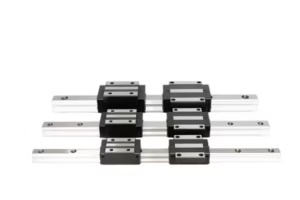
To understand their importance, let’s break down the fundamentals. A linear rail is a hardened, straight guide — often made of steel or aluminum — that provides a track for motion. A slide, also known as a carriage or block, is the part that moves along this rail. Together, they form a linear motion system designed to carry loads while maintaining perfect alignment.
The concept seems simple, yet its execution involves sophisticated engineering. Bearings, often ball or roller types, are housed within the slide to reduce friction and ensure consistent contact with the rail. This results in a motion system that can support heavy loads without compromising smoothness.
Applications are diverse: CNC routers cutting wood with hairline precision, robotic arms assembling microchips, or 3D printers creating complex designs. In each case, linear rails and slides deliver stability and reliability, setting them apart from conventional mechanical guides.
History of Linear Motion Systems
The idea of guided linear motion isn’t new. Early civilizations used wooden grooves and stone slides in construction, allowing massive blocks to be moved more easily. However, these primitive systems relied heavily on lubrication like animal fat or water and lacked durability.
The industrial revolution marked a turning point. With the rise of steam engines and machine tools, industries needed more precise ways to control movement. Dovetail slides — with their wedge-shaped grooves — became an early solution, especially in lathes and milling machines.
By the mid-20th century, ball bearings revolutionized linear motion. Engineers discovered that integrating rolling elements into slides drastically reduced friction, leading to longer-lasting and smoother systems. This paved the way for today’s linear rails and slides, capable of handling high speeds, heavy loads, and microscopic tolerances.
Fast forward to the digital age, and linear motion systems are now paired with sensors, automation, and smart controls. What began as grooves in wood has evolved into cutting-edge technology powering robotics, medical devices, and aerospace engineering.
Components of Linear Rails
Every linear rail system consists of several key components that work in harmony:
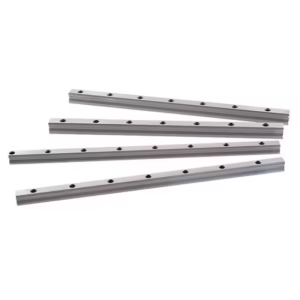
Rails: The rigid track, typically precision-ground for flatness and straightness. Rails can be profile-shaped or round, depending on application needs.
Carriages (Slides): These house the bearings and provide the moving platform. Carriages are often preloaded to reduce clearance and eliminate wobble.
Bearings: Either ball or roller bearings circulate inside the carriage, allowing smooth motion along the rail.
End Caps and Retainers: These keep bearings in place and allow continuous recirculation without jamming.
Lubrication Systems: Grease fittings or self-lubricating reservoirs keep the system running smoothly and extend its lifespan.
Each component is meticulously engineered to withstand loads, resist wear, and maintain accuracy. The precision in manufacturing these parts is so high that even microscopic irregularities can lead to performance issues. That’s why industries rely on trusted brands and rigorous quality standards.
Types of Linear Slides
Linear slides come in multiple variations, each suited for specific tasks:
Ball Bearing Slides: The most common type, offering smooth, precise motion with minimal resistance. Ideal for CNC machines and robotics.
Roller Slides: Use cylindrical rollers instead of balls, offering higher load capacity and rigidity. Preferred in heavy-duty applications.
Dovetail Slides: Rugged and inexpensive, though less smooth than ball or roller types. Often used in manual equipment.
Crossed Roller Slides: Feature cylindrical rollers arranged at 90° angles, delivering superior accuracy and stiffness. Common in optical and semiconductor industries.
The choice of slide depends on trade-offs between smoothness, cost, rigidity, and durability. For example, a medical imaging device prioritizes precision, while an industrial press may prioritize load capacity.
Types of Linear Rails
Just as slides vary, so do rails:
Profiled Rails: Rectangular in cross-section with grooves for ball or roller bearings. These are the backbone of high-precision machines.
Round Rails: Cylindrical in shape, offering flexibility in misaligned conditions but less rigidity. Often used in budget applications.
Miniature Rails: Small-scale versions used in compact devices like 3D printers or medical instruments.
Heavy-Duty Rails: Designed for large loads, featuring reinforced tracks and oversized bearings.
Each type serves a distinct role, balancing strength, precision, and cost. Engineers must weigh factors like speed, environment, and required accuracy when choosing rails.
Working Mechanism
At first glance, linear rails and slides seem simple — a block glides along a track. But their working mechanism is far more sophisticated. The secret lies in rolling contact instead of sliding contact.
Inside the slide, tiny ball bearings or rollers circulate in precisely engineered grooves. As the carriage moves, these bearings roll between the rail and the carriage. This dramatically reduces friction, ensuring smooth motion while minimizing wear. Unlike traditional sliding mechanisms that grind surfaces against each other, rolling elements preserve accuracy over long periods of use.
Another key feature is preloading. In high-precision applications, even a small gap (or clearance) between the rail and carriage can cause vibrations or misalignment. By slightly compressing the bearings against the rail, engineers eliminate this slack, creating a rigid system that resists deflection.
The result? Linear rails and slides can carry heavy loads at high speeds while maintaining micrometer-level precision. Whether guiding a robotic arm or positioning a surgical tool, this flawless mechanism guarantees repeatable accuracy.
Materials Used
The choice of materials in linear motion systems determines not only strength but also resistance to wear, corrosion, and environmental conditions.
Stainless Steel: Commonly used for rails and bearings due to its strength and corrosion resistance. It’s ideal for cleanrooms, medical devices, and food processing equipment.
High-Carbon Steel: Offers high load capacity and durability. Often used in heavy-duty industrial applications.
Aluminum: Lightweight, making it useful in applications where weight reduction is crucial, such as aerospace or 3D printing.
Polymer Coatings: Applied to reduce friction, dampen noise, or enhance corrosion resistance.
Ceramic Bearings (in some cases): Provide superior resistance to heat and wear, though more expensive.
Selecting the right material is often a trade-off. For example, a CNC machine in a dusty woodworking shop may need rugged, sealed steel rails, while a medical imaging device benefits from lightweight, corrosion-resistant aluminum rails.

Linear Rails and Slides in CNC Machines
CNC (Computer Numerical Control) machines rely heavily on linear rails and slides to achieve precision. Whether cutting wood, milling metal, or engraving plastics, the accuracy of a CNC machine depends on how well its motion system performs.
Smooth Motion: Rails and slides eliminate chatter, allowing clean cuts and polished finishes.
High Load Capacity: CNC spindles and worktables are heavy, and rails distribute these loads evenly.
Durability: Continuous operation under vibration and dust requires components that resist wear.
Imagine machining an aerospace component where a tolerance of just 0.02 mm is critical. Without linear rails and slides, the cutting tool might deviate, leading to wasted material and costly rework. That’s why industries trust them for applications where precision equals profit.
Applications in Robotics
In robotics, motion defines intelligence. A robot that can’t move accurately is like a musician playing out of tune. Linear rails and slides play a vital role in robotic arms, automated assembly lines, and even collaborative robots (cobots).
Pick-and-Place Systems: Robots require fast, repeatable movements when handling electronics or packaging goods.
Medical Robots: Surgical robots need micron-level accuracy to operate safely and effectively.
Industrial Automation: Rails and slides provide stability for robots moving heavy payloads in automotive plants.
The smoothness of linear motion reduces wear on robotic joints and ensures reliable performance. In many cases, rails are paired with sensors, enabling real-time monitoring and predictive maintenance — a cornerstone of modern smart robotics.
Role in 3D Printing
3D printing has revolutionized manufacturing, and linear rails and slides are key to its success. Every layer of a printed object relies on the precision of the print head’s movement.
Accuracy: Rails ensure that the print head deposits material exactly where it’s needed.
Repeatability: Each layer must align perfectly with the one below it.
Speed: High-performance rails allow printers to work faster without sacrificing quality.
Hobbyists often upgrade their budget printers with linear rails to achieve professional-grade prints. Industrial 3D printers, on the other hand, integrate advanced rails to produce aerospace components, medical implants, and even architectural models with unrivaled accuracy.
Benefits of Linear Rails and Slides
Why do industries consistently choose linear rails and slides over other motion systems? The benefits speak for themselves:
Smooth Motion: Rolling elements reduce friction, making motion effortless.
High Load Capacity: Can handle both light and heavy loads efficiently.
Durability: Designed to withstand millions of cycles without failure.
Precision: Maintain alignment and accuracy even under continuous use.
Versatility: Suitable for robotics, CNCs, medical devices, and DIY projects.
Low Maintenance: With proper lubrication, systems can run for years.
In short, they combine reliability with performance, making them indispensable in applications where errors are simply unacceptable.
Common Challenges
Despite their advantages, linear rails and slides face challenges that can affect performance:
Misalignment: Incorrect installation leads to uneven wear or binding.
Contamination: Dust, dirt, or chips can clog bearings and shorten lifespan.
Wear and Tear: Continuous heavy loads may cause deformation over time.
Lubrication Failures: Without proper lubrication, friction increases and rails degrade.
The good news? These issues can be prevented with correct installation, regular inspection, and the use of protective covers in harsh environments.
Maintenance Best Practices
Proper maintenance is key to maximizing the lifespan of linear rails and slides:
Regular Cleaning: Wipe rails to remove dust, chips, or contaminants.
Lubrication: Use the manufacturer’s recommended grease or oil to minimize friction.
Inspection: Check for unusual noise, vibration, or resistance in movement.
Alignment Checks: Ensure rails remain parallel and securely mounted.
Protective Covers: Use bellows or wipers in environments with debris.
Following these steps not only extends equipment life but also reduces downtime — a critical factor in industries where every hour of machine downtime translates into lost revenue.