

Introduction
Rails and rollers are fundamental components in mechanical and structural systems where controlled linear motion, load distribution, and smooth guidance are required. These two elements work together to enable precise movement in industries such as manufacturing, material handling, transportation, construction, robotics, and more.
Whether found in railway systems, automated conveyor lines, industrial sliding mechanisms, or heavy-duty machines, rails and rollers provide stability, durability, and efficiency. They reduce friction, carry heavy loads, and ensure that machinery or structures function safely and reliably.
This article explores rails and rollers in detail, covering their history, types, mechanics, design considerations, materials, industrial applications, maintenance practices, and emerging innovations.
Table of Contents
History of Rails and Rollers
Fundamentals of Rails and Rollers
Types of Rails
Types of Rollers
Mechanics of Rails and Rollers
Materials Used in Rails and Rollers
Advantages of Using Rails and Rollers
Applications Across Industries
Selecting the Right Rail and Roller System
Installation and Alignment
Maintenance and Lubrication
Common Issues and Troubleshooting
Innovations and Future Trends
Frequently Asked Questions
Conclusion
1. History of Rails and Rollers
The concept of using rails and rollers to reduce friction dates back thousands of years. Ancient civilizations used wooden logs as rollers to move massive stones during construction projects. Later, metal rails and wheels evolved during the Industrial Revolution, particularly in railway systems.
Ancient Times: Wooden rollers used for transporting blocks in pyramids.
Middle Ages: Wooden tracks with grooved wheels for mine carts.
Industrial Revolution: Iron and steel rails combined with steel wheels revolutionized rail transport.
Modern Era: Precision rails and rollers engineered for industrial machinery, automation, and robotics.
2. Fundamentals of Rails and Rollers
Rails are rigid, elongated structures designed to guide or support movement, while rollers are cylindrical elements that reduce friction and allow smooth rolling contact. Together, they form linear motion systems, sliding mechanisms, or load-bearing structures.
Rail Function: Provides a track or guide.
Roller Function: Reduces friction and carries load along the rail.
Combined Role: Enables controlled linear or rolling motion with high precision.
3. Types of Rails
3.1 Flat Rails
Used in conveyors and sliding mechanisms.
Provide a broad surface for rollers to travel on.
3.2 V-Shaped Rails
Designed to align rollers precisely.
Common in precision machinery and guiding systems.
3.3 Round Rails
Cylindrical rails used with linear bushings.
Offer smooth movement and are simple to manufacture.
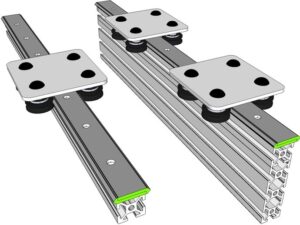
3.4 Profiled Rails
Include T-slot, dovetail, or custom extrusions.
Used in heavy-duty and precision applications.
3.5 Railway Tracks
Large-scale rails for trains and trams.
Engineered to support enormous loads and provide long-term durability.
4. Types of Rollers
4.1 Cylindrical Rollers
Basic roller type with a smooth cylindrical surface.
Used in conveyors and general linear motion.
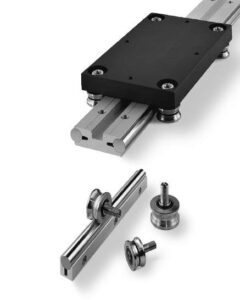
4.2 V-Groove Rollers
Designed to match V-shaped rails.
Offer precise tracking and alignment.
4.3 Tapered Rollers
Reduce misalignment and distribute loads evenly.
Common in roller bearings and conveyors.
4.4 Ball Rollers
Contain spherical rolling elements.
Used in omnidirectional movement systems.
4.5 Heavy-Duty Industrial Rollers
Built for high load capacities.
Found in steel mills, mining, and construction equipment.
5. Mechanics of Rails and Rollers
The performance of rails and rollers depends on fundamental mechanical principles:
Load Distribution: Rails spread loads over a large surface, while rollers concentrate load on small contact points.
Friction Reduction: Rollers minimize sliding friction, improving efficiency.
Alignment: Properly aligned rails and rollers reduce wear and ensure smooth operation.
Rigidity: Rails must resist bending under heavy loads.
Rolling Contact Mechanics: Determines wear, noise, and efficiency of the system.
6. Materials Used in Rails and Rollers
6.1 Steel
Most common material for both rails and rollers.
Offers high strength, durability, and resistance to wear.
6.2 Stainless Steel
Used in corrosive environments.
Ideal for food processing, medical, and marine applications.
6.3 Aluminum
Lightweight and corrosion-resistant.
Often used in medium-duty systems.
6.4 Plastics and Composites
Used in rollers for noise reduction and lightweight applications.
6.5 Hardened Alloys and Ceramics
Employed in high-precision, high-wear environments.
7. Advantages of Using Rails and Rollers
High load capacity.
Smooth and controlled motion.
Reduced friction and wear.
Long service life.
Versatile applications.
Low maintenance needs.
Energy-efficient operation.
8. Applications Across Industries
8.1 Rail Transport
Trains and trams rely on steel rails and rollers (wheels).
Provide efficient long-distance transport of goods and people.
8.2 Industrial Automation
Used in conveyors, assembly lines, and robotic systems.
Enhance production efficiency.
8.3 Material Handling
Pallet rollers, sliding doors, and transfer systems.
Ensure safe and smooth movement of heavy goods.
8.4 Construction and Mining
Heavy-duty rollers and rails guide massive machinery.
Used in cranes, excavators, and mining equipment.
8.5 Aerospace and Defense
Precision rails and rollers in testing and assembly equipment.
8.6 Architecture and Interior Design
Sliding doors, partitions, and curtain systems.
9. Selecting the Right Rail and Roller System
Key considerations include:
Load capacity.
Speed requirements.
Environmental conditions (humidity, dust, temperature).
Precision and alignment needs.
Maintenance requirements.
Material compatibility.
10. Installation and Alignment
Ensure rails are mounted on flat, rigid surfaces.
Align rollers precisely to avoid uneven wear.
Use appropriate fastening methods.
Conduct test runs for smooth operation.
11. Maintenance and Lubrication
Clean rails regularly to prevent debris accumulation.
Apply lubricants to reduce wear and noise.
Inspect for cracks, wear, or corrosion.
Replace damaged rollers or rails promptly.

12. Common Issues and Troubleshooting
Noise: Usually caused by misalignment or debris.
Uneven Wear: Indicates poor load distribution.
Corrosion: Use stainless steel or protective coatings.
Jamming: Caused by dirt, bent rails, or worn rollers.
13. Innovations and Future Trends
Smart Rails and Rollers: Integrated sensors for real-time monitoring.
Advanced Materials: Lightweight composites, ceramics, and hybrid alloys.
Automation Integration: Designed for robotics and Industry 4.0 systems.
Energy Efficiency: Low-friction designs to reduce power consumption.
Noise Reduction: Specialized coatings and polymer rollers for quieter operation.
14. Frequently Asked Questions
Q1: What’s the difference between rails and rollers?
A1: Rails guide and support motion, while rollers reduce friction and enable movement along the rails.
Q2: Are rails and rollers suitable for outdoor use?
A2: Yes, with corrosion-resistant materials like stainless steel or coated surfaces.
Q3: How long do rails and rollers last?
A3: With proper maintenance, they can last decades in industrial systems.
Q4: Can rails and rollers carry heavy loads?
A4: Yes, heavy-duty systems are designed for thousands of kilograms.
Q5: Do rails and rollers require lubrication?
A5: Most systems benefit from lubrication, though some use self-lubricating materials.
15. Conclusion
Rails and rollers are indispensable in both large-scale and precision systems, providing reliable guidance, reduced friction, and long-lasting performance. From trains and conveyor systems to robotic automation and architectural applications, their versatility makes them a cornerstone of engineering and industry.
By understanding their design, materials, and maintenance needs, engineers and designers can ensure optimal performance and longevity of rails and rollers. With ongoing innovations in smart monitoring, advanced materials, and noise-reducing technologies, the future of rails and rollers promises even greater efficiency, durability, and precision.