

Introduction
In the world of modern engineering, the demand for accuracy, reliability, and efficiency continues to rise across industries such as manufacturing, robotics, aerospace, medicine, and automation. A critical component that helps meet these demands is the precision linear bearing. These specialized bearings provide smooth, controlled linear motion, making them indispensable in systems where even the smallest deviation can compromise product quality or system performance.
Unlike traditional rotational bearings, precision linear bearings are designed to support and guide motion along a straight path with minimal friction and maximum accuracy. From CNC machines and 3D printers to semiconductor fabrication and surgical equipment, precision linear bearings are at the core of high-performance machinery.
This article takes a deep dive into precision linear bearings, exploring their fundamentals, history, design, material choices, applications, and future innovations.
Table of Contents
History of Precision Linear Bearings
Fundamentals of Linear Motion
What Are Precision Linear Bearings?
Types of Precision Linear Bearings
Mechanics and Operating Principles
Materials and Surface Treatments
Advantages of Precision Linear Bearings
Limitations and Challenges
Applications Across Industries
Selection Criteria for Precision Linear Bearings
Installation and Alignment Best Practices
Lubrication and Maintenance
Common Problems and Troubleshooting
Emerging Trends and Innovations
Frequently Asked Questions
Conclusion
1. History of Precision Linear Bearings
The history of linear bearings is closely tied to humanity’s need for moving heavy objects more efficiently.
Ancient times: Early civilizations used wooden rollers beneath large stones to reduce friction during transportation.
Industrial Revolution: As machining and manufacturing evolved, metal slides and rudimentary bearings were developed to improve efficiency.
20th century: With the advent of precision engineering, linear bearings were designed to handle not only loads but also tight tolerances and smooth motion.
Modern era: Precision linear bearings now feature advanced materials, self-lubricating options, and integration with automation and smart monitoring systems.
2. Fundamentals of Linear Motion
Linear motion is the controlled movement of an object along a straight path. Unlike rotational systems, linear systems require specialized bearings to:
Minimize friction between moving surfaces.
Ensure accuracy and repeatability.
Handle high loads with minimal wear.
Maintain alignment under dynamic conditions.
Precision linear bearings are engineered to optimize these aspects, allowing machines to function with extreme consistency.
3. What Are Precision Linear Bearings?
A precision linear bearing is a specialized component designed to provide frictionless or low-friction linear motion while maintaining high levels of accuracy.
Key Features:
Smooth travel: Consistent movement without sticking or slipping.
High accuracy: Micrometer-level precision in positioning.
Load-bearing capacity: Ability to support heavy loads without deformation.
Durability: Long service life under continuous operation.
They are often used with linear rails, shafts, or guides, depending on system requirements.
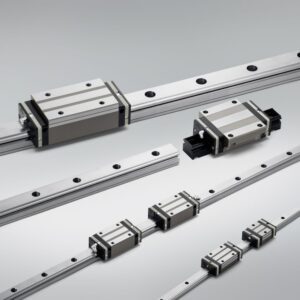
4. Types of Precision Linear Bearings
4.1 Ball Bushing Bearings
Consist of rows of recirculating balls inside a housing.
Provide low-friction motion along a shaft.
Common in 3D printers and CNC machines.
4.2 Linear Guide Bearings (Profile Rail Bearings)
Utilize rolling elements inside a profiled rail.
Offer high rigidity and accuracy.
Used in high-performance automation and machine tools.
4.3 Plain Linear Bearings (Slide Bearings)
Rely on sliding contact rather than rolling elements.
Often made from self-lubricating polymers or bronze.
Suitable for dirty environments where contamination is an issue.
4.4 Air Bearings
Use a thin film of pressurized air to eliminate contact.
Provide ultra-precise, frictionless motion.
Common in semiconductor manufacturing.
4.5 Magnetic Bearings
Rely on magnetic levitation to reduce friction.
Used in high-tech applications requiring contact-free operation.
5. Mechanics and Operating Principles
Precision linear bearings function on the principle of minimizing friction between moving parts while maintaining alignment.
Rolling-element bearings: Use balls or rollers to reduce surface contact.
Sliding bearings: Use low-friction materials to glide over rails.
Air and magnetic systems: Create non-contact environments for ultra-smooth operation.
The choice depends on load, accuracy, environment, and cost.
6. Materials and Surface Treatments
The performance and longevity of precision linear bearings depend heavily on material selection.
Common Materials:
High-carbon steel: Excellent load capacity and wear resistance.
Stainless steel: Corrosion resistance, ideal for medical and food industries.
Aluminum housings: Lightweight applications.
Polymers: Noise reduction and low maintenance.
Surface Treatments:
Hard chrome plating: Wear and corrosion resistance.
Nitriding: Improved hardness and fatigue resistance.
Coatings (PTFE, DLC): Reduce friction and extend service life.
7. Advantages of Precision Linear Bearings
High accuracy and repeatability.
Low friction operation.
Extended service life.
High load-carrying capacity.
Quiet and smooth performance.
Adaptability to automation.
8. Limitations and Challenges
Despite their benefits, precision linear bearings face some challenges:
Sensitivity to dirt, dust, and debris.
High initial cost compared to simpler solutions.
Need for lubrication in most systems.
Limited tolerance for misalignment.

9. Applications Across Industries
Precision linear bearings are widely used in fields that demand accuracy and efficiency:
9.1 Manufacturing and Machine Tools
CNC machines, milling machines, lathes.
Enhance tool positioning and repeatability.
9.2 Robotics and Automation
Enable precise robotic arm movements.
Support linear actuators in automated assembly.
9.3 Medical and Laboratory Equipment
Surgical robots, imaging machines, diagnostic devices.
Require sterility and precision.
9.4 Semiconductor Industry
Air bearings used in wafer handling.
Precision movement in chip production.
9.5 Aerospace and Defense
Aircraft assembly jigs.
Satellite and missile guidance testing.
9.6 Consumer Applications
3D printers, plotters, and home automation devices.
10. Selection Criteria for Precision Linear Bearings
When selecting bearings, consider:
Load capacity: Both static and dynamic.
Accuracy: Positioning and repeatability requirements.
Speed: Maximum travel speed.
Environment: Dust, moisture, temperature.
Maintenance needs: Lubrication intervals, ease of replacement.
Budget: Balancing cost with performance.
11. Installation and Alignment Best Practices
Ensure mounting surfaces are flat and rigid.
Align rails and shafts carefully to prevent binding.
Use torque-controlled fasteners.
Avoid contamination during installation.
12. Lubrication and Maintenance
Lubrication is essential for reducing wear and extending bearing life.
Grease lubrication: Common for high-load applications.
Oil lubrication: Reduces heat in high-speed systems.
Solid lubrication (PTFE, graphite): For maintenance-free operation.
Routine inspections should include:
Checking for wear patterns.
Cleaning debris from rails and rollers.
Reapplying lubricants as needed.
13. Common Problems and Troubleshooting
Noise or vibration: Often caused by contamination or misalignment.
Uneven wear: Indicates poor installation.
Sticking or binding: Usually from insufficient lubrication.
Corrosion: Requires stainless steel or coated bearings.
14. Emerging Trends and Innovations
Smart bearings: Integrated sensors for real-time monitoring.
Self-lubricating materials: Reduce maintenance.
Hybrid ceramic bearings: Lightweight and corrosion-resistant.
Miniaturization: Bearings for compact robotics and micro-machines.
Eco-friendly designs: Lubricants and materials with lower environmental impact.
15. Frequently Asked Questions
Q1: What is the difference between linear and rotational bearings?
Linear bearings guide straight-line motion, while rotational bearings support rotational movement.
Q2: How long do precision linear bearings last?
With proper installation and maintenance, they can last tens of thousands of hours.
Q3: Can linear bearings operate without lubrication?
Some polymer and air bearings can, but most require lubrication for optimal performance.
Q4: Are precision linear bearings expensive?
They are more costly than standard bearings, but their performance justifies the investment.
Q5: Can they handle heavy loads?
Yes, especially linear guide rails with recirculating ball or roller designs.
16. Conclusion
Precision linear bearings are the backbone of countless modern machines, enabling industries to achieve unparalleled accuracy, efficiency, and reliability. From high-speed automation lines to delicate surgical robots, these bearings ensure motion systems perform consistently and precisely.
As technology evolves, innovations such as smart monitoring, self-lubricating materials, and hybrid designs are expanding their potential. For engineers and designers, understanding precision linear bearings is essential for building robust systems that meet the challenges of modern industry.
By carefully selecting, installing, and maintaining these components, industries can maximize performance, reduce downtime, and ensure long-term operational success.