

What Are Linear Slide Rails?
Linear slide rails — often called linear guide rails or linear motion slides — are mechanical components engineered to enable smooth, controlled motion of an object in a straight line. The term linear slide rail describes the rail assembly (and often the mating carriage or slider) that constrains movement to a single axis.
These systems are foundational in automation, CNC machines, medical equipment, packaging systems and more. For instance, according to one supplier, linear rails “provide a variety of linear motion bearings” and allow “free motion in a single direction” while also offering “accuracy, compactness, and rigidness” thanks to their steel construction. RS+2elesa-ganter.nl+2
In essence, when you need one-dimensional motion that is precise, repeatable and low friction, you turn to linear slide rails.
Why Use Linear Slide Rails?
There are many advantages to selecting linear slide rails in your design, rather than simpler alternatives (like plain slides or bearings). Here are several reasons:
Precision and repeatability. Modern rails (for example those from manufacturers with hardened raceways and polished surfaces) allow very tight tolerances and minimal play. hiwin.sg
Low friction / smooth motion. Because many systems employ rolling elements (balls, rollers) or advanced polymer sliders, you get smoother movement and less resistance. elesa-ganter.nl+1
High load capacity relative to size. Linear rails often can carry forces in multiple directions (depending on design) while consuming less space. hiwin.sg
Modularity and versatility. Many systems allow rails of custom lengths, interchangeable carriages/blocks, and compatibility with precision drives. haydonkerkpittman.com
Durability and maintenance benefits. Some modern variants are lubrication-free, corrosion-resistant or specially designed for harsh environments. igus.sg+1
Thus, whether you are designing a high-speed pick-and-place machine or a precision measuring instrument, linear slide rails often deliver the performance you need.
Core Components and Structure of Linear Slide Rails
To understand how linear slide rails function, let’s break down the main components and how they are typically structured:
Rail (guide rail or track): This is the fixed part, mounted to the base or structure of your machine. It is typically a profile (steel, aluminium, or hardened material), often with holes for mounting. Example: the “hard anodised aluminium” rails of one system. igus.sg+1
Slider or carriage (block): This part moves along the rail. It houses the bearings or sliding elements and is attached to the moving load.
Rolling or sliding elements: Depending on design, the interface might use recirculating balls, rollers, polymer slide pads, or other low-friction interfaces. Example: “two rows of ball bearings placed between an inner rail and an outer rail” in a slide rail design. thk.com+1
Mounting features / holes / clearance adjustment: Some systems allow adjustment of preload, clearance, or clamping of the slider. igus.sg
End-caps, seals or covers: For protecting against contamination, dust, chips, moisture, especially in industrial use.
When selecting or designing a linear slide rail system, these components must align properly. The rail’s straightness, the carriage’s fit, the preload inside the block, the alignment of mounting—all matter significantly for performance and life. In many real-world builds, minor misalignment is the root cause of binding or premature wear.
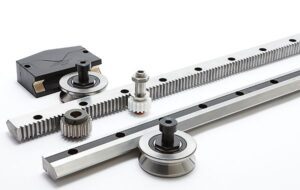
Common Types of Linear Slide Rails
There are several types of linear slide rails available, each suited to different application needs. Here are the major categories:
Ball-recirculating linear rails: These use recirculating balls between the carriage and rail for low friction and high precision. Typical in CNC machines, automation. hiwin.sg+1
Roller linear guides: Use rollers instead of balls, offering higher load capacity, particularly in heavy duty or high-rigidity applications. RS+1
Polymer/sliding element guides (lubrication-free): Some systems use high-performance polymers and Aluminium rails so that no external lubrication is needed; good for clean environments, food, medical. Example: the “drylin® N low-profile guide systems” from one vendor. igus.sg+1
Slide rails / plate type slides: These are simpler: for example thin-profile slides made from roll-formed steel plates, intended for light loads or constrained motion (e.g., in office equipment). Example: one product described as “low-price finite linear guides made out of precision roll-formed steel plate”. thk.com+1
Miniature / micro linear rails: For applications with tight space, small size loads (lab instruments, small robotics). Example: one supplier offers “miniature guide rail” versions. igus.sg+1
Selecting the type depends heavily on load, speed, accuracy requirements, environment (temperature, contamination, moisture), and cost.
Key Selection Criteria for Linear Slide Rails
When selecting the ideal linear slide rail for your project, you should consider and evaluate several important factors. Here’s a table of selection criteria with what you should check:
| Criterion | What to check | Why it matters |
|---|---|---|
| Load capacity (static / dynamic) | Maximum load in direction of motion, lateral forces, moment loads | Ensures the rail will support your actual load without failure or excessive deflection |
| Travel length / stroke | Required length of travel, whether you need custom length or standard | A rail too short will limit motion, too long may cost more or need supports |
| Precision / repeatability | Accuracy, straightness, flatness, bearing quality | For many automation/measurement tasks precision is critical |
| Speed & acceleration | Max velocity, acceleration, jerk limits | High speed and acceleration impose more dynamic loads and require better rail systems |
| Environment / contamination / temperature | Presence of dust, chips, moisture, chemicals, high/low temperature | Rail must be compatible with environment: e.g., lubrication-free for food, corrosion-resistant for outdoor use |
| Rigidity and deflection | Rail stiffness, carriage deflection under load | For large spans or heavy loads, deflection can degrade accuracy |
| Mounting and alignment | Straightness tolerance, mounting hole pattern, ease of alignment | Poor mounting leads to binding, wear or failure |
| Maintenance / lubrication | Does the system require periodic lubrication? Seals? Clean-in-place? | Reduces downtime and noise, important for certain environments |
| Cost & availability | Budget, lead-time, availability of parts/spares | Practical factor—sometimes a slightly less capable system is better value |
For example, if you are building a piece of equipment that will operate in a dusty environment and needs to move rapidly, you might choose a corrosion-resistant, low-lubrication, roller-type linear guide. On the other hand, for a low-cost slide inside an office printer you might choose a thin plate slide type.
Installation and Best Practices for Linear Slide Rails
Even when you pick the right rail, proper installation and maintenance is vital. Here are some practical tips based on industry knowledge and user feedback:
Mounting straight and level: The rail must be mounted on a flat, rigid base. Warpage or uneven mounting holes will lead to binding or uneven wear.
Align the rails properly: If using dual rails (for example in parallel), you must ensure both rails are at the same height and parallel spacing, else the carriage will bind.
Preload and clearance adjustment: Some systems allow you to set preload (tight fit) or clearance (free fit). Choosing correct preload ensures smooth motion with minimal play.
Secure screws but avoid over-tightening: As some DIY users of rails comment, over-tightening screws without correct alignment can cause binding:
“Both of the rails are oversized … QA is just not there.” Reddit
“I just did dual Y rails and found … It becomes tighter and tighter, and harder to move.” RedditLubrication and cleaning: Although some systems are lubrication-free, many still require grease or oil. Dust, chips and debris must be removed regularly to avoid surface damage.
Avoid contamination: Especially in manufacturing or CNC environments, chips and coolant can invade the rail carriage. Use seals or wipers where appropriate.
Check for straightness and smoothness after installation: Slide the block manually to feel for smooth motion. Any binding or ‘grittiness’ signals misalignment or contamination.
Consider end-of-stroke stops or buffers: For long strokes, to avoid shock at ends, which can reduce lifespan.
Regular inspection: Check for wear, play, misalignment or unexpected noise. Replace rails or blocks when wear becomes significant.
By following best practices, you will extend the life of your linear slide rail system and maintain better performance.
Applications of Linear Slide Rails
The range of applications for linear slide rails is broad. Here are a few illustrative examples:
Automation and manufacturing machinery: For pick-and-place robots, gantries, conveyor positioning, high speed feeders.
CNC machines and machining centres: Linear rails guide tool heads or beds with high precision and rigidity.
Packaging equipment: High speed wrappers, labeling machines often rely on linear slides for consistent motion. RS
Medical equipment: Imaging tables, sample handling systems where smooth motion and cleanliness matter.
Office equipment / consumer machines: Printers, vending machines, telecommunication equipment may use simple slide rails. For instance, one slide rail product is described as “thin, compact, and easy to mount… used in photocopiers, measuring instruments, … automatic vending machines”. thk.com
Harsh environments: Outdoor equipment, food trucks, shipborne sliding systems – corrosion-resistant or lubrication-free rails serve these applications. gsfasia.com+1
Recognising the specific use case is critical when choosing the right rail type.
Challenges and Mistakes to Avoid with Linear Slide Rails
Even with a good system, problems can sneak in. Here are some common mistakes and how to avoid them:
Miscalculation of load or moment loads: If you only check the linear load but ignore lateral or moment loads (tilt, pitch, yaw), the system can fail prematurely.
Poor base rigidity: If the structure on which the rails are mounted flexes, the precision and motion quality suffer.
Improper mounting alignment: If the rail is mounted with twist or offset, binding can occur, leading to increased friction and wear.
Wrong preload or clearance selection: Too much preload can increase friction and reduce life; too little can allow vibration or play.
Skipping lubrication/maintenance (if required): Even “lubrication-free” systems may need cleaning or inspection.
Using low-quality clones without verifying tolerances: Some users report issues with cheaper rails:
“In the last 5 days I’ve had two brand new sets … one rail was oversized… QA is just not there.” Reddit
Ignoring rail length / support issues: Long unsupported rail lengths can sag or deflect; blocks may bind at ends.
Contamination ingress: Debris, chips, coolant can damage the surface or block recirculation of balls/rollers.
By being aware of these traps, you can avoid costly downtime or replacement.
Product Examples & Comparison
Here are some sample product options for linear slide rails, to give you an idea of range and features:


Here’s a quick commentary:
RS PRO HG Series Linear Guide Rail 20 mm × 640 mm: A heavy-duty, precision industrial rail; suitable for serious applications requiring high load and high accuracy.
THK SHS20‑280L Linear Guide Rail: From a premium brand (THK), designed for precision motion; likely higher cost but excellent quality.
RS PRO MGN Series Linear Guide Rail 12 mm × 220 mm: Narrow width rail, good for moderate loads or smaller systems.
RS PRO MGN Series Linear Guide Rail 12 mm × 120 mm: Even smaller rail length; good for prototyping or compact systems.
Linear Rail Slide Guide Aluminium Profile V‑Slot 300 mm: Budget aluminium profile option, often for DIY or hobby CNC/3D-printer upgrades; less precision than industrial rails.
Linear Guide Rail Slide VEVOR Bulk Length: Bulk length, budget option; good for large travel but may require custom blocks or quality verification.
When choosing among these, weigh the application’s demands (load, precision, speed, environment) with your budget and required life cycle.
Maintenance and Lifecycle of Linear Slide Rails
To get the most out of your linear slide rail system, focus on maintenance and lifecycle management:
Initial break-in: After installation, many systems perform better after some “run in” time. Some user reports indicate those rails become smoother after use. Reddit
Periodic inspection: Check for play, noise, binding, corrosion. Replace blocks or rails if wear becomes too high.
Lubrication / cleaning schedule: Even lubrication-free systems may need to be cleaned of debris. Systems requiring grease/oil should have it applied per manufacturer guidelines.
Protect against contamination: Chips, coolant, dust can degrade the raceways. Use wipers, covers, bellows if necessary.
Alignment checks: Over time, machines may shift or sag. Re-check alignment of rails especially in heavy duty or large span systems.
Replacement planning: Note that even high-quality rails have finite life. Based on load cycles, wear, environment, plan for replacing them before catastrophic failure.
Proper care means better uptime, smoother motion and more consistent precision—something every machine builder appreciates.
Future Trends and Innovations in Linear Slide Rails
As motion systems evolve, linear slide rails are also seeing innovations:
Lubrication-free materials and polymer-based sliding systems (e.g., high-performance plastics) are becoming more mainstream, especially in clean-room, food or medical environments. igus.sg+1
Corrosion-resistant versions: for outdoor, marine, or food-processing use, rails made from stainless steel or with coatings help. Example: one C-profile roller linear guide in stainless steel for high-humidity uses. gsfasia.com
Longer rails and modular systems: For large machines or gantries, rails up to many metres are supplied; managing straightness and support is a challenge.
Sensor integration and smart rails: Some systems integrate sensors for condition monitoring (wear, load, temperature) to support predictive maintenance.
Greater adoption in robotics and automation: As factories move to more flexible automation, linear slide rails will be embedded more widely in robots, cobots, material-handling systems.
These trends suggest that staying informed about rail technology is beneficial for machine-builders and designers alike.
Summary
In summary: linear slide rails are critical components for enabling controlled, precise linear motion. When selected and installed properly, they deliver low friction, high precision, and long life. But to fully benefit from them you must match the rail type to your application, mount and align them correctly, and maintain them appropriately. Whether you are building a high-speed packaging machine or a prototype gadget in a maker-space, understanding linear slide rails will raise your design game.
FAQs
What is the difference between a linear slide rail and a plain slide?
A plain slide (often just a flat bearing surface) allows motion but usually with more friction, wear and less precision. A linear slide rail uses rolling elements or precision sliding components, offers better smoothness, load capacity, precision, and often constrained motion in one axis only.
Can I use any linear rail for high-speed applications?
No. High-speed applications impose higher dynamic loads, require tight tolerances, very good alignment, appropriate lubrication or low-friction materials, and often higher quality rails specifically rated for speed and acceleration.
How important is preload in linear slide rails?
Very important. Preload is the elimination of clearance in the system; it improves rigidity and precision, but too much preload raises friction and wear. Correct preload balances stiffness and smooth motion.
Do linear slide rails require frequent maintenance?
It depends on type. Some modern systems are lubrication-free and low-maintenance (e.g., polymer-based). Others with recirculating balls or rollers will require periodic lubrication, cleaning and inspection. The environment (dust, debris, moisture) plays a big role.
What environments are challenging for linear slide rails?
Environments with heavy dust/chips (machining), moisture or chemicals (food, marine), extreme temperatures, or very high speed/acceleration. In these cases you’ll pick corrosion-resistant rails, sealed carriages, polymer guides or special coatings.
How do I know when a linear rail needs replacement?
Signs include increased friction or binding, unusual noise, play or looseness in carriage, visible wear/scratches on the rail or block, reduced accuracy or repeatability of motion. Monitoring these and acting before catastrophic failure is wise.
Inbound & Outbound Link Suggestions
Inbound links:
Link to other articles on linear motion systems or rail selection on your site (e.g., “How to choose linear bearings”, “Maintaining linear guides”).
Link to pages where you discuss related components (e.g., ball screws, gantry systems).
Outbound links: