

Outline for Linear Guide Slider
| Main Topic | Sub-Topics / Sub-Headings |
|---|---|
| Introduction | Why Linear Guide Slider Matters |
| Linear Guide Slider | Core Definition and Purpose |
| History of Linear Guide Slider | Evolution from Sliding Ways to Precision Rails |
| Components of Linear Guide Slider | Rail, Block, Bearings, End Caps, Lubrication |
| Types of Linear Guide Slider | Ball Type, Roller Type, Miniature, Heavy-Duty |
| Linear Guide Slider vs. Linear Guide Rail | Key Differences and Applications |
| Advantages of Linear Guide Slider | Accuracy, Durability, and Smooth Motion |
| Applications in CNC Machines | High Precision Tool Movement |
| Linear Guide Slider in Robotics | Reliable and Repeatable Operations |
| Role in Industrial Automation | Backbone of Smart Factories |
| Linear Guide Slider in Medical Equipment | Imaging, Surgery, and Laboratory Uses |
| Aerospace Applications | Precision in Extreme Environments |
| How to Choose the Right Linear Guide Slider | Factors and Buying Tips |
| Installation of Linear Guide Slider | Step-by-Step Setup |
| Maintenance Best Practices | Lubrication, Cleaning, Inspection |
| Common Problems and Fixes | Noise, Vibration, Misalignment |
| Improving Performance of Linear Guide Slider | Best Upgrades and Add-ons |
| Cost of Linear Guide Slider | Price Range and Value Factors |
| Top Manufacturers | THK, Hiwin, NSK, Bosch Rexroth |
| Comparing Leading Brands | Which Brand Suits You Best |
| Linear Guide Slider in 3D Printing | Smooth Head and Bed Movement |
| Future of Linear Guide Slider | Smart Sensors and AI Diagnostics |
| Eco-Friendly Innovations | Green Materials and Efficiency |
| DIY Uses for Linear Guide Slider | CNC, 3D Printing, Camera Sliders |
| Troubleshooting Guide | Quick Fixes for Common Issues |
| Buying Checklist | Final Things to Verify Before Purchase |
| Conclusion | Why Linear Guide Slider is Essential in 2025 |
| FAQs | Answers to Common Questions |
Introduction
Precision is no longer a luxury—it’s a necessity. From robotics and CNC machining to healthcare and aerospace, industries depend on components that deliver flawless motion. Among these, the linear guide slider stands out as a cornerstone of modern engineering.
This system allows smooth, accurate, and reliable motion along a straight line, making it essential for automation and high-performance machinery. Without linear guide sliders, robotics would falter, CNC machines would lose accuracy, and advanced medical equipment could fail to deliver life-saving results.
This article dives into everything you need to know about linear guide sliders—their history, components, benefits, applications, and future.
Linear Guide Slider
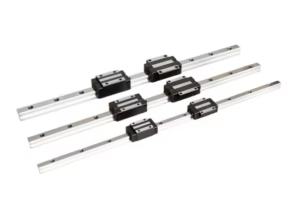
A linear guide slider is a mechanical system that allows controlled, frictionless linear motion. It consists of a rail and a sliding block (carriage) that moves along the rail using rolling elements like ball bearings or rollers.
Its purpose is to support and guide moving parts in machines while maintaining high accuracy under load. In simple terms, it ensures machines move in a straight line with minimum friction and maximum precision.
History of Linear Guide Slider
The evolution of the linear guide slider reflects humankind’s quest for smoother and more precise motion:
Ancient Era: Wooden grooves and stone tracks guided carts.
Industrial Revolution: Sliding metal ways powered early machines, but friction was high.
20th Century: Introduction of ball bearings revolutionized precision motion.
Modern Era: Today’s linear guide sliders feature hardened steel, anti-corrosion coatings, and IoT-enabled monitoring systems.
Each stage has brought us closer to the advanced systems we rely on today.
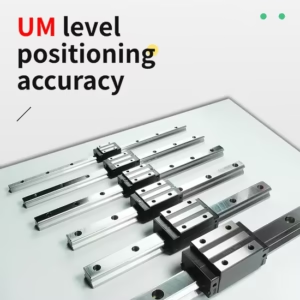
Components of Linear Guide Slider
The system is made up of:
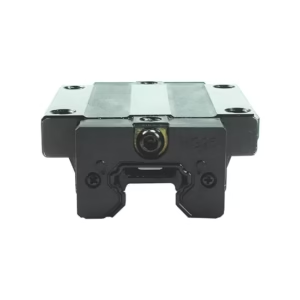
Rail: The fixed guiding path.
Slider Block/Carriage: The moving component.
Rolling Elements: Balls or rollers reduce friction.
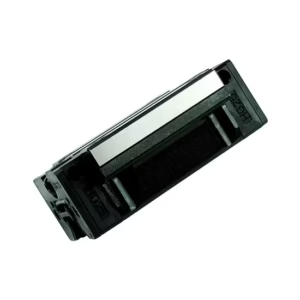
End Caps & Seals: Keep dirt and dust out.
Lubrication Ports: Ensure smooth, long-lasting performance.
These components work together to provide durability, accuracy, and efficiency.
Types of Linear Guide Slider
Depending on the application, different types are available:
Ball Type: High speed, smooth movement.
Roller Type: Handles heavy loads with rigidity.
Miniature Sliders: Compact, used in electronics and small devices.
Heavy-Duty Sliders: Designed for industrial-scale loads.
Linear Guide Slider vs. Linear Guide Rail
Although they sound similar, there are differences:
| Feature | Linear Guide Slider | Linear Guide Rail |
|---|---|---|
| Design | Slider block on rail | Rail-only, needs block |
| Load Handling | High | High |
| Precision | Excellent | Very High |
| Applications | Robotics, automation, 3D printing | CNC, aerospace, medical |
Both are essential, but the slider is the moving block that makes the rail functional.
Advantages of Linear Guide Slider
High Precision: Keeps machines accurate.
Durability: Long service life under heavy loads.
Smooth Movement: Reduced vibration and noise.
Versatility: Used across industries.
Efficiency: Reduces energy waste.
Applications in CNC Machines
In CNC machining, linear guide sliders enable micron-level accuracy. They guide cutting tools and workpieces with stability, ensuring:
Higher productivity.
Better surface finishes.
Longer tool life.
Linear Guide Slider in Robotics
Robotics demands repeatability and reliability. Linear guide sliders allow robotic arms to move smoothly without deviation, powering everything from automated warehouses to assembly robots.
Role in Industrial Automation
Automation thrives on speed and accuracy. Linear guide sliders enable:
Conveyor systems.
Pick-and-place machines.
Packaging equipment.
When paired with sensors, they support predictive maintenance and smart factory efficiency.
Linear Guide Slider in Medical Equipment
In healthcare, there’s no room for error. Sliders power:
MRI and CT scanners.
Surgical robots.
Laboratory automation.
They ensure precise imaging and delicate surgical accuracy.
Aerospace Applications
The aerospace industry needs strength and consistency. Linear guide sliders withstand vibration, temperature changes, and extreme loads in applications like aircraft assembly and satellite manufacturing.
How to Choose the Right Linear Guide Slider
Consider:
Load Capacity
Accuracy Requirement
Operating Environment
Speed
Budget
Installation of Linear Guide Slider
Steps for installation:
Prepare flat, clean mounting surface.
Align rails carefully.
Bolt evenly without distortion.
Install slider block.
Apply lubricant.
Maintenance Best Practices
Lubricate regularly.
Clean rails and blocks.
Inspect seals.
Replace worn bearings.
Recheck alignment.
Common Problems and Fixes
Noise/Vibration: Add lubrication or realign.
Jamming: Remove debris.
Wear: Replace block or bearings.
Corrosion: Use stainless steel or coatings.
Improving Performance of Linear Guide Slider
Boost performance by:
Using higher-grade lubricants.
Adding dust covers.
Switching to roller types for heavy loads.
Integrating IoT sensors for monitoring.
Cost of Linear Guide Slider
Prices vary:
Small sliders: $50–$200
Industrial sliders: $500–$3,000
Specialized aerospace/medical: $10,000+
Top Manufacturers
THK
Hiwin
NSK
Bosch Rexroth
Comparing Leading Brands
THK: Premium, aerospace-grade.
Hiwin: Affordable, reliable.
NSK: Long lifespan.
Bosch Rexroth: Great for automation.
Linear Guide Slider in 3D Printing
3D printers need smooth, accurate motion. Sliders improve:
Print quality.
Stability.
Vibration control.
Future of Linear Guide Slider
The future lies in:
AI-based diagnostics.
IoT-enabled monitoring.
Eco-friendly materials.
Eco-Friendly Innovations
Manufacturers now use recyclable materials, low-friction coatings, and energy-efficient processes to reduce environmental impact.
DIY Uses for Linear Guide Slider
Popular for hobbyists:
CNC machines.
3D printers.
Camera sliders.
Home automation projects.
Troubleshooting Guide
Noisy movement: Check lubrication.
Uneven wear: Recheck load distribution.
Block stuck: Clean and realign.
Reduced accuracy: Replace bearings.
Buying Checklist
Verify load rating.
Check size and length.
Choose trusted brand.
Ensure environmental protection.
Compare warranty options.
Conclusion
The linear guide slider may be small, but it plays a massive role in modern engineering. From CNC machines and robotics to aerospace and medicine, it ensures precise, smooth, and reliable motion.
In 2025 and beyond, sliders will evolve with smart features, sustainability, and AI monitoring. For engineers, manufacturers, and even hobbyists, the linear guide slider is not just a component—it’s the backbone of precision motion systems.
FAQs
What is a linear guide slider used for?
It provides precise linear motion in machines like CNC systems, robots, and automation lines.
Is it the same as a linear guide rail?
No, the slider is the moving block that works with the rail.
Do sliders need lubrication?
Yes, lubrication prevents friction and extends life.
Which industries use linear guide sliders?
Manufacturing, aerospace, robotics, and medical equipment.
How long does a linear guide slider last?
With proper care, 10–20 years.
What’s the price of a linear guide slider?
Anywhere from $50 to $10,000+, depending on type and industry.
Suggested Inbound Links
CNC machining basics
Robotics automation guide
3D printing upgrades blog