

Introduction
Linear roller bearings (LRBs) are advanced mechanical components used to guide and support loads along a linear path with minimal friction and high precision. Unlike ball-type linear bearings, which use spherical rolling elements, linear roller bearings employ cylindrical rollers. This gives them higher load capacity, better rigidity, and superior performance under heavy-duty applications. Linear roller bearings are widely used in CNC machinery, industrial automation, robotics, precision assembly lines, and heavy-load transport systems.
This article explores the types, construction, mechanics, selection criteria, installation, lubrication, maintenance, and practical applications of linear roller bearings. It is intended for engineers, technicians, and professionals involved in mechanical design and automation who need a thorough understanding of LRBs for high-performance applications.
Table of Contents
What are linear roller bearings?
Linear roller bearing vs linear ball bearing
Construction and components
Working principle
Types of linear roller bearings
Design considerations
Load capacity and stiffness
Accuracy and precision
Preload, clearance, and rigidity
Sizing and selection
Mechanical calculations: load, speed, and life
Mounting and alignment
Lubrication and maintenance
Environmental considerations
Application examples
Troubleshooting common issues
Standards, tolerances, and specifications
Cost, lifecycle, and replacement planning
Advantages and limitations
Conclusion
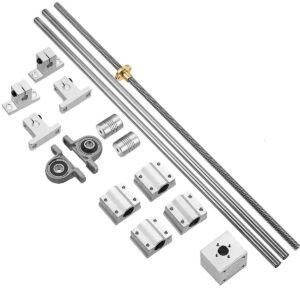
1. What are Linear Roller Bearings?
Linear roller bearings are bearing assemblies designed to support and guide a load along a straight path using cylindrical rolling elements. The rollers reduce friction, distribute loads evenly, and maintain high rigidity under axial and radial forces. They are designed for high-load, high-precision, and heavy-duty linear motion applications.
Key characteristics:
High load-carrying capacity due to roller contact (line contact vs point contact in ball bearings).
Excellent rigidity for minimal deflection under heavy loads.
Smooth linear motion with low friction.
Compatibility with linear guide rails or profiles for guided motion.
2. Linear Roller Bearing vs Linear Ball Bearing
| Feature | Linear Ball Bearing | Linear Roller Bearing |
|---|---|---|
| Rolling element | Ball | Cylindrical roller |
| Load capacity | Medium | High |
| Rigidity | Moderate | High |
| Moment load resistance | Limited | Excellent |
| Accuracy under heavy load | Degrades faster | Maintains precision |
| Common applications | Light machinery, automation | CNC machines, heavy loads, press equipment |
| Cost | Lower | Higher |
Summary: Linear roller bearings are preferred for applications requiring high load capacity and stiffness, whereas linear ball bearings are suitable for lighter and faster-moving systems.
3. Construction and Components
A typical linear roller bearing consists of:
Rollers: Cylindrical elements made of hardened steel or stainless steel. They provide line contact with the rail, resulting in high load capacity.
Bearing cage: Maintains roller spacing and prevents skewing. Cages are often steel or polymer-based.
Raceway / Rail interface: Linear guide rails with hardened and ground surfaces serve as the track for rollers.
End caps / seals: Protect against contamination, retain lubrication, and prevent rollers from falling out.
Housing (optional): Some LRBs come in pre-assembled housings for easy mounting and integration.
Material selection:
Hardened alloy steel for rollers and raceways provides high wear resistance and long life.
Stainless steel variants for corrosive or humid environments.
Polymer cages reduce noise and friction.
4. Working Principle
Linear roller bearings operate on the principle of rolling motion along a linear guide. Unlike sliding contact systems, the rollers roll along the rail, converting applied force into smooth linear motion while minimizing friction.
Key points:
Cylindrical rollers distribute loads along a line of contact, significantly increasing load capacity.
Bearings can support axial, radial, and moment loads simultaneously, depending on design.
Preloaded roller bearings eliminate play, increasing rigidity and positional accuracy.
Proper lubrication minimizes friction and wear, extending life.
5. Types of Linear Roller Bearings
Linear roller bearings can be classified based on roller arrangement, preload, and mounting style:
5.1 Roller Arrangement
Single-row linear roller bearing: Supports unidirectional load; simpler and compact.
Double-row linear roller bearing: Handles higher radial and moment loads; higher rigidity.
Four-row or multi-row roller bearing: For extremely heavy-duty applications with very high rigidity.

5.2 Preload Type
Non-preloaded: Standard bearing with some clearance; lower friction but allows slight movement.
Preloaded: Bearings are axially or laterally preloaded to remove clearance, enhancing rigidity and precision.
5.3 Mounting Style
Open bearings: Easy inspection and lubrication; used where contamination is minimal.
Sealed bearings: Protection against dust, debris, and fluids; reduces maintenance.
Cartridge or housed units: Pre-assembled with mounting provisions for simple integration.
5.4 Roller Shape Variations
Cylindrical: Most common, high load capacity.
Needle rollers: Longer, thinner rollers for compact designs and lower profile.
Tapered rollers: Reduce edge stresses for high moment load applications.
6. Design Considerations
Key design factors for linear roller bearing selection:
Load direction: Determine whether the load is primarily radial, axial, or combined.
Moment load: Consider overhung or eccentric loads that create bending moments.
Precision and repeatability: Preload, rail quality, and bearing tolerance affect accuracy.
Speed requirements: Roller size, lubrication, and cage design influence maximum travel speed.
Environmental factors: Dust, humidity, temperature extremes, and chemicals impact material and seal selection.
7. Load Capacity and Stiffness
7.1 Load Types
Dynamic load: Maximum load the bearing can sustain while maintaining rated life.
Static load: Maximum load without permanent deformation.
Moment load: Bending moment supported without compromising accuracy.
7.2 Stiffness
Line contact of rollers provides higher stiffness than ball-type bearings, essential for machining or press operations.
Stiffness depends on number of rollers, roller diameter, preload, and guide width.
Preload increases stiffness but also increases friction.
8. Accuracy and Precision
Manufacturing tolerances: Roller roundness, raceway flatness, and rail straightness determine positional accuracy.
Repeatability: Preloaded roller bearings can achieve sub-micron repeatability.
Error sources: Misalignment, rail bending, thermal expansion, and uneven preload.
Compensation strategies: High-precision applications may combine LRBs with linear encoders or adjustable preloaded units.
9. Preload, Clearance, and Rigidity
Preload:
Eliminates backlash and improves stiffness.
Must be balanced; excessive preload increases friction and wear.
Clearance:
Provides slight play in non-preloaded bearings.
Tolerances depend on load, speed, and application requirements.
Rigidity:
Key for heavy-load applications, machine tools, and high-accuracy automation.
Achieved with multi-row bearings, wider rails, and high-preload configurations.
10. Sizing and Selection
Factors for selecting linear roller bearings:
Load capacity: Calculate based on dynamic and static load requirements.
Travel length: Ensure rail and bearing can handle stroke distance.
Precision class: Choose based on repeatability and allowable deflection.
Speed: Consider lubrication and roller size to prevent overheating.
Environmental conditions: Corrosion resistance, sealing, and material choice.
Space constraints: Roller diameter, rail width, and carriage height must fit application.
Cost vs performance: High-precision preloaded units are more expensive but necessary for critical applications.
11. Mechanical Calculations: Load, Speed, and Life
11.1 Dynamic Load
L10=(CP)3×10⁶L_{10} = \left(\frac{C}{P}\right)^3 \times 10^6
Where:
CC = dynamic load rating (N)
PP = equivalent dynamic load (N)
L10L_{10} = expected life in revolutions
11.2 Speed Limits
Determined by roller diameter, cage design, lubrication, and rail length.
Exceeding recommended speed causes heat buildup, wear, and vibration.
11.3 Preload Torque
Preloaded bearings require slightly higher driving torque.
Calculate motor torque considering bearing friction, preload, and load inertia.
11.4 Deflection
Linear roller bearings have predictable deflection under load:
δ=Fk\delta = \frac{F}{k}
Where FF is load and kk is bearing stiffness. This helps design compliant systems and ensure accuracy.