

Bearing rails are at the heart of every precision motion system — the unseen yet essential components that make modern automation possible. They transform mechanical energy into controlled linear motion with minimal friction and maximum stability. Whether used in robotics, CNC machinery, 3D printers, or semiconductor manufacturing, bearing rails ensure movement that is straight, accurate, and repeatable.
At YH Linear, we design and manufacture world-class bearing rails built to deliver uncompromising accuracy and durability. This comprehensive guide explores what bearing rails are, how they work, their types, applications, and why YH Linear stands as a global leader in this technology.
Outline
| Section | Heading |
|---|---|
| 1 | Introduction to Bearing Rails |
| 2 | What Are Bearing Rails? |
| 3 | Structure and Working Principle of Bearing Rails |
| 4 | The Role of Bearing Rails in Precision Motion |
| 5 | Advantages of Using Bearing Rails |
| 6 | Components of a Bearing Rail System |
| 7 | Material Composition and Surface Treatments |
| 8 | Types of Bearing Rails |
| 9 | Linear Ball Bearing Rails |
| 10 | Linear Roller Bearing Rails |
| 11 | Miniature Bearing Rails |
| 12 | Heavy-Duty Bearing Rails |
| 13 | Aluminum Bearing Rails |
| 14 | Differences Between Bearing Rails and Linear Guides |
| 15 | How to Select the Right Bearing Rail |
| 16 | Key Parameters in Bearing Rail Design |
| 17 | Installation Guidelines for Bearing Rails |
| 18 | Lubrication and Maintenance Best Practices |
| 19 | Common Problems and Troubleshooting |
| 20 | Bearing Rails in CNC Machines |
| 21 | Bearing Rails in Robotics and Automation |
| 22 | Bearing Rails for Medical and Semiconductor Equipment |
| 23 | How YH Linear Manufactures High-Precision Bearing Rails |
| 24 | Quality Control and Testing Procedures at YH Linear |
| 25 | Customization Capabilities from YH Linear |
| 26 | Future Trends in Bearing Rail Technology |
| 27 | FAQs About Bearing Rails |
| 28 | Conclusion |
Bearing Rails
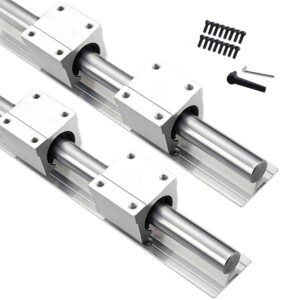
Bearing rails are linear motion components designed to provide smooth, low-friction travel for moving parts along a straight path. They consist of a precision rail and a bearing block or carriage that slides or rolls over the rail surface using rolling elements such as balls or rollers.
At YH Linear, our bearing rails combine robust load capacity with exceptional accuracy, serving industries like robotics, medical imaging, semiconductors, and CNC machining. These rails are engineered for both light-duty precision instruments and heavy-duty industrial systems.
What Are Bearing Rails?
Simply put, bearing rails guide motion in one direction with minimal friction. They replace traditional bushings and sliding systems with high-precision rolling elements, drastically improving performance.
The rail provides a hardened path, while the bearing block houses circulating elements (balls or rollers) that move along the rail grooves, ensuring consistent contact and stable support. This combination results in smooth, controlled motion even under dynamic loads.

Structure and Working Principle of Bearing Rails
A bearing rail assembly typically consists of:
Guide Rail: Precision-ground steel or aluminum bar that defines the motion path.
Bearing Block (Carriage): Houses the rolling elements that move along the rail.
Rolling Elements: Steel balls or cylindrical rollers that circulate continuously to reduce friction.
Seals and End Caps: Protect the internal mechanism from contamination.
Lubrication Ports: Provide maintenance access for grease or oil.
The block moves linearly along the rail, and the rolling elements circulate inside internal raceways. This rolling contact reduces friction by up to 95% compared to sliding contact, improving efficiency and life expectancy.
The Role of Bearing Rails in Precision Motion
Modern industry demands accuracy measured in microns. Bearing rails play a vital role by providing:
Precise linear positioning
High rigidity and load capacity
Low friction for energy-efficient movement
Durability under repeated cycles
From industrial robots to surgical devices, bearing rails enable consistent, controlled motion essential for automation and advanced manufacturing.
Advantages of Using Bearing Rails
Exceptional Accuracy:
YH Linear’s bearing rails maintain micron-level straightness and repeatability.Low Friction:
The rolling elements minimize drag and energy loss.High Load Capacity:
Bearing rails handle loads from multiple directions—ideal for complex motion systems.Long Lifespan:
Hardened steel rails and optimized lubrication extend operational life.Compact and Versatile:
From miniature to heavy-duty sizes, YH Linear offers options for every application.
Components of a Bearing Rail System
| Component | Function |
|---|---|
| Rail | Provides a precision path for motion |
| Bearing Block | Houses rolling elements and carries loads |
| Rolling Elements | Ensure smooth movement with minimal friction |
| Seals | Protect against dust and debris |
| End Caps | Keep the circulating path sealed |
| Lubrication Port | Maintains consistent lubrication |
Each element in a YH Linear system is crafted using state-of-the-art machining and surface grinding, ensuring seamless operation under demanding conditions.
Material Composition and Surface Treatments
High-quality bearing rails require durable materials and precise surface finishes.
YH Linear uses:
Alloy tool steel hardened to 58–62 HRC
Stainless steel for corrosion resistance
Aluminum for lightweight applications
Protective coatings such as nickel plating, black oxide, or chrome for enhanced wear protection
Each rail undergoes precision grinding to achieve mirror-like surfaces for ultra-smooth rolling.
Types of Bearing Rails
Bearing rails come in several designs based on performance and load needs:
Linear ball bearing rails
Linear roller bearing rails
Miniature bearing rails
Heavy-duty bearing rails
Aluminum bearing rails
Linear Ball Bearing Rails
The most common type, ball-bearing rails, use recirculating steel balls to support linear movement. They are known for high speed, smoothness, and cost efficiency.
YH Linear’s ball-bearing rails offer near-silent operation and minimal vibration — ideal for CNC routers, laser cutters, and 3D printers.
Linear Roller Bearing Rails
Instead of balls, roller-bearing rails use cylindrical rollers that increase the contact area between the block and rail. This design offers:
Greater stiffness
Higher load capacity
Enhanced accuracy for heavy-duty applications
YH Linear’s roller rails are perfect for machine tools and robotic automation where performance and rigidity are paramount.
Miniature Bearing Rails
Compact and precise, miniature bearing rails are used in electronics assembly, optical devices, and small robotics. YH Linear’s miniature rails like the MGN9 and MGN12 series are built to deliver micro-precision with smooth, silent operation.
Heavy-Duty Bearing Rails
For demanding industrial environments, YH Linear’s heavy-duty bearing rails provide superior strength and shock resistance. These rails feature reinforced steel cores and longer carriage blocks for enhanced stability under high load conditions.
Aluminum Bearing Rails
When weight reduction is critical, aluminum bearing rails are ideal. They combine a lightweight body with hardened steel inserts or coatings for wear resistance. YH Linear’s aluminum rails are used in aerospace, robotics, and laboratory automation systems.
Differences Between Bearing Rails and Linear Guides
| Feature | Bearing Rails | Linear Guides |
|---|---|---|
| Structure | Rolling block on a rail | Rail and carriage assembly |
| Friction | Very low | Low |
| Load Capacity | High | High to medium |
| Accuracy | Excellent | Excellent |
| Common Use | CNC, robotics, automation | General precision motion |
Although often used interchangeably, bearing rails typically emphasize rolling element design and load support, while linear guides focus on guidance and motion control.
How to Select the Right Bearing Rail
Consider these factors before choosing your system:
Load direction (radial, axial, or moment)
Required accuracy and repeatability
Speed and acceleration profile
Environmental conditions (dust, humidity, temperature)
Installation space and mounting structure
Maintenance accessibility
YH Linear’s engineering experts provide customized consultation to ensure your chosen rail perfectly matches your application.
Key Parameters in Bearing Rail Design
Dynamic Load Rating (C)
Static Load Rating (C₀)
Preload and Clearance
Accuracy Grade (C, H, P, SP, UP)
Rail Straightness and Flatness
At YH Linear, each parameter is verified through advanced metrology equipment to guarantee precision beyond industrial standards.
Installation Guidelines for Bearing Rails
Prepare the Surface: Clean, flat, and free of debris.
Align the Rail: Use a dial indicator or laser alignment tool.
Secure Fasteners: Tighten gradually in sequence to prevent distortion.
Install the Carriage: Slide gently to avoid damage.
Check Motion: Verify smooth, consistent travel before operation.
YH Linear provides installation support and technical documentation for all products, simplifying integration.
Lubrication and Maintenance Best Practices
Regular lubrication reduces friction, prevents wear, and extends life.
Use high-quality lithium or fluorine-based grease.
Reapply lubrication after 500–1,000 hours of use.
Avoid contamination and over-greasing.
Inspect seals and replace if worn.
YH Linear offers self-lubricating block options that deliver maintenance-free performance for extended use.
Common Problems and Troubleshooting
| Problem | Cause | Solution |
|---|---|---|
| Vibration or noise | Poor lubrication or misalignment | Re-lubricate and re-align |
| Binding | Contamination or damaged rail | Clean or replace components |
| Reduced accuracy | Wear or loose fasteners | Retighten and inspect |
| Short service life | Overload or improper use | Reassess application and select correct size |
Bearing Rails in CNC Machines
CNC systems rely heavily on bearing rails for toolpath accuracy and repeatable motion. YH Linear’s high-stiffness bearing rails ensure vibration-free cutting, smooth feed, and superior surface finishes — essential for milling, turning, and laser operations.
Bearing Rails in Robotics and Automation
Robotic arms demand lightweight, responsive, and precise motion. YH Linear’s compact bearing rails enhance positional accuracy while reducing power consumption — ideal for pick-and-place systems and assembly robots.
Bearing Rails for Medical and Semiconductor Equipment
YH Linear’s stainless-steel bearing rails meet stringent hygiene and cleanliness requirements, making them suitable for MRI scanners, surgical tools, and wafer inspection systems where quiet, contamination-free performance is vital.
How YH Linear Manufactures High-Precision Bearing Rails
Our production process integrates:
CNC grinding and honing
Vacuum heat treatment
Automated assembly
Laser measurement for dimensional verification
Each bearing rail undergoes 100% inspection before shipment, ensuring unmatched consistency and reliability.
Quality Control and Testing Procedures at YH Linear
We maintain world-class standards with:
ISO 9001-certified quality management
Coordinate Measuring Machines (CMM)
Surface roughness and hardness testing
Straightness and parallelism verification
YH Linear’s commitment to excellence ensures every rail meets or exceeds client specifications.
Customization Capabilities from YH Linear
We offer custom solutions including:
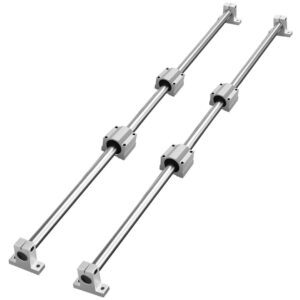
Cut-to-length rails
Modified carriage block dimensions
Special coatings for corrosion resistance
Non-standard preload and clearance options
OEM branding and packaging
These tailored systems empower our clients to integrate YH Linear products seamlessly into their designs.
Future Trends in Bearing Rail Technology
The future is smart, lightweight, and sustainable. Expect developments like:
Integrated sensors for predictive maintenance
Smart lubrication systems
Lightweight composites replacing traditional steel
AI-based motion diagnostics
YH Linear continues to invest in R&D and innovation, driving the evolution of intelligent motion components.
FAQs About Bearing Rails
What are bearing rails used for?
They provide precise linear motion for machines like CNCs, robots, and inspection equipment.
Do bearing rails require maintenance?
Yes, regular cleaning and lubrication ensure long-lasting performance.
What’s the difference between ball and roller bearing rails?
Ball rails are faster and quieter, while roller rails handle higher loads.
Can YH Linear supply custom rail lengths?
Yes. YH Linear offers fully customizable rail sizes and preload settings.
How long do YH Linear bearing rails last?
With proper care, they can operate reliably for tens of thousands of hours.
Are stainless steel bearing rails better?
For humid or cleanroom environments, stainless steel offers superior corrosion resistance.
Conclusion
Bearing rails are the foundation of precision motion technology — quietly enabling the world’s most advanced machines. Their role in delivering smooth, accurate, and stable linear motion makes them indispensable across industries.
At YH Linear, we combine engineering excellence with advanced manufacturing to produce bearing rails that redefine reliability and performance. Whether your goal is higher speed, greater accuracy, or longer service life, YH Linear delivers precision you can trust.
Inbound Link Suggestions:
Link to: “Linear Guideway MGN9” (internal page)
Link to: “Heavy Duty Linear Bearings” (internal page)
Outbound Link Suggestions:
Link to: YH Linear Product Catalog
Link to: ISO Quality Standards