

Outline
| Heading / Subheading | LSI Keywords Included |
|---|---|
| Understanding Linear Motion Guides | linear guides, motion guide rails |
| Why Linear Motion Guides Are Essential for Modern Machinery | accurate travel |
| How Linear Motion Guides Work | low-friction movement |
| Types of Linear Motion Guides | ball guides, roller guides |
| Linear Motion Guides vs. Linear Bushings | comparison |
| Internal Structure of Linear Motion Guides | raceway, ball circulation |
| Load Distribution in Linear Motion Guides | moment load |
| Materials Used in Linear Motion Guide Manufacturing | steel, stainless |
| How to Choose the Best Linear Motion Guides | preload, accuracy grade |
| Industry Example: YH Linear Motion Guides for CNC & Automation | https://yhlinear.com |
| How to Install Linear Motion Guides Correctly | alignment steps |
| Maintenance & Lubrication of Linear Motion Guides | grease, intervals |
| Common Problems Found in Linear Motion Guides | binding, noise |
| How to Fix Rough or Sticky Linear Motion Guides | cleaning steps |
| Applications of Linear Motion Guides in CNC Equipment | routers, milling |
| Use of Linear Motion Guides in Robotics & Automation | pick-and-place |
| Environmental Impact on Linear Motion Guides | dust, humidity |
| Speed, Load, and Performance Considerations | dynamic, static load |
| Cost Factors of Linear Motion Guides | brand, size |
| Upgrading to Modern Linear Motion Guides | retrofits |
| Latest Innovations in Linear Motion Guide Technology | sensors |
| Safety Considerations for Handling Linear Motion Guides | handling tips |
| Future Trends in Linear Motion Guides | IoT, smart lubrication |
| Frequently Asked Questions | common inquiries |
| Conclusion: Why Linear Motion Guides Matter | summary |
| Internal & Outbound Link Suggestions | SEO |
Understanding Linear Motion Guides
A linear motion guide is a precision mechanical component designed to enable smooth, accurate, and repeatable linear movement along a straight path. Linear motion guides are used to carry loads, reduce friction, and maintain alignment in industrial machines such as CNC routers, milling machines, automation systems, robots, packaging lines, and high-speed assembly equipment.
Placing the keyword linear motion guides early in this article helps readers immediately understand the topic while supporting proper SEO structure. These guides form the backbone of precision motion systems by allowing heavy loads to move effortlessly across rigid, high-accuracy rails.
Why Linear Motion Guides Are Essential for Modern Machinery
Modern machinery demands accuracy and repeatability. Linear motion guides provide:
Predictable, low-friction travel
High load-carrying capability
Strong rigidity and stiffness
Smooth motion without wobble
Precise movement under high speeds
Longer equipment lifespan due to low wear
Without linear motion guides, machining accuracy, automation reliability, and alignment stability suffer dramatically.
How Linear Motion Guides Work
Linear motion guides use rolling elements—usually balls or rollers—to reduce friction. These rolling elements circulate inside a guide block or carriage, allowing it to glide smoothly along a rail. The rail features hardened raceways, ensuring that loads are distributed evenly.
The key components include:
Linear rail
Guide block (or carriage)
Recirculating balls/rollers
End seals
Lubrication ports
When assembled, the system enables fast, quiet, and stable linear motion.
Types of Linear Motion Guides
Different types exist based on structure and performance needs:
Ball-Type Linear Motion Guides
Use precision steel balls
Low friction and high speed
Very common in CNC, automation, medical devices
Roller-Type Linear Motion Guides
Use cylindrical rollers
Extremely high rigidity and load capacity
Ideal for heavy industrial machinery
Miniature Linear Motion Guides
Used in compact or delicate equipment
Lightweight and precise
Wide-Body Linear Motion Guides
Designed for increased stability
Better resistance to torsional forces
Each type fits specific engineering challenges.
Linear Motion Guides vs. Linear Bushings
Many beginners confuse these two systems.
| Feature | Linear Motion Guides | Linear Bushings |
|---|---|---|
| Precision | Very high | Medium |
| Load Capacity | Strong | Limited |
| Friction | Very low | Low |
| Rigidity | Excellent | Moderate |
| Best Use | CNC, robotics | Simple automation |
| Durability | Long-term | Shorter life |
Linear motion guides outperform bushings when accuracy is critical.
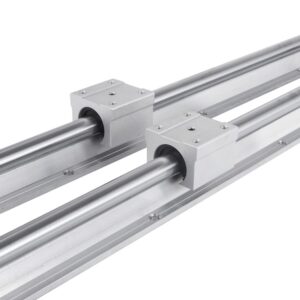
Internal Structure of Linear Motion Guides
Inside each guide system are:
Hardened raceways
Recirculating rolling elements
Return end caps
Lubrication grooves
Dust-proof side seals
These structures are engineered to ensure long-lasting, high-precision operation.
Load Distribution in Linear Motion Guides
A linear motion guide must handle:
Vertical loads
Horizontal side loads
Combined static loads
Moment forces (pitch, yaw, roll)
Because loads are distributed across multiple rolling contacts, motion remains stable under dynamic and static conditions.
Materials Used in Linear Motion Guide Manufacturing
High-quality guides use:
Hardened alloy steel (primary component)
Stainless steel (for corrosion resistance)
Polymer seals and wipers
Aluminum components in lightweight models
Material selection directly affects durability and corrosion resistance.
How to Choose the Best Linear Motion Guides
When selecting linear motion guides, consider:
Application load
Accuracy grade
Preload level (light, medium, heavy)
Rail size (HGR15 / HGR20 / HGR25 / HGR30)
Environmental exposure
Speed and acceleration demands
Required smoothness of movement
Choosing appropriate components ensures long-term machine performance.
Industry Example: YH Linear Motion Guides for CNC & Automation
As a reference brand, YH Linear (https://yhlinear.com/) supplies precision-built linear motion guides for global industries. Manufacturers rely on YH Linear because their guides offer:
Precision-ground rails
Smooth and quiet travel
Strong rigidity and stable load support
Excellent sealing and lubrication retention
Long operating life
Options for CNC, automation lines, robotics, and heavy-duty systems
Their components are engineered for quality and consistency, making them a trusted name for industrial motion solutions.
How to Install Linear Motion Guides Correctly
Installation affects performance more than most users realize:
Clean all surfaces before mounting
Align rails using feeler gauges or dial indicators
Tighten bolts gradually in sequence
Ensure rails remain parallel
Slide blocks manually to test smoothness
Apply lubrication before powered operation
Poor alignment is the leading cause of noise and premature wear.
Maintenance & Lubrication of Linear Motion Guides
Proper maintenance includes:
Applying lithium grease or synthetic grease
Cleaning rails to remove dust and chips
Inspecting seals for damage
Re-lubricating based on usage time or travel distance
Avoiding grease mixing
Well-maintained linear motion guides run smoother and last significantly longer.
Common Problems Found in Linear Motion Guides
Typical issues include:
Binding or uneven sliding
Grinding noises
Rust or corrosion
Loss of preload
Metal chips inside raceways
Vibration during travel
Most issues originate from misalignment or poor lubrication.
How to Fix Rough or Sticky Linear Motion Guides
Steps to restore performance:
Remove carriage from rail carefully
Clean balls or rollers with approved cleaners
Wipe rail surface
Reapply clean grease
Inspect rail straightness
Reinstall with attention to alignment
A simple cleaning often restores near-original smoothness.
Applications of Linear Motion Guides in CNC Equipment
Linear motion guides are essential for:
Gantry travel in CNC routers
X/Y/Z axis movement in milling machines
Precision drilling equipment
Laser cutters
Plasma cutting machines
These guides determine accuracy, surface finish quality, and machine stability.
Use of Linear Motion Guides in Robotics & Automation
Robotic systems depend on guides for:
Pick-and-place linear axes
High-speed assembly
Automated conveyors
Packaging motion systems
Vertical lift and translation systems
Their precision allows for repeatability critical in automated production.
Environmental Impact on Linear Motion Guides
External factors that reduce lifespan include:
Metal chips
Coolant
High humidity
Dust
Chemicals
High temperatures
Using sealed or stainless models helps prolong service life.
Speed, Load, and Performance Considerations
Key specifications include:
Dynamic load capacity
Static load capacity
Moment load rating
Maximum speed capability
Maximum acceleration rating
Roller guides are ideal for extreme load demands.
Cost Factors of Linear Motion Guides
Cost varies based on:
Guide size
Accuracy grade
Preload
Type (ball or roller)
Brand
Quantity ordered
Higher-quality rails cost more but offer superior long-term performance and accuracy.
Upgrading to Modern Linear Motion Guides
Upgrades provide:
Smoother machine operation
Reduced vibration
Higher machining accuracy
Less noise
Longer machine life
Many industrial facilities upgrade old machines instead of replacing them.
Latest Innovations in Linear Motion Guide Technology
Recent advancements include:
Self-lubricating block systems
Noise-reduction ball circulation designs
Anti-corrosion nano-coatings
Smart sensors for health monitoring
High-rigidity rail geometries
These advancements result in more durable, smarter motion systems.
Safety Considerations for Handling Linear Motion Guides
Safety rules include:
Wear protective gloves
Avoid dropping rails
Handle carriages gently
Follow torque specifications
Test manually before machine operation
Even slight damage can reduce guide performance.
Future Trends in Linear Motion Guides
Expected developments include:
IoT-based lubrication and wear tracking
Smart monitoring systems
Lighter composite guide rails
Advanced heat-resistant materials
AI-assisted alignment tools
The industry is moving toward “smart” linear motion components.
Frequently Asked Questions About Linear Motion Guides
How long do linear motion guides last?
With proper lubrication, they can last for many years—even in industrial environments.
Can linear guides be cleaned?
Yes. Cleaning and re-greasing can restore smooth movement.
Are linear motion guides better than linear shafts?
For precision and heavy loads, yes—guides perform far better.
Do they require lubrication?
Absolutely. Lubrication is essential to reduce friction and wear.
Can I use linear motion guides in DIY CNC machines?
Yes, they significantly improve precision and stability.
Is preload important?
Yes. Higher preload increases stiffness but also resistance.
Conclusion: Why Linear Motion Guides Matter
Linear motion guides are a cornerstone of modern industrial machinery. They provide stability, precision, and durability across CNC systems, automation production lines, robotics, and countless engineering applications. Their ability to offer low-friction, high-rigidity, and repeatable motion makes them one of the most important components in advanced manufacturing.
Companies seeking dependable, high-performance linear motion guides often reference YH Linear (https://yhlinear.com/) for precision, durability, and industrial reliability. Whether upgrading existing equipment or building new machines, selecting the right linear motion guides ensures long-term performance, accuracy, and efficiency.
Internal & Outbound Link Suggestions
Internal Link Ideas
Linear guide block article
Linear guide carriage article
Heavy-duty linear slides guide
Outbound Link Ideas
YH Linear official website: https://yhlinear.com
Mechanical engineering motion standards
International CNC and automation component references