

Introduction
In modern industrial automation and precision machinery, achieving accurate, smooth, and controlled linear motion is critical. One of the key components enabling this functionality is the linear bearing track.
A linear bearing track (also called a linear rail system or linear guide track) allows machinery components to move along a straight path with minimal friction while carrying substantial loads. From CNC machines and 3D printers to industrial robots, laboratory equipment, and packaging machinery, linear bearing tracks are fundamental to modern engineering and automation.
This article provides a comprehensive overview of linear bearing tracks, including their design, types, working principles, advantages, applications, selection criteria, and maintenance practices.
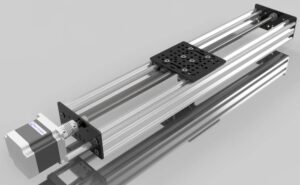
What Is a Linear Bearing Track?
A linear bearing track is a mechanical system that provides precise linear movement by combining a track (rail) and a bearing block (carriage or slider). Unlike traditional sliding systems, linear bearing tracks use rolling elements, such as balls or rollers, to minimize friction, improve accuracy, and extend the lifespan of machinery.
The main function of a linear bearing track is to support and guide moving parts along a straight path, ensuring smooth motion, stability, and precision under dynamic loads.
Linear bearing tracks are widely used in applications where repeatability, load capacity, and low friction are critical.
Structure of a Linear Bearing Track
A typical linear bearing track system is composed of three primary elements:
Rail (Track)
A rigid, precision-machined component made from hardened steel, stainless steel, or aluminum alloy.
Provides a smooth, linear path for the bearing carriage.
Designed to withstand radial, axial, and moment loads without deformation.
Bearing Carriage (Slider/Block)
Moves along the rail while carrying the load.
Houses recirculating rolling elements, such as ball bearings or cylindrical rollers, which facilitate low-friction motion.
Supports machinery components or tools with high stability and rigidity.
Rolling Elements (Balls or Rollers)
Circulate inside the carriage to convert sliding motion into rolling motion, drastically reducing friction.
Ensure uniform load distribution and smooth linear movement.
Additional components can include end caps, lubrication ports, seals, or wipers to protect the system from dust, debris, or contamination, enhancing longevity and reliability.
Working Principle of Linear Bearing Tracks
Linear bearing tracks operate on the principle of rolling friction:
The bearing carriage moves along the rail, guided by rolling elements such as balls or rollers.
The rolling elements circulate within the carriage, ensuring consistent contact with the rail while minimizing sliding friction.
The system maintains precise linear motion, high rigidity, and smooth operation under varying loads.
The design allows the track to handle dynamic and static loads, including radial, axial, and moment forces, while preserving accuracy.
The precision machining of rails and carriages ensures minimal deflection, vibration, and wear, making linear bearing tracks suitable for high-speed and high-precision applications.
Types of Linear Bearing Tracks
Linear bearing tracks can be categorized by load capacity, rolling elements, material, and design:
1. Ball-Type Linear Bearing Tracks
Uses recirculating ball bearings for motion.
Provides high precision and low friction.
Common in CNC machines, 3D printers, and light to medium-duty automation equipment.
2. Roller-Type Linear Bearing Tracks
Uses cylindrical rollers instead of balls.
Can support higher loads and offer greater rigidity.
Ideal for heavy machinery, industrial presses, and large-scale automation systems.
3. Profile Rail Linear Bearing Tracks
Features a profiled rail with integrated mounting holes.
Rolling elements circulate within a compact carriage design.
Supports multi-directional loads and precise motion.
4. Miniature Linear Bearing Tracks
Small, lightweight systems for precision applications with limited space.
Common in medical devices, optics, electronics assembly, and laboratory automation.
5. Round Shaft Linear Bearing Tracks
Cylindrical rails with linear bushings or bearing slides.
Simpler design, suitable for lightweight machinery and low-load applications.
6. Aluminum Linear Bearing Tracks
Lightweight and corrosion-resistant, often anodized for surface durability.
Preferred for 3D printers, robotics, and applications where weight reduction is crucial.
Advantages of Linear Bearing Tracks
Linear bearing tracks offer numerous benefits compared to traditional sliding or plain bearing systems:
High Precision – Ensures smooth and accurate linear motion.
Low Friction – Rolling elements minimize friction, energy consumption, and wear.
Load Capacity – Can support heavy and multi-directional loads depending on design.
Long Service Life – Reduced wear and proper lubrication extend operational lifespan.
Smooth Operation – Vibration-free and quiet linear motion.
Versatility – Suitable for CNC machines, automation, robotics, medical devices, and packaging machinery.
Easy Installation and Maintenance – Pre-drilled rails, integrated lubrication channels, and modular design simplify setup and upkeep.
Applications of Linear Bearing Tracks
Linear bearing tracks are critical in industries that require precise, repeatable linear motion:
CNC Machines – For milling, cutting, engraving, and precision machining.
3D Printers – Ensures accurate movement of print heads and platforms.
Industrial Robots – Supports linear actuators for pick-and-place operations.
Medical and Laboratory Equipment – High-precision stages for diagnostics and automation.
Packaging Machinery – Smooth motion for filling, labeling, and sorting.
Semiconductor Manufacturing – Precision stages for wafer handling and inspection.
Assembly Lines – Accurate motion for automated assembly and material handling.
In any application where accuracy, rigidity, and low friction are critical, linear bearing tracks play a fundamental role.
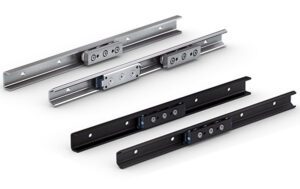
Materials Used in Linear Bearing Tracks
Linear bearing tracks are manufactured from a range of materials depending on load, environment, and cost considerations:
Hardened Steel
High strength and load-bearing capacity.
Suitable for heavy machinery and industrial automation.
Stainless Steel
Corrosion-resistant, ideal for medical, food, and chemical industries.
Aluminum Alloy
Lightweight, corrosion-resistant, ideal for robots, 3D printers, and portable equipment.
Composite or Coated Materials
Reduce friction or wear in specific industrial environments.
How to Choose the Right Linear Bearing Track
Choosing the correct linear bearing track requires careful consideration of several factors:
Load Capacity – Ensure the track supports static and dynamic loads, including moments.
Precision and Accuracy – Higher precision requires smaller clearances and tighter tolerances.
Travel Distance – Match the rail length to your application’s required movement.
Environmental Conditions – Use stainless steel or sealed tracks for dusty, humid, or corrosive environments.
Speed and Acceleration – Ensure the system can handle desired operational speeds without vibration or backlash.
Maintenance Requirements – Some systems feature self-lubricating elements or integrated lubrication channels.
Space Constraints – Consider miniature or compact designs for limited installation areas.
Installation and Maintenance Guidelines
Proper installation and maintenance are critical to achieving long service life and optimal performance:
Alignment – Ensure rails are mounted on a flat, rigid surface with proper alignment.
Lubrication – Regular lubrication of rolling elements reduces wear and prevents corrosion.
Cleaning – Remove dust, debris, and contaminants from rails and carriage.
Inspection – Periodically check for wear, looseness, or damage.
Replacement – Replace worn or damaged carriages or rails promptly to prevent system failure.
Following these guidelines ensures smooth motion, high precision, and extended lifespan for linear bearing tracks.
Future Trends in Linear Bearing Tracks
The industry continues to innovate with enhanced materials, designs, and technologies:
Smart Linear Tracks – Integrated sensors for position, vibration, and temperature monitoring.
Low-Friction Coatings – Advanced coatings reduce wear and energy consumption.
Compact and Lightweight Designs – Aluminum and composite rails for portable and lightweight machines.
IoT-Enabled Automation – Tracks integrated into smart factory networks for predictive maintenance.
Hybrid Materials – Combining aluminum and steel for lightweight yet high-strength rails.
These innovations are driving precision automation, robotics, and smart manufacturing to higher levels of efficiency and reliability.
Frequently Asked Questions (FAQs)
1. What is a linear bearing track?
A linear bearing track is a system consisting of a rail and bearing carriage that provides smooth, precise, and low-friction linear motion.
2. What are the main types of linear bearing tracks?
The main types include ball-type, roller-type, profile rail, miniature, round shaft, and aluminum linear bearing tracks.
3. How do linear bearing tracks reduce friction?
Rolling elements (balls or rollers) inside the carriage circulate along the rail, converting sliding friction into rolling friction, which reduces wear and improves smoothness.
4. Where are linear bearing tracks commonly used?
They are widely used in CNC machines, 3D printers, robotics, packaging machinery, semiconductor equipment, and medical devices.
5. Can linear bearing tracks support heavy loads?
Yes. Steel or roller-type tracks can handle heavy radial, axial, and moment loads depending on their design and size.
6. Do linear bearing tracks require maintenance?
Yes. Periodic lubrication, cleaning, and inspection are essential for maintaining smooth motion and prolonging lifespan.
7. What materials are linear bearing tracks made from?
Common materials include hardened steel, stainless steel, aluminum alloys, and composite materials, selected based on load, environment, and application requirements.
Conclusion
A linear bearing track is a crucial component in modern machinery, enabling accurate, smooth, and controlled linear motion.
By providing low-friction, high-precision, and stable movement, linear bearing tracks improve efficiency, accuracy, and durability across a wide range of industries, including CNC machining, robotics, 3D printing, medical devices, packaging, and semiconductor manufacturing.
Proper selection, installation, and maintenance are essential to maximize performance, load capacity, and lifespan. With ongoing advancements in materials and smart technology, linear bearing tracks will continue to play a critical role in industrial automation and precision engineering.
