

Comprehensive Outline
| Main Topics | Detailed Coverage |
|---|---|
| Ball Bearing Rail Overview | Definition and industrial relevance |
| Evolution of Ball Bearing Rail Technology | From sliding guides to rolling systems |
| Ball Bearing Rail Working Principles | Rolling contact and circulation |
| Core Components of Ball Bearing Rail | Rail, carriage, steel balls |
| Materials and Manufacturing Precision | Hardened steel and tolerances |
| Load Capacity Characteristics | Static and dynamic load handling |
| Speed and Motion Smoothness | Low friction advantages |
| Accuracy and Repeatability | Precision positioning |
| Ball Bearing Rail vs Roller Rail | Speed vs rigidity comparison |
| Types of Ball Bearing Rail Systems | Standard, miniature, wide rails |
| Installation Requirements | Mounting surface preparation |
| Alignment and Preload Control | Accuracy optimization |
| Lubrication Methods | Grease and oil systems |
| Maintenance and Service Life | Long-term reliability |
| Noise and Vibration Performance | Quiet and stable motion |
| Automation Applications | Robotics and pick-and-place |
| CNC and Light Machining | Precision axis guidance |
| Medical and Laboratory Equipment | Clean and smooth movement |
| Electronics and Semiconductor Use | High-speed precision |
| Selecting the Right Ball Bearing Rail | Technical considerations |
| Common Selection Mistakes | Oversizing and underloading |
| Cost Efficiency and ROI | Performance-to-cost balance |
| YH Linear Ball Bearing Rail Solutions | Brand strengths |
| Future Trends | Smart and lightweight rail designs |
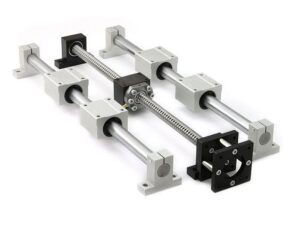
Introduction
Speed, precision, and smooth motion are critical in modern machinery. The ball bearing rail has become one of the most widely used linear motion solutions because it balances performance, efficiency, and cost. From automation systems to CNC machines, ball bearing rail technology ensures accurate and repeatable linear movement with minimal friction.
At YH Linear, years of hands-on experience in linear motion systems have shown that ball bearing rails are often the best choice for applications requiring high speed and excellent positioning accuracy. This article explores how ball bearing rail systems work, their advantages, applications, and why YH Linear delivers reliable solutions for global industries.
Ball Bearing Rail
A ball bearing rail is a linear motion guidance system that uses hardened steel balls as rolling elements between the rail and the carriage. These balls circulate continuously along precision-ground raceways, creating rolling contact instead of sliding contact.
This rolling motion significantly reduces friction. As a result, ball bearing rails enable smooth movement, high travel speed, and low energy consumption. They also provide consistent accuracy over long operating cycles.
Because of their versatility, ball bearing rail systems are widely used in both light-duty and medium-load applications.
Evolution of Ball Bearing Rail Technology
Early linear motion systems relied on plain slides and dovetail guides. While robust, these designs suffered from high friction and rapid wear.
The introduction of ball bearing rail technology marked a major improvement. Rolling elements replaced sliding surfaces, reducing friction and maintenance needs. Over time, advances in manufacturing precision and material quality further enhanced performance.
Today, modern ball bearing rails achieve micron-level accuracy, supporting the demands of automation and precision manufacturing.
Engineering Principles Behind Ball Bearing Rail Systems
The core principle of a ball bearing rail is rolling contact. Steel balls roll along hardened raceways, minimizing friction and wear.
Ball circulation is carefully designed to ensure smooth and continuous motion. Load is distributed evenly among multiple balls, preventing localized stress.
Preload is applied to eliminate internal clearance. This increases rigidity and improves positioning accuracy, especially in high-speed applications.
Core Components of a Ball Bearing Rail
A ball bearing rail system consists of a rail, a carriage, rolling balls, seals, and lubrication channels.
The rail is precision-ground from hardened steel to maintain straightness and durability. The carriage houses the balls and guides their circulation path.
Seals protect the internal components from dust and debris, while lubrication ports ensure smooth long-term operation. At YH Linear, each component is produced under strict quality control.
Materials and Manufacturing Precision
High-quality materials are essential for ball bearing rail performance. Alloy steels with high hardness and toughness are commonly used.
Advanced grinding and heat treatment processes ensure tight tolerances and smooth raceway surfaces. This precision directly affects motion smoothness and accuracy.
YH Linear applies strict inspection standards to guarantee consistent product quality.

Load Capacity and Performance Characteristics
Ball bearing rails are designed to handle both static and dynamic loads. They support vertical, lateral, and moment loads simultaneously.
While their load capacity is generally lower than roller rails, ball bearing rails excel in applications requiring speed and smoothness. Proper sizing ensures reliable performance and long service life.
YH Linear provides technical support to help customers select the correct rail size for their application.
Speed, Smoothness, and Efficiency
One of the greatest advantages of a ball bearing rail is its low friction. This allows for high-speed operation with minimal heat generation.
Smooth motion reduces vibration and improves positioning stability. Energy consumption is also lower, contributing to overall system efficiency.
These characteristics make ball bearing rails ideal for automation and high-speed machinery.
Accuracy and Repeatability
Precision is a defining feature of ball bearing rail systems. Tight tolerances and preload control deliver excellent repeatability.
This accuracy ensures consistent positioning over long production runs. In precision-driven industries, this reliability is essential.
Ball bearing rails maintain their performance even after millions of cycles when properly maintained.
Ball Bearing Rail vs Roller Rail
Ball bearing rails and roller rails serve different purposes. Ball bearing rails offer lower friction and higher speed.
Roller rails provide higher rigidity and load capacity due to line contact. The choice depends on application requirements.
For high-speed and precision-focused systems, ball bearing rails are often the preferred solution.