

Introduction
In modern manufacturing and automation, achieving high-precision, smooth, and repeatable linear motion is essential. One of the most important components that enable this is the precision linear guide. These guides are widely used in CNC machine tools, industrial automation, robotics, medical equipment, semiconductor manufacturing, and high-precision measurement systems.
A precision linear guide is engineered to provide high rigidity, low friction, and exact positioning, distinguishing it from standard linear guides. They are critical in applications where accuracy, repeatability, and reliability directly affect product quality and system performance.
This article provides a comprehensive overview of precision linear guides, including their definition, structure, working principle, types, materials, advantages, applications, selection criteria, installation, and maintenance.
What Is a Precision Linear Guide?
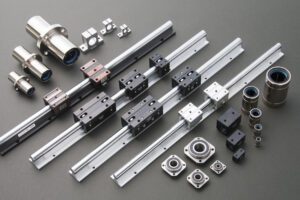
A precision linear guide is a mechanical component designed to support and guide motion along a straight path with minimal friction, high accuracy, and stability. It usually consists of a guide rail and a carriage (slider) that moves along the rail, often incorporating rolling elements like balls or cylindrical rollers.
The primary purposes of a precision linear guide are:
To provide accurate and repeatable linear motion
To reduce friction and wear
To support radial, axial, and moment loads
To maintain alignment and rigidity over long travel distances
Precision linear guides are essential for high-speed, high-precision, and heavy-load applications.
Key Components of a Precision Linear Guide
Guide Rail
Precision-machined and hardened steel or aluminum
Provides a rigid, straight path for motion
Carriage / Slider
Moves along the guide rail and carries the load
Houses rolling elements for low-friction motion
Rolling Elements
Steel balls or cylindrical rollers that recirculate within the carriage
Reduce friction and evenly distribute loads
End Caps and Ball Circulation System
Guide rolling elements back into the carriage for continuous motion
Seals and Wipers
Prevent contamination from dust, debris, or coolant
Extend service life and maintain precision
Lubrication System
Oil or grease channels for smooth operation
Essential for durability and consistent performance
How Precision Linear Guides Work
Precision linear guides operate using rolling contact between the carriage and rail:
The rail is mounted on a flat and rigid surface.
The carriage moves along the rail while carrying the load.
Rolling elements circulate inside the carriage, reducing friction.
Loads are evenly distributed across multiple contact points.
Smooth, accurate, and repeatable linear motion is achieved along the full stroke.
This mechanism allows high-speed operation, high accuracy, and long service life, even under heavy loads or high-frequency motion.
Types of Precision Linear Guides
1. Ball-Type Precision Linear Guides
Use recirculating steel balls
Low friction and smooth motion
Suitable for high-speed, high-precision applications
2. Roller-Type Precision Linear Guides
Use cylindrical rollers for larger contact area
Higher rigidity and load capacity
Ideal for heavy-duty and industrial automation systems
3. Profile Rail Precision Guides
Rectangular rail with integrated raceways for rolling elements
Support multi-directional loads
Common in CNC machines, gantry systems, and industrial automation
4. Round Shaft Linear Guides
Cylindrical shafts with linear bushings
Simple design and cost-effective
Suitable for light to medium-load applications
5. Miniature Precision Linear Guides
Compact design for limited installation space
High precision for small-scale equipment
Used in medical devices, laboratory instruments, and electronics assembly
Materials Used in Precision Linear Guides
Hardened Carbon Steel: High strength, wear resistance, common in industrial applications
Stainless Steel: Corrosion resistance, ideal for humid or cleanroom environments
Aluminum Alloy: Lightweight, corrosion-resistant, used in portable or robotics applications
Surface Treatments: Chrome plating, black oxide, anti-corrosion coatings
Material selection depends on load, precision, speed, and environmental factors.
Advantages of Precision Linear Guides
High Positioning Accuracy and Repeatability
Smooth, Low-Friction Motion
High Load Capacity and Rigidity
Long Service Life with Proper Lubrication
Reduced Energy Consumption
Low Noise and Vibration
Versatility Across Multiple Applications
Applications of Precision Linear Guides
Precision linear guides are widely used in:
CNC Machine Tools: Milling, turning, grinding machines
Industrial Automation: Assembly lines, inspection systems
Robotics: Linear axes, gantry systems, pick-and-place machines
Semiconductor Manufacturing: Wafer handling and precision inspection
Medical Devices: Imaging systems, automated diagnostics
3D Printing and Additive Manufacturing: High-precision linear motion
Packaging Machinery: High-speed filling, labeling, and sorting
How to Select the Right Precision Linear Guide
Load Capacity: Consider static, dynamic, and moment loads
Precision Requirements: Determine required accuracy and repeatability
Travel Length and Stroke: Match guide size and type to machine design
Speed and Acceleration: Choose a guide that supports motion dynamics
Environment: Dust, moisture, chemical exposure, or temperature
Mounting Constraints: Available space and surface quality
Maintenance Requirements: Lubrication frequency and accessibility
Selecting the right guide ensures reliable, accurate, and long-lasting performance.
Installation Best Practices
Mount rails on flat, rigid surfaces
Align rails accurately to avoid binding
Use manufacturer-specified bolt torque
Apply recommended lubrication before operation
Test for smooth travel and proper alignment
Proper installation ensures accuracy, load capacity, and durability.
Maintenance Tips
Regularly clean rails and carriages to remove debris
Lubricate according to manufacturer instructions
Inspect rolling elements, raceways, and seals for wear
Replace worn or damaged components promptly
Routine maintenance extends service life and maintains high precision.
Future Trends in Precision Linear Guides
Condition Monitoring and Smart Sensors for predictive maintenance
Advanced Low-Friction Coatings for longer life
Maintenance-Free Designs
Higher Load and Speed Capabilities
Compact, Lightweight Solutions for robotics and portable systems
These developments are driving smart manufacturing and Industry 4.0 applications.
Frequently Asked Questions (FAQs)
1. What is a precision linear guide used for?
It provides smooth, accurate, and repeatable linear motion in CNC machines, robotics, and automation equipment.
2. How does a precision linear guide differ from a standard linear guide?
Precision linear guides are manufactured to tighter tolerances, offering higher accuracy, rigidity, and repeatability.
3. Do precision linear guides require lubrication?
Yes, lubrication is essential to maintain smooth motion and long service life.
4. Can precision linear guides handle heavy loads?
Yes, especially roller-type or profile rail precision guides.
5. Where are miniature precision linear guides used?
Medical devices, electronics assembly, laboratory instruments, and compact automation systems.
Conclusion
A precision linear guide is a cornerstone of modern high-accuracy linear motion systems, delivering smooth, precise, and reliable movement across a wide range of industrial applications. Choosing the appropriate type, installing it correctly, and performing regular maintenance ensures optimal performance, longevity, and productivity.
As industries continue to demand higher precision and automation, precision linear guides will remain essential components in CNC machining, robotics, industrial automation, and high-tech manufacturing.