

Introduction
In modern mechanical engineering and industrial automation, smooth and controlled linear motion is essential for efficiency, accuracy, and durability. One important component that supports this requirement is the roll rail. Roll rails are widely used in applications where low friction, high load capacity, and smooth rolling motion are required.
Compared with traditional sliding guides, roll rails rely on rolling contact, which significantly reduces friction and wear. As a result, they are commonly found in material handling systems, industrial machinery, automation equipment, heavy-duty transport mechanisms, and precision motion systems.
This article provides a comprehensive explanation of roll rails, including their definition, structure, working principle, types, materials, advantages, applications, selection considerations, installation, and maintenance.
What Is a Roll Rail?
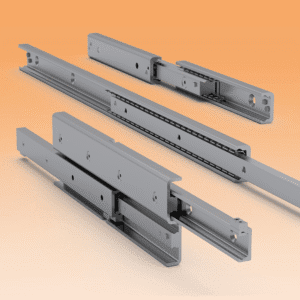
A roll rail is a linear guiding component designed to support and guide motion using rolling elements, such as rollers or wheels, instead of sliding surfaces. It typically works together with rollers, cam followers, or rolling carriages that move along the rail.
The main functions of a roll rail are:
To guide linear motion smoothly
To reduce friction and energy loss
To support heavy or dynamic loads
To ensure stable and repeatable movement
Roll rails are especially suitable for systems that require long travel distances, high load capacity, or continuous operation.
Key Components of a Roll Rail System
1. Roll Rail Profile
The main guiding track
Usually made of hardened steel or high-strength aluminum
Designed to provide a precise rolling surface
2. Rolling Elements
Rollers, wheels, or cam followers
Provide rolling contact instead of sliding contact
Reduce friction and wear
3. Carriage or Support Frame
Holds the rolling elements
Transfers load from the moving structure to the rail
4. Mounting Base
Fixes the roll rail securely to the machine structure
Ensures alignment and rigidity
5. Optional Covers and Seals
Protect the rail from dust, debris, and contamination
Extend service life
How a Roll Rail Works
Roll rails operate on the principle of rolling friction, which is significantly lower than sliding friction:
The roll rail is mounted on a rigid, flat surface.
Rollers or wheels are positioned to run along the rail profile.
As the load moves, the rollers rotate instead of sliding.
Friction and heat generation are minimized.
Smooth and efficient linear motion is achieved, even under heavy loads.
This design allows roll rail systems to handle high loads with minimal resistance, making them ideal for industrial environments.

Types of Roll Rails
1. V-Guide Roll Rails
V-shaped rail profile
Used with V-groove rollers
High self-centering capability and stability
2. Flat Roll Rails
Flat or slightly profiled rail surface
Used with cylindrical rollers or wheels
Simple design and flexible mounting
3. U-Profile Roll Rails
U-shaped cross-section
Rollers run inside the rail
Provides guidance and protection from contamination
4. Heavy-Duty Roll Rails
Designed for high loads and shock resistance
Thick rail profiles and large rollers
Used in industrial transport and material handling
5. Precision Roll Rails
Tight manufacturing tolerances
Smooth rolling surfaces
Used in applications requiring accurate positioning
Materials Used in Roll Rails
Hardened Carbon Steel – High load capacity and wear resistance
Stainless Steel – Corrosion resistance for harsh or humid environments
Aluminum Alloy – Lightweight, corrosion-resistant, easy to install
Surface Treatments – Induction hardening, chrome plating, anodizing
Material choice depends on load, environment, speed, and required service life.
Advantages of Roll Rails
Very Low Friction Compared to Sliding Guides
High Load Capacity
Smooth and Quiet Operation
Energy-Efficient Motion
Long Service Life with Minimal Wear
Suitable for Long Travel Distances
Flexible Design and Easy Integration
These benefits make roll rails ideal for continuous-duty and heavy-load systems.
Applications of Roll Rails
Roll rails are widely used in:
Material Handling Systems – Conveyors, transfer units
Industrial Automation – Linear transport modules
Machine Tools – Auxiliary axes and support systems
Warehouse and Logistics Equipment
Heavy Machinery and Fabrication Equipment
Packaging and Assembly Lines
Doors, Gates, and Industrial Sliding Systems
How to Choose the Right Roll Rail
When selecting a roll rail, consider the following factors:
Load Capacity – Static and dynamic loads
Travel Length – Required stroke and system size
Speed and Duty Cycle – Continuous or intermittent motion
Precision Requirements – Standard or precision-grade rails
Environmental Conditions – Dust, moisture, chemicals
Mounting Space and Alignment Tolerance
Maintenance Requirements
Proper selection ensures stable performance and long-term reliability.
Installation Best Practices
Ensure mounting surfaces are flat and rigid
Align rails accurately to prevent uneven roller wear
Secure rails using recommended fasteners and torque
Check roller preload and spacing
Perform test runs to confirm smooth motion
Correct installation is essential for performance and service life.
Maintenance and Care
Regular inspection of rail surfaces and rollers
Remove dust, debris, and contaminants
Lubricate rolling elements if required
Replace worn rollers promptly to protect the rail
Compared with sliding guides, roll rails generally require less maintenance.
Roll Rail vs. Linear Guide Rail
| Feature | Roll Rail | Linear Guide Rail |
|---|---|---|
| Friction | Very low | Low |
| Load Capacity | High | Medium to high |
| Precision | Medium to high | High |
| Travel Length | Very long | Limited by rail design |
| Maintenance | Low | Moderate |
Roll rails are often preferred for heavy loads and long travel, while linear guide rails are chosen for high-precision positioning.
Future Trends in Roll Rail Technology
Improved Wear-Resistant Coatings
Integrated Damping and Noise Reduction
Hybrid Roll and Guide Systems
Lightweight High-Strength Materials
Smart Monitoring for Industrial Automation
These developments support more efficient and durable motion systems.
Frequently Asked Questions (FAQs)
1. What is a roll rail used for?
Roll rails guide linear motion using rolling elements, reducing friction and supporting heavy loads.
2. Are roll rails suitable for precision applications?
Yes, precision roll rails can provide accurate guidance, though linear guides are better for ultra-high precision.
3. Do roll rails require lubrication?
Some systems do, depending on roller type and operating conditions.
4. Can roll rails handle long travel distances?
Yes, roll rails are ideal for long-stroke and continuous-motion applications.
5. What industries commonly use roll rails?
Material handling, automation, machinery manufacturing, logistics, and industrial transport systems.
Conclusion
A roll rail is a highly efficient solution for smooth, low-friction, and load-bearing linear motion. Its rolling-based design offers excellent durability, energy efficiency, and reliability, especially in heavy-duty and long-travel applications.
By selecting the appropriate roll rail type, ensuring proper installation, and performing routine inspections, manufacturers can achieve stable operation, reduced maintenance costs, and extended service life. As industrial automation continues to grow, roll rails will remain a key component in robust and efficient motion systems.