

Introduction
In modern manufacturing, automation, and mechanical design, precise and repeatable linear movement is essential. Whether positioning a CNC cutting head, guiding an automated inspection unit, or enabling smooth motion in industrial equipment, a linear track system plays a critical role in ensuring accuracy, stability, and efficiency.
Linear track systems are engineered to support controlled motion along a straight path while minimizing friction and wear. With their versatility and reliability, they are widely used across industries ranging from heavy manufacturing to medical technology.
This article provides an in-depth overview of linear track systems, including their structure, working principles, types, advantages, applications, and key selection criteria.
What Is a Linear Track System?
A linear track system is a mechanical assembly designed to guide moving components in a straight line with high precision. It typically consists of:
Track or Rail: A rigid guide fixed to a base or frame
Carriage or Slider: A moving element that travels along the track
Bearing Elements: Balls, rollers, or sliding surfaces that reduce friction
Mounting Interfaces: Features that allow secure installation
Together, these components form a reliable motion solution that maintains alignment and load stability during operation.
How a Linear Track System Works
Linear track systems function by controlling motion through either rolling contact or sliding contact:
The track is mounted precisely onto a stable structure
The carriage or slider is installed on the track
Bearing elements minimize friction between moving parts
Loads are evenly distributed along the track
The system delivers smooth, controlled linear motion
Rolling-element systems offer higher efficiency and longer service life than sliding designs.
Main Components of a Linear Track System
1. Linear Track or Rail
Manufactured from hardened steel, stainless steel, or aluminum
Precision-machined raceways for consistent motion
Provides structural support and guidance
2. Carriage or Slider
Houses bearing elements
Transfers loads from moving parts to the track
Available in different sizes and load ratings
3. Bearing Elements
Ball bearings: High speed, low friction
Roller bearings: High load capacity and rigidity
4. Seals and Lubrication System
Protect against dust and contaminants
Ensure long-term performance
Types of Linear Track Systems
1. Ball Bearing Linear Track System
Uses recirculating ball bearings
Smooth and quiet operation
Suitable for high-speed and precision applications
Typical Applications: CNC machines, automation equipment, robotics
2. Roller Linear Track System
Uses cylindrical rollers instead of balls
Higher load capacity and stiffness
Better resistance to vibration and shock
Typical Applications: Heavy machinery, gantry systems, industrial automation
3. Sliding Linear Track System
Uses plain bearings or polymer liners
Simple structure and lower cost
Higher friction compared to rolling systems
Typical Applications: Light-duty machinery, basic positioning systems
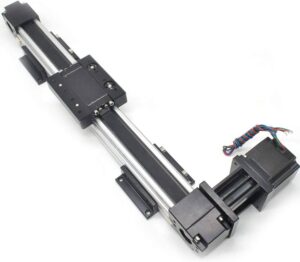
4. Modular Linear Track System
Pre-assembled and configurable
Easy installation and scalability
Compatible with motors and actuators
Typical Applications: Automated production lines, assembly systems
Materials and Surface Treatments
Linear track systems rely on advanced materials to ensure durability:
Hardened Carbon Steel: High strength and wear resistance
Stainless Steel: Corrosion resistance for harsh environments
Aluminum Alloy: Lightweight and cost-effective
Surface Treatments: Black oxide, chrome plating, or anodizing
Precision surface finishing enhances accuracy and service life.
Advantages of Linear Track Systems
Smooth and Accurate Motion
High Load Capacity
Low Friction and Energy Efficiency
Excellent Repeatability
Long Service Life
Flexible Design Options
These benefits make linear track systems essential in precision engineering.
Applications of Linear Track Systems
Linear track systems are used in numerous industries:
CNC Machine Tools: Axis guidance and worktable movement
Industrial Automation: Conveyors, pick-and-place units
Robotics: Linear actuators and motion modules
Packaging Equipment: High-speed processing lines
Medical Devices: Imaging and diagnostic systems
Semiconductor Manufacturing: Cleanroom positioning systems
Their adaptability allows integration into both light and heavy-duty applications.
Linear Track System vs Linear Guide Rail
| Feature | Linear Track System | Linear Guide Rail |
|---|---|---|
| Design | Track-based assembly | Profiled rail with bearing blocks |
| Precision | Medium to high | Very high |
| Load Capacity | Medium to high | High |
| Cost | Moderate | Higher |
| Installation | Flexible | Precision-dependent |
Both solutions are effective, but linear guide rails are often preferred for ultra-high precision tasks.
How to Choose the Right Linear Track System
1. Load and Moment Requirements
Evaluate static, dynamic, and moment loads.
2. Accuracy and Speed
High-speed systems benefit from ball-bearing designs.
3. Travel Length
Match track length to required motion stroke.
4. Operating Environment
Consider dust, moisture, temperature, and corrosion risks.
5. Installation Space
Ensure compatibility with available mounting surfaces.
Installation Best Practices
Prepare flat and rigid mounting surfaces
Align tracks carefully to prevent binding
Tighten mounting bolts evenly
Apply proper lubrication before use
Conduct low-speed test runs
Proper installation directly impacts system performance.
Maintenance and Service Life
Clean tracks regularly
Lubricate according to manufacturer guidelines
Inspect for wear, misalignment, or contamination
Replace seals or bearing elements as needed
Routine maintenance ensures consistent performance and longevity.
Frequently Asked Questions (FAQs)
1. What is a linear track system used for?
It is used to guide components in a straight line with controlled and precise motion.
2. Are linear track systems suitable for heavy loads?
Yes, roller-type systems are specifically designed for heavy-duty applications.
3. Do linear track systems require lubrication?
Most rolling systems require regular lubrication to maintain performance.
4. How long do linear track systems last?
With proper maintenance, they can operate reliably for many years.
5. Can linear track systems be customized?
Yes, many systems offer modular and customizable configurations.
Conclusion
A linear track system is a vital component in precision motion control, offering smooth operation, high load capacity, and long-term reliability. By understanding the different types, materials, and selection factors, engineers and manufacturers can choose the right system to meet their application requirements.
From CNC machining to automated production lines, linear track systems continue to support the evolution of modern industrial technology.