

In mechanical design and automation, creating a reliable linear motion system starts with one foundational element: the linear rail groove. Whether you’re designing a CNC machine, 3D printer, industrial robot, or high-precision positioning stage, the geometry, finish, and layout of the rail groove determine the system’s accuracy, smoothness, and durability.
In this comprehensive, SEO-optimized article, we’ll dive deep into what a linear rail groove is, how to design it correctly, key considerations for performance, and practical tips for integrating it into your motion systems.
What Is a Linear Rail Groove?
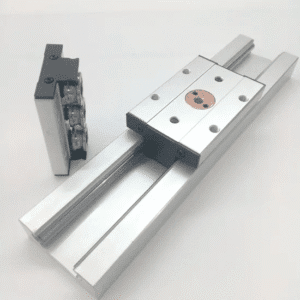
A linear rail groove is a precisely machined channel or recess cut into a base or mounting surface to accommodate a linear guide rail. The groove ensures proper alignment, retention, and load distribution for the bearing carriage as it travels along the rail.
Grooves can be:
- Open-channel – For bolt-down rails with external mounting.
- Enclosed or pocketed – For flush-mounting or aesthetic applications.
- Integrated into extruded profiles – In custom aluminum or steel framing.
The design of this groove is critical because it directly affects the stability, stiffness, and service life of the entire linear motion system.
Why Proper Groove Design Matters
- Alignment Accuracy – A well-designed groove positions the rail with minimal deviation, preventing binding or uneven wear.
- Load Distribution – Correct groove dimensions ensure the rail bears radial, axial, and moment loads effectively.
- Vibration Damping – A snug but not overly tight fit reduces resonance and noise during motion.
- Ease of Assembly – Properly sized grooves make rail installation straightforward, reducing production downtime.
- Long-Term Stability – Prevents rail shifting or loosening under dynamic loads.
Key Design Parameters for Linear Rail Grooves
1. Groove Width
- Should match the rail’s base width with a small clearance (typically 0.1–0.3 mm) to allow easy insertion but prevent lateral movement.
- Too wide → rail wobbles; too narrow → difficult assembly or rail distortion.
2. Groove Depth
- Must accommodate the rail’s height and allow for mounting bolts below or beside the rail.
- Deeper grooves provide more stability but require stronger base material.
3. Flatness and Straightness
- The groove’s bottom and sides must be machined to tight tolerances (±0.05 mm or better) to ensure the rail sits perfectly level.
- Use precision milling or grinding for high-accuracy systems.
4. Surface Finish
- A smooth finish (Ra ≤ 1.6 µm) reduces friction and wear on the rail’s contact surfaces.
- Avoid burrs or tool marks that could cause stress concentrations.
5. Mounting Hole Placement
- Bolt holes should align with the rail’s fixing points, with proper spacing to prevent warping.
- Include countersinks or counterbores for a clean, flat surface.
Materials and Base Considerations
- Base Material – Use rigid materials like cast iron, steel, or hard-anodized aluminum to resist deflection.
- Thermal Expansion – Account for temperature changes; use expansion slots or flexible mounting in long spans.
- Sealing – In dirty environments, add groove lips or gaskets to keep out dust and debris.
Design Process: Step-by-Step
- Define Load Requirements – Calculate static and dynamic loads, including moments.
- Select Rail Type – Choose ball, roller, or plain bearing guides based on load and precision needs.
- Model the Groove – Use CAD software to create a 3D model of the base with the rail groove.
- Simulate Fit and Stress – Perform FEA (finite element analysis) to check for deformation or stress concentrations.
- Prototype and Test – Build a prototype, measure actual clearances, and run motion tests.
- Refine Dimensions – Adjust groove size and surface finish based on test results.
Common Mistakes to Avoid
- Insufficient Clearance – Causes binding during thermal expansion or vibration.
- Poor Surface Finish – Leads to increased friction and premature wear.
- Inaccurate Alignment – Results in uneven load distribution and reduced accuracy.
- Weak Base Material – Allows flexing, leading to rail misalignment over time.
Applications of Precision Linear Rail Grooves
- CNC Machining Centers – For tool and table movement.
- 3D Printers – In X, Y, and Z axes for smooth filament deposition.
- Robotic Arms – In joint and end-effector linear stages.
- Semiconductor Equipment – For wafer handling and inspection stages.
- Medical Imaging – In patient table and gantry movement systems.
Conclusion
Designing a linear rail groove is a critical step in building high-performance motion systems. By carefully considering dimensions, tolerances, materials, and environmental factors, you can ensure your linear guides operate with precision, stability, and longevity.
Whether you’re an engineer, designer, or maker, mastering groove design will elevate the quality and reliability of your mechanical assemblies.