

Outline for Linear Guideway Rail
| Main Heading | Sub-Headings |
|---|---|
| Introduction to Linear Guideway Rail | What is a linear guideway rail? |
| The Importance of Linear Guideway Rail in Modern Engineering | Role in automation, robotics, and CNC machining |
| Key Components of a Linear Guideway Rail | Rails, blocks, rolling elements, seals |
| Working Principle of Linear Guideway Rail | How smooth linear motion is achieved |
| Different Types of Linear Guideway Rail | Ball-type, roller-type, miniature guideways |
| Linear Guideway Rail vs Traditional Slide Rails | Efficiency and accuracy comparison |
| Material Selection in Linear Guideway Rail Manufacturing | Stainless steel, carbon steel, alloys |
| Load Capacity and Rigidity of Linear Guideway Rail | Static and dynamic load considerations |
| Accuracy and Repeatability in Linear Guideway Rail Systems | High precision requirements |
| Applications of Linear Guideway Rail in CNC Machines | Milling, lathes, laser cutting |
| Role of Linear Guideway Rail in Robotics | Smooth arm movement and high positioning accuracy |
| Use of Linear Guideway Rail in Medical Equipment | Imaging systems, surgical devices |
| Benefits of Linear Guideway Rail in Packaging and Automation | Speed, efficiency, durability |
| Installation Guidelines for Linear Guideway Rail | Mounting, alignment, torque requirements |
| Lubrication and Maintenance of Linear Guideway Rail | Grease, oil, and self-lubrication systems |
| Common Challenges and Solutions in Linear Guideway Rail Systems | Misalignment, contamination, corrosion |
| Environmental Factors Affecting Linear Guideway Rail | Dust, temperature, humidity |
| Innovations in Linear Guideway Rail Technology | Coatings, smart sensors, noise reduction |
| Comparing Ball-Type and Roller-Type Linear Guideway Rail | Pros and cons |
| High-Speed Applications of Linear Guideway Rail | Electronics, automation, packaging |
| Sustainability in Linear Guideway Rail Production | Eco-friendly materials, recycling |
| Cost Considerations for Linear Guideway Rail | Upfront vs lifecycle costs |
| Choosing the Right Linear Guideway Rail for Your Needs | Key selection parameters |
| Future of Linear Guideway Rail Systems | AI-driven manufacturing, automation trends |
| Linear Guideway Rail | Summary of importance and versatility |
| Frequently Asked Questions | Six detailed FAQs |
| Conclusion | Final thoughts on linear guideway rail |
Introduction to Linear Guideway Rail
A linear guideway rail is one of the most crucial components in modern precision engineering. It enables smooth, accurate, and controlled linear motion in machines and automated systems. Unlike simple sliding mechanisms, linear guideways use rolling elements such as balls or rollers between the rail and the carriage. This drastically reduces friction while increasing rigidity and accuracy.
These systems are essential in CNC machining, robotics, medical devices, and packaging industries. Whether it’s a robotic arm assembling electronics or a CNC machine cutting titanium, linear guideway rails ensure precision at every step.
The Importance of Linear Guideway Rail in Modern Engineering
Modern industries demand higher accuracy, speed, and efficiency than ever before. This is where linear guideway rails shine. They:
Provide consistent, low-friction motion for precision tasks.
Enable high load capacity while maintaining rigidity.
Reduce energy consumption, making automation more sustainable.
Extend machine lifespan by minimizing wear and tear.
Without linear guideway rails, the performance of today’s CNC machines, industrial robots, and medical devices would be far less accurate and efficient.
Key Components of a Linear Guideway Rail
A linear guideway rail consists of several key parts:
Rail: The hardened track that guides the motion.
Block (carriage): Travels along the rail, carrying loads and ensuring smooth travel.
Rolling elements: Balls or rollers that reduce friction and distribute load.
End caps and seals: Prevent contamination and ensure even circulation of rolling elements.
Each component plays a role in precision and durability. Together, they form a system that delivers smooth and reliable linear motion.
Working Principle of Linear Guideway Rail
The working principle is straightforward yet powerful: rolling elements travel between the rail and the block, ensuring smooth and accurate motion. Instead of sliding friction, which causes wear, rolling friction ensures:
Higher efficiency
Reduced heat generation
Longer lifespan
Greater stability under load
This principle makes linear guideway rails far superior to traditional sliding rails in high-precision environments.
Different Types of Linear Guideway Rail
Linear guideway rails come in several types, each with unique benefits:
Ball-type linear guideways: Offer smooth motion and high speed. Best for light to medium loads.
Roller-type linear guideways: Provide higher rigidity and load capacity, suitable for heavy-duty applications.
Miniature guideways: Compact, precise, and ideal for electronics, optical equipment, and medical devices.
Selecting the right type depends on application needs—load, accuracy, space, and environmental conditions.
Linear Guideway Rail vs Traditional Slide Rails
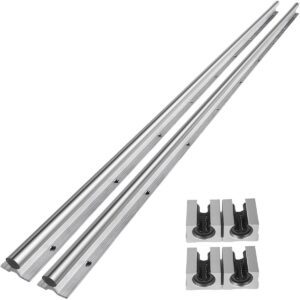
Traditional slide rails rely on sliding contact, which causes higher friction, wear, and reduced accuracy. In contrast, linear guideway rails use rolling contact, which:
Minimizes friction by up to 90%.
Increases efficiency and speed.
Provides higher rigidity for precision machining.
Extends lifespan due to reduced wear.
This makes linear guideways the standard in industries requiring high performance and precision.
Material Selection in Linear Guideway Rail Manufacturing
The materials used in a linear guideway rail are critical to its performance and durability. Engineers carefully select metals and coatings to withstand environmental stress, loads, and operational conditions.
Stainless Steel: Offers superior corrosion resistance, making it ideal for cleanrooms, medical devices, and environments with high humidity or chemical exposure.
Carbon Steel: Provides excellent hardness and strength, commonly used in CNC machines and industrial automation.
Special Alloys: Designed for extreme applications, such as aerospace, where temperature fluctuations and vibrations are significant.
In addition to base materials, surface treatments and coatings play an important role:
Chromium plating resists rust and wear.
Black oxide coatings provide anti-corrosion properties and reduce glare.
Titanium nitride coatings enhance surface hardness and wear resistance.
The choice depends on the intended application. For example, a CNC milling machine may prioritize rigidity and hardness, while a surgical robot requires corrosion resistance and hygiene.
Load Capacity and Rigidity of Linear Guideway Rail
A standout feature of linear guideway rails is their load-bearing capability. Unlike sliding systems, where the load rests on a small contact area, linear guideways distribute loads across multiple rolling elements.
Static load capacity: Maximum load the guide can support without permanent deformation.
Dynamic load capacity: The load the system can handle while moving continuously over its lifespan.
Additionally, linear guideways are designed to handle moment loads—forces that twist or bend the rail. This makes them ideal for machines that operate under complex, multi-directional forces.
Rigidity is another key advantage. High rigidity ensures:
Less deflection under heavy loads.
Higher precision during cutting, drilling, or machining.
Improved vibration control for smoother operation.
This is why industries like aerospace and automotive manufacturing rely heavily on roller-type linear guideways, which provide maximum stiffness.
Accuracy and Repeatability in Linear Guideway Rail Systems
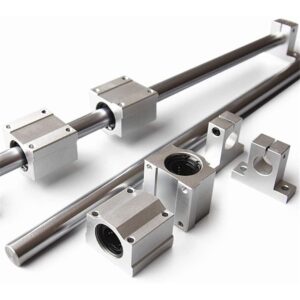
For industries like semiconductor manufacturing or high-precision medical imaging, accuracy is everything. Linear guideway rails are designed to deliver:
High positional accuracy: Ensuring exact placement and movement.
Repeatability: Achieving the same movement results every single time.
Reduced vibration: Smoother operation minimizes measurement and machining errors.
Thanks to rolling contact and tight manufacturing tolerances, linear guideways achieve micron-level accuracy. This means a machine tool can cut or measure with confidence, knowing the guideway rail will keep motion consistent throughout production.
Applications of Linear Guideway Rail in CNC Machines
CNC (Computer Numerical Control) machines depend on linear guideway rails for both speed and precision. They are used in:
Milling machines: To provide stable, accurate movement during high-speed cutting.
Lathes: Ensuring smooth sliding of tool carriages.
Laser cutting machines: For ultra-precise beam positioning.
3D printers and additive manufacturing: Offering stability for layer-by-layer precision.
In each of these machines, rigidity and load capacity directly impact output quality. Without linear guideways, CNC machines would lose the accuracy needed to produce reliable, repeatable parts.
Role of Linear Guideway Rail in Robotics
Robotics relies heavily on linear guideway rails for positioning and motion control. From industrial robots assembling cars to collaborative robots working in factories, precision is non-negotiable.
Robotic arms use guideways to move components with exact placement.
Gantry robots depend on long rails for smooth, consistent motion.
Pick-and-place robots require linear guideways for fast and accurate positioning.
Here, speed and precision go hand-in-hand. A poorly aligned or worn rail would lead to errors, which in robotics can cause costly downtime or defective products.
Use of Linear Guideway Rail in Medical Equipment
The medical field demands absolute precision and reliability. Linear guideway rails are widely used in:
Imaging systems (MRI, CT, and X-ray machines) where patient tables must move smoothly and accurately.
Surgical robots, which rely on linear guideways to control delicate instruments.
Diagnostic equipment, where smooth linear motion ensures sample integrity.
In medical applications, low noise, corrosion resistance, and compact design are critical. Stainless steel linear guideways with sealed carriages are most commonly used to meet hygiene and safety standards.
Benefits of Linear Guideway Rail in Packaging and Automation
Automation and packaging industries require speed, efficiency, and durability—three qualities that linear guideway rails provide.
High-speed packaging lines use linear guideways for rapid product movement.
Filling and labeling machines depend on smooth rails to ensure accuracy.
Automated inspection systems use linear rails for stable camera and sensor positioning.
The reduced friction not only improves efficiency but also lowers energy costs. In high-volume industries like packaging, this translates to significant long-term savings.
Installation Guidelines for Linear Guideway Rail
Proper installation is critical to performance and longevity. A poorly installed rail can lead to misalignment, wear, and premature failure.
Steps for correct installation:
Surface preparation: Ensure the mounting base is flat and clean.
Rail alignment: Rails must be parallel within micrometer tolerances.
Bolt tightening: Apply torque evenly to prevent distortion.
Carriage preload: Adjust preload for optimal stiffness without excessive friction.
Manufacturers often provide detailed manuals and installation kits. Following these precisely ensures maximum efficiency and extends the guide’s service life.
Lubrication and Maintenance of Linear Guideway Rail
Like any precision system, linear guideways need proper lubrication to reduce wear and friction.
Grease lubrication: Suitable for low to medium speeds.
Oil lubrication: Ideal for high-speed, continuous motion systems.
Self-lubricating units: Integrated reservoirs that automatically lubricate, reducing maintenance needs.
Routine maintenance includes:
Cleaning rails and carriages.
Inspecting seals for wear.
Checking for smooth, noise-free motion.
A well-maintained linear guideway rail can last for decades, making regular upkeep a wise investment.
Common Challenges and Solutions in Linear Guideway Rail Systems
Even though linear guideway rails are highly reliable, they can face challenges depending on the application and environment. Some common issues include:
Misalignment: Poor installation or uneven mounting surfaces cause uneven load distribution. This leads to higher wear and premature failure. Solution: Precision installation with alignment tools.
Contamination: Dust, dirt, and machining chips can get into the guideway, causing roller or ball damage. Solution: Protective seals, covers, or bellows.
Corrosion: In humid or chemical-heavy environments, unprotected steel can rust. Solution: Stainless steel or coated rails.
Lubrication failure: Inadequate lubrication leads to high friction and damage. Solution: Scheduled lubrication or self-lubricating units.
Proactive maintenance and correct installation practices resolve most of these challenges before they escalate into costly downtime.
Environmental Factors Affecting Linear Guideway Rail
A linear guideway rail doesn’t operate in isolation—its performance depends heavily on the surrounding environment.
Temperature extremes: Excessive heat degrades lubrication, while freezing conditions make metal brittle. Rails in aerospace or cryogenic applications must use special alloys.
Humidity and moisture: Causes rusting and corrosion. Stainless steel rails or coated surfaces are preferred.
Dust and debris: Common in woodworking and machining environments. Protective seals prevent contamination.
Chemicals and solvents: Found in pharmaceutical and food industries. Rails must be resistant to cleaning agents and disinfectants.
Selecting the correct material and protective design ensures that the guideway rail performs reliably in its specific environment.
Innovations in Linear Guideway Rail Technology
Linear guideway rails are evolving with modern engineering demands. Recent innovations include:
Advanced surface coatings: Diamond-like carbon (DLC) coatings improve wear resistance.
Smart monitoring systems: Sensors embedded in guideways monitor vibration, load, and lubrication in real time.
Noise reduction technology: Special ball retainers and cage designs reduce vibration and acoustic output.
Lightweight materials: Composite carriages reduce inertia in high-speed robotics.
Self-lubricating blocks: Extend service life and minimize downtime.
These innovations not only improve efficiency but also align with Industry 4.0, where predictive maintenance and smart monitoring are becoming standard.
Comparing Ball-Type and Roller-Type Linear Guideway Rail
Both ball-type and roller-type linear guideway rails are popular, but they serve different needs.
Ball-Type Guideways:
Smooth and quiet operation.
High speed, but lower rigidity.
Best for applications like 3D printers, electronics assembly, and light automation.
Roller-Type Guideways:
Higher rigidity and load capacity due to line contact.
Better suited for heavy-duty CNC machines and aerospace.
Slightly noisier than ball-type but more durable.
Choosing between them depends on whether the priority is speed and smoothness or rigidity and load capacity.
High-Speed Applications of Linear Guideway Rail
In industries where every millisecond counts, linear guideway rails provide the stability needed for speed.
Electronics manufacturing: Circuit boards and microchips require fast but accurate positioning.
High-speed packaging: Rails ensure precise and rapid movement of products.
Automated inspection: Cameras move quickly across items without vibration.
Key advantages in high-speed applications:
Low vibration and noise.
Stable movement with minimal deflection.
Lubrication systems that handle heat effectively.
Thus, linear guideway rails are the backbone of high-throughput industries.
Sustainability in Linear Guideway Rail Production
As industries embrace green manufacturing, linear guideway rail production is also evolving.
Eco-friendly materials: Manufacturers are adopting recyclable steels and environmentally safe coatings.
Energy efficiency: Rails with low friction reduce machine power consumption.
Extended product lifespan: Long-lasting rails reduce waste and replacement frequency.
Recycling programs: Old rails can be reconditioned or recycled, reducing industrial waste.
Sustainability not only helps the environment but also lowers operating costs over time.
Cost Considerations for Linear Guideway Rail
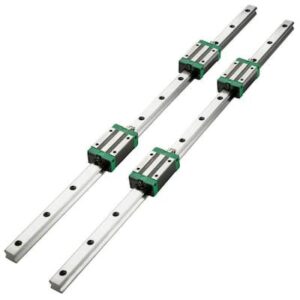
The cost of a linear guideway rail system includes much more than the purchase price.
Initial investment: Roller-type rails are costlier than ball-type due to higher load capacity.
Operating costs: Efficient, low-friction systems reduce energy consumption.
Maintenance costs: Self-lubricating systems save money on upkeep.
Lifecycle cost: A high-quality rail may cost more upfront but lasts longer, reducing long-term expenses.
Ultimately, total cost of ownership matters more than the initial price tag.
Choosing the Right Linear Guideway Rail for Your Needs
Selecting the right linear guideway rail depends on several factors:
Load requirements – Will the rail handle light or heavy loads?
Precision levels – Is micron-level accuracy needed?
Environment – Will it face dust, moisture, or chemicals?
Speed – Is the application high-speed or low-speed?
Budget – Is the goal to minimize upfront cost or maximize long-term value?
Consulting with experts and analyzing application conditions ensures you pick the right system.
Future of Linear Guideway Rail Systems
The future of linear guideway rails is tied to automation and digital transformation. We can expect:
AI-powered predictive maintenance, where sensors detect wear before failures occur.
Hybrid systems combining rolling and magnetic technology.
Ultra-lightweight composite rails for faster robotics.
Integration into smart factories where guideways communicate with other machines.
This evolution will make guideway rails more efficient, durable, and adaptive to next-generation manufacturing.
Linear Guideway Rail
In essence, the linear guideway rail is the backbone of precision engineering. Its ability to combine rigidity, accuracy, and durability makes it indispensable in CNC machining, robotics, medical equipment, aerospace, and automation. Without it, modern manufacturing would lose the efficiency and precision we often take for granted.