

Introduction
In today’s industrial and automated environments, precision linear movement is no longer optional—it is essential. From CNC machining centers and robotics to semiconductor equipment and automated assembly lines, linear motion guide rails form the backbone of accurate, repeatable, and smooth motion.
Linear motion guide rails are designed to guide moving components along a straight path with minimal friction, high rigidity, and excellent load-carrying capability. When properly selected and maintained, they significantly improve machine accuracy, productivity, and service life.
This article provides a comprehensive overview of linear motion guide rails, including their working principles, types, materials, advantages, applications, selection criteria, and maintenance best practices.
What Are Linear Motion Guide Rails?
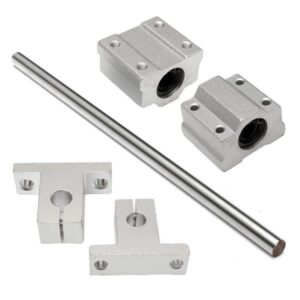
Linear motion guide rails are precision-engineered mechanical components that allow a moving element—such as a carriage or bearing block—to travel in a straight line with controlled motion. They work together with linear guide blocks or carriages, forming a complete linear guidance system.
Key Components of a Linear Motion Guide Rail System
Guide Rail: A hardened, precision-machined track mounted to a machine frame
Guide Block / Carriage: The moving element that slides along the rail
Rolling Elements: Steel balls or rollers that reduce friction
Raceways: Precisely ground surfaces on the rail and block
Seals & Lubrication Ports: Protect against contamination and reduce wear
This system enables high-precision linear motion with low resistance, even under heavy loads.
How Linear Motion Guide Rails Work
Linear motion guide rails operate using rolling contact instead of sliding contact, which drastically reduces friction.
The rail is rigidly mounted to the machine base
The guide block is installed onto the rail
Rolling elements circulate between the rail and block raceways
Loads are distributed across multiple contact points
Motion remains smooth, accurate, and stable
Because rolling friction is far lower than sliding friction, these systems offer higher efficiency, longer lifespan, and better positional accuracy.
Types of Linear Motion Guide Rails
1. Ball-Type Linear Motion Guide Rails
Use recirculating steel balls
Low friction and smooth movement
Suitable for high-speed and high-precision applications
Common Uses: CNC machines, robotics, automation systems
2. Roller-Type Linear Motion Guide Rails
Use cylindrical rollers instead of balls
Higher load capacity and rigidity
Better resistance to shock and vibration
Common Uses: Heavy-duty CNC equipment, gantry systems, industrial machinery
3. Miniature Linear Motion Guide Rails
Compact and lightweight
Designed for limited installation space
High precision with lower load capacity
Common Uses: 3D printers, medical devices, optical instruments
4. Wide or Heavy-Duty Linear Motion Guide Rails
Wider rail profile for enhanced stability
Supports large moment and multi-directional loads
Designed for continuous industrial operation
Common Uses: Machining centers, automated production lines
Materials Used in Linear Motion Guide Rails
Material quality is critical for performance and durability:
Hardened Carbon Steel: High strength and wear resistance
Stainless Steel: Corrosion resistance for humid, clean-room, or food-grade environments
Alloy Steel with Surface Coatings: Enhanced durability and reduced friction
Special Heat Treatments: Improve hardness and fatigue life
High-quality rails undergo precision grinding and strict quality control to ensure accuracy.
Advantages of Linear Motion Guide Rails
High Precision & Repeatability – Ideal for CNC and robotics
Low Friction – Smooth motion with minimal energy loss
High Load Capacity – Supports radial, axial, and moment loads
Excellent Rigidity – Maintains alignment under dynamic forces
Long Service Life – Rolling contact minimizes wear
Compact Design – High performance in limited space
These advantages make linear motion guide rails superior to traditional sliding mechanisms.
Applications of Linear Motion Guide Rails
Linear motion guide rails are used across many industries:
CNC Machines: Milling, turning, engraving, and cutting
Industrial Automation: Assembly lines, conveyors, pick-and-place systems
Robotics: Linear axes, gantry robots, positioning systems
Semiconductor Manufacturing: Wafer handling and inspection
Medical Equipment: Imaging systems and lab automation
Packaging Machinery: High-speed, high-accuracy packaging lines
Wherever precision linear movement is required, guide rails are essential.
Linear Motion Guide Rails vs Traditional Slide Rails
| Feature | Linear Motion Guide Rails | Traditional Slide Rails |
|---|---|---|
| Friction | Very low | Higher |
| Precision | High | Moderate |
| Load Capacity | Medium to high | Low to medium |
| Speed | High | Limited |
| Wear | Minimal | Higher |
| Maintenance | Moderate | Frequent |
Linear motion guide rails provide better performance, accuracy, and durability, especially in industrial environments.
How to Choose the Right Linear Motion Guide Rails
1. Load Requirements
Consider static, dynamic, and moment loads
2. Accuracy Level
CNC and robotics require high positioning accuracy
3. Speed & Acceleration
High-speed systems benefit from ball-type rails
4. Environmental Conditions
Dust, moisture, or chemicals may require sealed or stainless rails
5. Rail Size & Mounting Space
Ensure compatibility with machine design
6. Maintenance & Lubrication
Choose rails with accessible lubrication ports
Selecting the right guide rail ensures reliable performance and long-term stability.
Maintenance Tips for Linear Motion Guide Rails
Clean rails regularly to remove debris and contaminants
Lubricate properly using recommended grease or oil
Inspect rails and blocks for wear or damage
Ensure proper alignment during installation
Avoid overloading beyond rated specifications
Good maintenance practices significantly extend rail lifespan and motion accuracy.
Frequently Asked Questions (FAQs)
1. What are linear motion guide rails used for?
They guide moving components along a straight path with high precision and low friction.
2. Are linear motion guide rails suitable for heavy loads?
Yes. Roller-type and wide rails are designed for heavy-duty applications.
3. Do linear motion guide rails require lubrication?
Yes. Proper lubrication reduces wear and ensures smooth operation.
4. What is the difference between ball and roller guide rails?
Ball rails offer smoother motion and higher speed, while roller rails provide higher load capacity and rigidity.
5. Can linear motion guide rails be used in CNC machines?
Absolutely. They are a core component of modern CNC equipment.
Conclusion
Linear motion guide rails are essential components in precision machinery, automation systems, and CNC equipment. Their ability to provide smooth, accurate, and durable linear motion makes them indispensable in modern industrial applications.
By understanding the different types, materials, and selection criteria, engineers and manufacturers can choose guide rails that deliver long-term reliability, efficiency, and precision in demanding environments.