

Introduction
As manufacturing and automation technologies advance, the demand for accurate, smooth, and reliable linear motion continues to grow. From CNC machines and robotic systems to medical equipment and automated production lines, the linear motion rail guide has become a core mechanical component.
A linear motion rail guide provides controlled straight-line movement, supporting loads while minimizing friction and maintaining alignment. Choosing the right rail guide is critical for achieving high precision, long service life, and stable performance in modern machinery.
This article offers a comprehensive look at linear motion rail guides, including their working principles, types, advantages, applications, and selection guidelines.
What Is a Linear Motion Rail Guide?
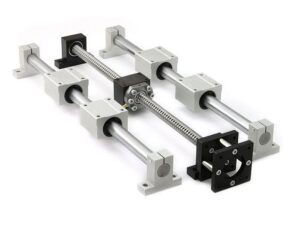
A linear motion rail guide is a precision-engineered system that enables a moving element—usually a carriage or bearing block—to travel along a hardened guide rail with minimal friction. It typically consists of:
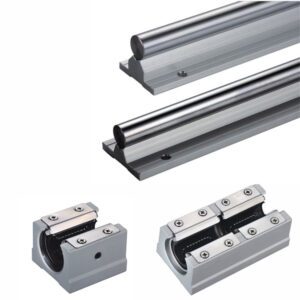
Guide Rail: A precision-ground steel rail mounted to the machine frame
Guide Block (Carriage): The moving component that rides on the rail
Rolling Elements: Balls or rollers that reduce friction and carry loads
Raceways: Contact surfaces inside the rail and block
Seals and Wipers: Prevent contamination from dust and debris
Together, these components form a linear guidance system designed for accuracy and durability.
How Linear Motion Rail Guides Work
Linear motion rail guides operate on the principle of rolling contact:
The guide rail is securely mounted and aligned
The guide block is installed onto the rail
Rolling elements circulate between raceways
Loads are distributed evenly across multiple contact points
Motion remains smooth, stable, and precise
This rolling mechanism significantly reduces friction compared to sliding systems, resulting in higher efficiency and longer service life.
Types of Linear Motion Rail Guides
1. Ball-Type Linear Motion Rail Guide
Uses recirculating steel balls
Low friction and smooth movement
Suitable for high-speed and high-precision applications
Applications: CNC machines, automation systems, robotics
2. Roller-Type Linear Motion Rail Guide
Uses cylindrical rollers instead of balls
Higher load capacity and rigidity
Excellent resistance to shock and vibration
Applications: Heavy-duty CNC equipment, gantry systems, industrial machinery
3. Miniature Linear Motion Rail Guide
Compact and lightweight
Designed for limited installation space
High precision for small-scale applications
Applications: 3D printers, laboratory equipment, medical devices
4. Heavy-Duty Linear Motion Rail Guide
Wider rail profile for enhanced stability
Designed to handle large moment loads
Suitable for continuous industrial operation
Applications: Machining centers, automated production lines
Materials Used in Linear Motion Rail Guides
Material quality plays a major role in performance and durability:
Hardened Carbon Steel: High strength and wear resistance
Stainless Steel: Corrosion-resistant for harsh or humid environments
Alloy Steel with Surface Coatings: Improved wear resistance and reduced friction
Advanced Heat Treatment: Enhances hardness and fatigue life
Precision grinding and strict quality control ensure high accuracy and consistency.
Advantages of Linear Motion Rail Guides
High Precision and Repeatability
Low Friction for Smooth Movement
High Load Capacity (Radial, Axial, and Moment Loads)
Excellent Rigidity and Stability
Long Service Life
Compact and Space-Efficient Design
These advantages make linear motion rail guides essential in modern industrial machinery.
Applications of Linear Motion Rail Guides
Linear motion rail guides are used across a wide range of industries:
CNC Machines: Milling, turning, cutting, engraving
Industrial Automation: Assembly lines, conveyors, pick-and-place systems
Robotics: Linear axes, gantry robots
Semiconductor Manufacturing: Wafer handling systems
Medical Equipment: Imaging and laboratory automation
Packaging Machinery: High-speed, high-accuracy operations
Where precise linear motion is required, rail guides are a proven solution.
Linear Motion Rail Guides vs Traditional Slide Systems
| Feature | Linear Motion Rail Guide | Traditional Slide Rail |
|---|---|---|
| Friction | Very low | Higher |
| Precision | High | Moderate |
| Load Capacity | Medium to high | Low to medium |
| Speed | High | Limited |
| Wear | Minimal | Higher |
| Maintenance | Moderate | Frequent |
Linear motion rail guides outperform traditional slides in precision, efficiency, and lifespan.
How to Choose the Right Linear Motion Rail Guide
1. Load Requirements
Static and dynamic loads
Moment loads (pitch, yaw, roll)
2. Precision Needs
CNC and robotics require tight tolerances
3. Speed and Acceleration
High-speed applications favor ball-type guides
4. Environmental Conditions
Dust, moisture, or chemicals may require sealed or stainless rails
5. Installation Space
Rail size, length, and mounting options
6. Maintenance and Lubrication
Accessibility and lubrication intervals
Choosing the right guide ensures optimal performance and long-term reliability.
Maintenance Tips for Linear Motion Rail Guides
Clean rails and blocks regularly
Lubricate according to manufacturer recommendations
Inspect seals and raceways
Check alignment periodically
Avoid overloading and shock loads
Proper maintenance significantly extends service life and maintains precision.
Frequently Asked Questions (FAQs)
1. What is a linear motion rail guide used for?
It guides moving components in a straight line with high precision and low friction.
2. Are linear motion rail guides suitable for heavy loads?
Yes. Roller-type and heavy-duty guides are designed for high-load applications.
3. Do linear motion rail guides require lubrication?
Yes. Regular lubrication is essential for smooth operation and durability.
4. What is the difference between ball and roller rail guides?
Ball guides offer smoother motion and higher speed, while roller guides provide higher load capacity and rigidity.
5. Can linear motion rail guides be used in CNC machines?
Absolutely. They are a key component of modern CNC and automation equipment.
Conclusion
Linear motion rail guides are essential for achieving precise, smooth, and reliable linear movement in modern machinery. Their low friction, high rigidity, and versatility make them indispensable in CNC machining, automation, robotics, and many other industries.
By understanding the types, materials, and selection criteria, engineers and manufacturers can choose linear motion rail guides that deliver consistent accuracy, efficiency, and long-term performance.