

Introduction: Embracing Friction for Simple Motion
In the world of linear motion systems, not every application demands the high speed, ultra-precision, or immense load capacity of recirculating ball or roller guides. For countless scenarios where cost, simplicity, environmental resilience, or compactness are paramount, the linear sliding bearing—often called a plain bearing, bushing, or slide bearing—stands as an indispensable solution. Operating on the ancient yet effective principle of sliding friction, these bearings represent a distinct and vital branch of linear motion technology. This article delves into the design principles, material science, types, and diverse applications of linear sliding bearings, highlighting their unique role in engineering design.
1. Fundamental Operating Principle: Sliding Versus Rolling
The core distinction between sliding and rolling-element (ball/roller) bearings lies in their motion mechanism:
- Rolling-Element Bearings: Use recirculating balls or rollers to create rolling friction between moving parts. This minimizes kinetic friction, enabling high speeds, high precision, and low heat generation, but at a cost of higher complexity, sensitivity to contamination, and typically higher price.
- Linear Sliding Bearings: Rely on direct sliding contact between two surfaces, a shaft (or rail) and a bushing. The goal is not to eliminate friction, but to manage and optimize it using specialized materials and lubrication. The result is a system characterized by simplicity, high load capacity in a small footprint, inherent damping, and excellent resistance to shock, vibration, and contamination.
2. Key Characteristics and Design Trade-offs
Linear sliding bearings offer a unique set of advantages and considerations:
Advantages:
- Simplicity & Compactness: No rolling elements or complex recirculation paths. Often a single, compact component.
- High Load Capacity: The entire contact area supports the load (conformal contact), unlike the point/line contact of ball bearings. Ideal for high static and dynamic loads in a small space.
- Damping & Smoothness: The sliding interface inherently dampens vibrations and provides exceptionally smooth, silent, and chatter-free motion, crucial for sensitive instrumentation and machine tools.
- Contamination Resistance: Many types have excellent tolerance to dust, grit, and moisture, especially self-lubricating variants. They can even run dry.
- Cost-Effectiveness: Generally lower manufacturing cost than precision rolling element guides.
- Maintenance: Many are maintenance-free (self-lubricating), while others require simple periodic lubrication.
Considerations:
- Friction & Stick-Slip: Static friction (stiction) is higher than kinetic friction, which can cause stick-slip motion—a jerky start-stop movement at very low speeds. Material selection and lubrication are critical to mitigate this.
- Speed & Heat: Higher friction limits maximum continuous speed due to heat generation from sliding contact.
- Wear: The sliding interface is subject to wear, though advanced materials make this predictable and manageable.
- Accuracy & Play: Generally offers less positional accuracy and repeatability than preloaded rolling element systems, though precision-grade sliding bearings exist.
3. Core Material Technology: The Bearing Liner
The performance of a sliding bearing is almost entirely dictated by the material of its inner liner or sliding surface. These materials fall into three main categories:
A. Metallic Liners
- Bronze Alloys (Sintered/Bound): The most common. Often sintered (powdered metal) to create a porous structure that can be impregnated with lubricant (oil or graphite). Offers good load capacity, thermal conductivity, and wear resistance.
- Babbitt (White Metal): A soft tin- or lead-based alloy with excellent conformability and embeddability (traps contaminants). Used in heavy, slow-moving machinery.
B. Polymer & Composite Liners (Most Common for Linear Guides)
- PTFE (Teflon®) Based Composites: The industry standard. PTFE provides an extremely low coefficient of friction. It is typically combined with:
- Reinforcements: Fiberglass, carbon, or bronze powder for strength, wear resistance, and thermal conductivity.
- Fillers: Molybdenum disulfide (MoS2) or graphite for solid lubrication.
- Thermoplastics (POM/Acetal, Nylon/Polyamide): Offer good wear resistance, low moisture absorption, and are cost-effective for lighter loads.
- Thermosets (Phenolic, Epoxy): Often fabric-reinforced, providing high strength and temperature resistance.
- Polyimide (Vespel®): Exceptional high-temperature performance and wear resistance.
C. Ceramic and Carbon-Graphite Liners
- Used in extreme environments: high temperatures, corrosive chemicals, or where lubrication is impossible (e.g., food processing, cleanrooms).
4. Major Types of Linear Sliding Bearings
4.1. Shaft Bushings (Round Linear Bearings)
- Description: A cylindrical bushing that slides directly on a precision ground or hardened steel round shaft.
- Variants:
- Standard Polymer Bushings: A metal housing with a polymer composite liner. Simple, cheap, and effective.
- Sleeve Bearings: Simplest form—a cylinder of bearing material (e.g., Oilite bronze, plastic).
- Composite Guide Bushings: Often have a split design or adjustment feature to take up wear and eliminate play.
- Applications: Packaging machinery, agricultural equipment, light-duty automation, furniture drawers, 3D printer axes.
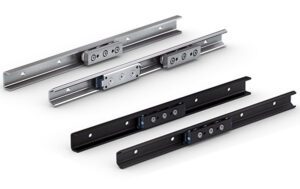
4.2. Linear Guideway Bearings (Profile Rail Types)
- Description: A carriage block that slides on a profiled rectangular rail, analogous to a ball-type linear guide but using sliding pads instead of balls.
- Design: The block contains multiple adjustable, replaceable sliding pads made of polymer composite. These pads preload against all raceway surfaces of the rail, providing high rigidity and moment load capacity.
- Advantages: Excellent vibration damping, high load/rigidity, contamination resistance, and often maintenance-free operation.
- Applications: Machine tools (especially for vibration-sensitive grinding or finishing), semiconductor handling, medical imaging tables, high-load positioning stages.
4.3. Dovetail and Boxway Slides
- Description: Traditional, heavy-duty sliding systems integral to the machine structure. The sliding surfaces are large, flat metal ways (often cast iron) in direct contact.
- Operation: Typically use a scraping fit for ultra-high precision or employ a low-friction material (like Turcite® or Rulon®) laminated onto one surface. Require forced lubrication.
- Characteristics: Supreme rigidity, damping, and load capacity. Complex to manufacture and adjust.
- Applications: The foundation of classic heavy machine tools (milling machines, lathes), where absolute rigidity and vibration absorption are critical for surface finish.
4.4. Linear Plain Bearings for Rods and Tubes
- Simple bushings used for guiding actuating cylinders, support rods, and in hydraulic/pneumatic systems.
5. Critical Application Areas
Linear sliding bearings are the preferred choice when the design priorities align with their strengths:
- Heavy/Load & Low Speed: Presses, lifts, agricultural and construction equipment.
- Precision with Damping: High-end machine tool slides (boxways), optical positioning stages, coordinate measuring machine (CMM) arms.
- Harsh Environments: Food & beverage (washdown), packaging (dust, paper fibers), chemical processing, outdoor applications.
- Clean & Quiet Operation: Medical devices, laboratory automation, office equipment, studio machinery.
- Cost-Sensitive & Simple Designs: Consumer products, light industrial automation, furniture, appliances.
6. Selection, Installation, and Maintenance
Selection Factors: The “PV Limit” (Pressure x Velocity) is a key rating for polymer bearings, defining the safe operating window. Engineers must also consider load (radial, moment), speed, temperature, environment, required precision, and lubrication plan.
Installation: Generally simpler than rolling guides. Key requirements are proper alignment and ensuring the shaft or rail has appropriate surface hardness and finish. Avoid mounting on soft or corroded surfaces.
Maintenance:
- Self-Lubricating Bearings: Designed to run dry or with initial lubrication. Often maintenance-free.
- Lubricated Bearings: Require a consistent lubrication schedule. Over-lubrication can attract contaminants in dirty environments.
- Wear Adjustment: Many sliding guide systems feature adjustable pads or gibs to compensate for wear over time, restoring precision—a significant advantage over fixed preload ball systems.
Conclusion: The Intelligent Choice for Managed Motion
The linear sliding bearing is a testament to elegant engineering simplicity. It solves motion problems not by fighting friction with complex mechanisms, but by mastering it through advanced material science. In a world racing toward ever-higher speeds and nano-scale precision, the sliding bearing remains irreplaceable for applications demanding robustness, quietness, damping, and sheer load-bearing ability in a simple package. From the massive ways of a century-old lathe to the delicate slide in a DNA sequencer, linear sliding bearings provide a fundamentally reliable, cost-effective, and often superior solution. They remind us that in engineering, the most sophisticated solution is not always the best—the most appropriate one is.