

Precision and reliability define modern automation systems, and linear motion guideways form the foundation of that excellence. These mechanical components enable smooth, controlled, and repeatable movement across various industrial applications—from robotic arms to high-speed CNC machining. In the world of precision engineering, the role of linear motion guideways cannot be overstated.
Introduction to Linear Motion Guideways
Linear motion guideways are mechanical devices designed to support and guide moving parts in a straight line with minimal friction. Unlike conventional sliding mechanisms, these systems use rolling elements—such as balls or rollers—to achieve smooth, precise linear motion. They have revolutionized modern industry by delivering unparalleled accuracy and durability.
Developed to overcome the limitations of sliding friction, linear motion guideways provide rigidity, repeatability, and long-term stability. Today, they’re indispensable in manufacturing, robotics, and semiconductor industries.
What Are Linear Motion Guideways?
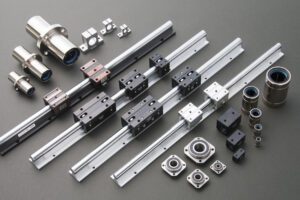
A linear motion guideway consists of a rail and a block (or carriage) containing rolling elements. These rolling elements—balls or rollers—run between the rail and block, allowing frictionless motion. The system ensures accurate linear movement under both light and heavy loads.
Engineers prefer guideways for their ability to maintain consistent accuracy across repetitive operations. Whether it’s an automated packaging line or a precision laser cutter, linear motion guideways ensure reliable performance.
Working Principle of Linear Motion Guideways
The operation of linear motion guideways relies on rolling contact between the carriage and rail. When the block moves, the rolling elements rotate, transferring the load while minimizing friction. This allows precise linear motion without stick-slip effects or deformation, even under high-speed conditions.
Advanced designs often include circulating rolling elements that continuously move through a return path inside the block, ensuring uniform motion throughout the stroke.
Key Components of Linear Motion Guideways
The primary components include:
Rail: The fixed track that guides motion.
Block/Carriage: The moving part that holds the rolling elements.
Rolling Elements: Balls or rollers that minimize friction.
End Caps: Prevent dirt and dust from entering.
Retainer or Cage: Keeps rolling elements evenly spaced.
Lubrication System: Ensures long-term smooth operation.

Types of Linear Motion Guideways
Linear motion guideways are classified based on their rolling elements and design configurations:
Linear Roller Guideways
Linear Ball Guideways
Cross Roller Guideways
Each type serves a distinct purpose depending on required precision, load capacity, and environmental conditions.
Linear Roller Guideways
Linear roller guideways use cylindrical rollers as rolling elements, providing line contact with the rail. This design ensures higher rigidity and load-bearing capacity compared to ball-type systems. They are ideal for heavy-duty applications like machining centers, presses, and industrial robots.
The line contact allows better distribution of stress, reducing wear and extending lifespan. Moreover, roller guideways maintain excellent precision even under fluctuating loads.
Linear Ball Guideways
These are the most common and cost-effective type of guideways. They utilize steel balls as rolling elements that make point contact with the rail, ensuring smooth and fast movement. Although they have lower load capacity compared to roller guideways, they are preferred in light to medium-load applications such as 3D printers and assembly machines.
Cross Roller Guideways
Cross roller guideways feature cylindrical rollers arranged alternately at 90° angles, allowing them to bear loads in all directions. They are primarily used in ultra-precision applications like optical equipment, measuring instruments, and medical scanners, where micro-level accuracy is critical.
Design and Structure of Linear Motion Guideways
The architecture of a linear motion guideway is engineered to ensure both high performance and longevity. The rails are precision-ground for straightness, while the blocks are hardened to withstand continuous use. Modern systems often include seals and covers to prevent contamination and enhance durability.
Materials and Coatings
The materials used significantly affect the guideway’s performance. Common materials include:
High-Carbon Steel: High load capacity and strength.
Stainless Steel: Corrosion-resistant for cleanroom or outdoor use.
Aluminum: Lightweight and suitable for portable devices.
Ceramic Coatings: Provide additional hardness and reduce friction.
Surface treatments such as nickel plating or black oxide coating further protect the guideway from rust and wear.
Advantages of Linear Motion Guideways
Linear motion guideways offer numerous advantages:
Exceptional Precision: Maintains tight tolerances.
Low Friction and Energy Efficiency: Reduces power consumption.
High Rigidity: Resists bending and deflection.
Long Service Life: Designed for millions of motion cycles.
Easy Maintenance: Simplified lubrication and inspection.
Applications of Linear Motion Guideways
These systems find use in a vast range of industries:
CNC milling and turning centers
Industrial robotics
Semiconductor fabrication
Laser cutting and engraving
Automated packaging systems
Medical diagnostic machines
In each of these fields, precision and repeatability are non-negotiable—and that’s exactly what guideways deliver.
Linear Motion Guideways in Robotics
Robotic systems rely on accuracy and smoothness. Linear motion guideways enable precise articulation of robotic arms and end effectors. By minimizing vibration and positional error, they allow robots to perform repetitive tasks with exact precision, crucial in industries like automotive assembly and electronics.
Use in CNC Machines
In CNC machining, linear motion guideways are indispensable. They ensure that cutting tools and worktables move accurately along defined paths. This precision translates into smoother surface finishes, consistent dimensional accuracy, and reduced tool wear—key factors in high-volume production.
Linear Motion Guideways in Semiconductor Manufacturing
The semiconductor industry demands nanometer-level precision. Cross roller guideways and advanced linear systems are essential for wafer handling, lithography, and inspection equipment. Their frictionless design ensures contamination-free, vibration-resistant operation.
Installation and Alignment
Proper installation is vital for optimal performance:
Ensure a clean and flat mounting surface.
Align both rails parallel using a dial gauge.
Use recommended torque values during assembly.
Apply consistent lubrication immediately after installation.
Incorrect alignment can cause premature wear, vibration, or even guideway failure.

Maintenance of Linear Motion Guideways
Regular maintenance extends service life:
Clean surfaces with lint-free cloths.
Lubricate using manufacturer-recommended grease or oil.
Inspect rolling elements for wear or corrosion.
Check preload to maintain consistent rigidity.
Preventive maintenance schedules save significant downtime in automated systems.
Troubleshooting Common Issues
| Problem | Possible Cause | Solution |
|---|---|---|
| Noise during operation | Lack of lubrication | Reapply grease or oil |
| Vibration or chatter | Misalignment | Reinstall and recheck alignment |
| Uneven motion | Contamination in rail | Clean and replace seals |
| Reduced precision | Worn elements | Replace rolling elements |
Linear Motion Guideways vs Linear Bearings
While both enable linear movement, guideways are designed for higher precision and load capacity.
| Aspect | Linear Guideways | Linear Bearings |
|---|---|---|
| Load Capacity | High | Moderate |
| Accuracy | Very High | Medium |
| Cost | Higher | Lower |
| Friction | Very Low | Low |
| Lifespan | Long | Shorter under heavy loads |
How to Choose the Right Guideway
Consider the following factors:
Load and Force Requirements
Operating Speed and Frequency
Environmental Conditions
Desired Precision
Budget Constraints
For instance, roller guideways suit high-load machines, while ball guideways fit lightweight automation systems.
Latest Innovations in Linear Motion Guideways
The future of linear motion systems is digital and intelligent. Key innovations include:
IoT-enabled smart sensors for real-time monitoring.
Self-lubricating materials that minimize maintenance.
Lightweight composite rails for high-speed automation.
AI-based predictive diagnostics for longer system uptime.
Sustainability and Green Engineering
Manufacturers now emphasize eco-friendly designs, using recyclable materials and energy-efficient coatings. Some linear guideways incorporate dry lubrication systems, eliminating the need for oil-based lubricants and reducing waste.
Cost and ROI Analysis
While linear motion guideways involve higher upfront costs, their benefits—improved precision, longer lifespan, and reduced maintenance—make them a profitable investment. In automated factories, their ROI becomes evident through improved throughput and reduced downtime.
Global Market Trends
The global linear motion systems market continues to grow, driven by automation and digital transformation. Key sectors such as automotive, semiconductor, and packaging lead the demand, especially in regions adopting Industry 4.0 principles.
Future of Linear Motion Guideways
The next generation of guideways will integrate smart feedback systems, allowing predictive maintenance and autonomous operation. With IoT, data analytics, and AI at the forefront, the humble guideway is transforming into an intelligent, connected component of the industrial ecosystem.
FAQs about Linear Motion Guideways
What are linear motion guideways used for?
They are used to achieve precise, smooth, and controlled linear motion in machinery like CNC machines, robots, and measuring devices.
Which is better: roller or ball guideways?
Roller guideways handle higher loads, while ball guideways offer smoother motion at lower costs.
How do I maintain linear motion guideways?
Regular cleaning, lubrication, and alignment checks are essential for maintaining accuracy and extending life.
Can linear motion guideways operate in harsh environments?
Yes, with proper sealing, stainless steel materials, and corrosion-resistant coatings.
What determines the lifespan of a guideway?
Proper lubrication, load capacity, alignment, and environmental conditions all affect lifespan.
Do linear motion guideways require calibration?
Yes, periodic calibration ensures continued precision in high-accuracy applications.
Conclusion
Linear motion guideways are the unsung champions of modern automation. Their ability to provide frictionless, precise, and reliable motion underpins industries from robotics to semiconductors. As technology advances, these guideways are evolving with smart sensors, better materials, and sustainable designs—ushering in a new era of intelligent, efficient linear motion systems.
Suggested Inbound Links:
Benefits of Roller Rails in Industrial Machinery
Guide to CNC Machine Maintenance
How Linear Bearings Work