

Linear motion is the heartbeat of automation. Whether in robotics, CNC machining, or high-speed assembly lines, precise linear movement defines success. Among the many components enabling this motion, linear slide rails stand out for their exceptional accuracy, rigidity, and reliability.
These mechanical systems ensure frictionless movement along a straight path, allowing machines to operate efficiently and consistently—even under extreme loads or high-speed conditions.
Introduction to Linear Slide Rails
A linear slide rail is a mechanical device designed to support and guide linear motion in machinery. It provides a stable and precise path for movement while minimizing friction and maintaining accuracy over time.
From industrial robots to surgical instruments, linear slide rails are integral to systems demanding repeatable, precise, and low-resistance linear travel. Their robustness and versatility make them indispensable in today’s world of automated precision.
What Are Linear Slide Rails?
Linear slide rails are guiding mechanisms composed of a rail and a moving block or carriage that glides smoothly along it. Inside the carriage, rolling elements—either balls or rollers—circulate continuously as the carriage moves. This rolling contact drastically reduces friction compared to traditional sliding mechanisms.
In simpler terms, a linear slide rail acts as the track and trolley system for machinery, ensuring controlled, accurate, and durable motion along a linear path.
Working Principle of Linear Slide Rails
The functioning of a linear slide rail depends on rolling contact between the rail and the carriage. As the carriage moves, the rolling elements circulate in a looped path, continuously rolling between the rail and block surfaces.
This recirculating motion ensures low friction, smooth travel, and consistent load distribution across the rail. The result is an extremely stable motion system capable of high speed and precision.
Preloading and lubrication systems are often added to enhance rigidity, reduce vibration, and maintain long-term stability.
Key Components of Linear Slide Rails
Each part of a linear slide rail plays a vital role in achieving motion precision.
Guide Rail: The hardened and ground steel base on which the carriage slides.
Carriage (Slider Block): The movable part that supports the load.
Rolling Elements: Balls or rollers that enable frictionless movement.
End Caps and Retainers: Direct the circulation path of rolling elements.
Seals: Protect against contamination from dust or debris.
Lubrication Ports: Allow easy maintenance and grease application.
A well-designed combination of these components ensures long life, accuracy, and durability under continuous use.
Design Structure of Linear Slide Rails
Linear slide rails are engineered for micron-level precision. The rail’s groove geometry matches the rolling elements’ shape, allowing even load distribution.
Their contact angle design determines load capacity and direction handling. For instance, a 45° contact angle allows the system to bear loads from all directions equally—a critical feature for multi-axis applications.
The rails and blocks undergo heat treatment for hardness and are finely ground for surface flatness, ensuring seamless motion and minimal vibration.
Types of Linear Slide Rails
There are three major types of linear slide rails, each catering to different load, speed, and accuracy requirements:
Ball-Type Linear Slide Rails
Roller-Type Linear Slide Rails
Cross Roller Linear Slide Rails
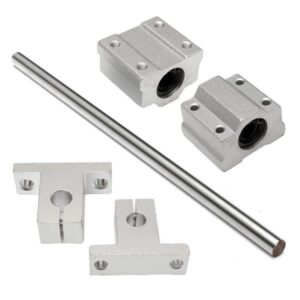
Ball-Type Linear Slide Rails
These systems use steel balls as rolling elements. The balls recirculate within the carriage as it slides, providing ultra-smooth and low-resistance motion.
Advantages:
High speed and low noise
Lightweight and compact
Cost-effective solution
Applications:
Used in electronics assembly lines, medical devices, and light-duty automation systems.
Roller-Type Linear Slide Rails
Instead of balls, cylindrical rollers are used, providing line contact with the rail surface. This design increases stiffness, load capacity, and precision, making it ideal for heavy-duty applications.
Advantages:
High rigidity and load-bearing capacity
Reduced deflection under heavy forces
Superior vibration control
Applications:
Commonly used in CNC machining, presses, and robotic arms.
Cross Roller Linear Slide Rails
This design alternates rollers at 90° orientations, forming an “X” pattern. Such configuration allows high precision and multi-directional load handling, making it perfect for compact precision instruments.
Applications:
Optical measuring devices, semiconductor manufacturing, and precision stages.
Materials Used in Linear Slide Rails
| Material | Features | Typical Application |
|---|---|---|
| High-Carbon Steel | High hardness and rigidity | Heavy industrial machinery |
| Stainless Steel | Corrosion-resistant | Medical and cleanroom equipment |
| Aluminum | Lightweight and rust-free | Small automation systems |
Material choice depends on operational environment, load, and motion requirements.
Surface Treatment and Coating
To improve lifespan and resistance, surface treatments are applied:
Nickel Plating: Enhances corrosion resistance.
Black Oxide Coating: Reduces reflection and mild rust protection.
Chrome Plating: Provides hard, smooth surfaces with minimal friction.
Advanced coatings can increase life expectancy by 30–50%, especially in harsh environments.
Installation of Linear Slide Rails
Proper installation ensures performance and longevity:
Clean the mounting base thoroughly.
Align rails accurately using precision alignment tools.
Tighten bolts uniformly to the specified torque.
Apply initial lubrication through the provided ports.
Move the block gently to confirm smooth travel.
Improper alignment can cause vibration, wear, or even premature failure.
Lubrication and Maintenance
Lubrication is vital for longevity and smooth performance.
Use lithium-based grease or specialized oils for precision systems.
Apply at intervals recommended by the manufacturer.
Keep the rails clean to prevent debris accumulation.
Replace seals periodically to maintain cleanliness.
Some systems come with self-lubricating cartridges, extending maintenance intervals up to 20,000 km of travel.
Advantages of Linear Slide Rails
Linear slide rails offer a variety of benefits:
High Precision: Maintains consistent accuracy even under variable loads.
Low Friction: Reduces power loss and heat generation.
Durability: Withstands millions of cycles with minimal wear.
Compactness: Allows for lightweight machine design.
Quiet Operation: Rolling contact ensures silent motion.
Low Maintenance: Long intervals between servicing.
Limitations and Challenges
While linear slide rails are highly efficient, they face challenges such as:
Sensitivity to dust or contamination
Limited tolerance for misalignment
Potential for corrosion without proper treatment
Initial setup cost higher than traditional slides
Proper sealing, cleaning, and environmental protection can mitigate these issues.
Linear Slide Rails in CNC Machines
CNC machines rely on linear slide rails for accurate positioning and repeatability. They ensure that the tool follows precise paths, producing perfect cuts and fine surface finishes.
The high rigidity of roller-type rails also helps absorb cutting forces, improving machining stability.
Linear Slide Rails in Robotics
In robotics, precision and stability are key. Linear slide rails allow controlled, repeatable motion with minimal backlash. Their low friction and rigidity enhance speed, positioning accuracy, and energy efficiency.
Robotic arms, pick-and-place systems, and automation gantries depend on these rails for smooth and reliable performance.
Applications in 3D Printing
Modern 3D printers use linear slide rails to achieve consistent layer alignment and high-quality prints. Their low-friction design ensures smooth nozzle movement and accurate positioning, vital for precision printing.
Use in Medical and Optical Equipment
In medical imaging and optical devices, cleanliness and precision are critical. Stainless steel linear slide rails provide silent operation, corrosion resistance, and vibration-free motion, ideal for delicate instruments.

Linear Slide Rails vs Linear Bearings
| Feature | Linear Slide Rails | Linear Bearings |
|---|---|---|
| Load Capacity | Higher | Moderate |
| Accuracy | Superior | Standard |
| Rigidity | Very High | Low |
| Speed | Moderate to High | Very High |
| Maintenance | Minimal | Moderate |
| Application | CNC, robotics | Light-duty machinery |
Linear slide rails provide greater accuracy and load handling, making them preferable for industrial automation.
How to Select the Right Linear Slide Rail
When choosing the right linear slide rail, consider:
Load requirements
Speed and acceleration
Environmental factors (temperature, humidity, dust)
Space constraints
Budget and maintenance needs
Always consult the manufacturer’s load ratings and life expectancy charts to match your system design.
Innovations in Linear Slide Rail Technology
Modern advancements include:
Sensor-integrated guide rails for monitoring temperature and wear.
Smart lubrication systems that release grease automatically.
Lightweight composite materials for improved energy efficiency.
AI-based predictive maintenance to reduce downtime.
These innovations are reshaping how industries approach motion design.
Common Problems and Troubleshooting
| Issue | Possible Cause | Solution |
|---|---|---|
| Noise or vibration | Misalignment | Reinstall and realign |
| Sticking movement | Lack of lubrication | Apply fresh grease |
| Irregular motion | Contamination | Clean and reseal |
| Decreased accuracy | Rolling element wear | Replace carriage or block |
Early detection prevents costly system failures.
Cleaning and Replacement Practices
To maintain optimal performance:
Use lint-free cloths for cleaning.
Avoid high-pressure air, which may push dirt into seals.
Replace blocks and seals if pitting or scratches are visible.
Inspect alignment regularly during scheduled maintenance.
Global Market Trends
The global linear slide rail market is growing rapidly, driven by robotics, semiconductor manufacturing, and electric vehicle assembly. Asia-Pacific dominates production, with Japan, Taiwan, and Germany leading innovation in linear motion technology.

Future of Linear Slide Rails
The next generation of linear slide rails will integrate IoT sensors, AI-driven diagnostics, and self-healing materials. With Industry 5.0 emphasizing human-machine collaboration, these rails will ensure smooth, safe, and intelligent motion across advanced automation systems.
FAQs about Linear Slide Rails
What are linear slide rails used for?
They guide and support precise linear motion in machinery, robotics, and automation systems.
Do linear slide rails require frequent lubrication?
No, modern rails have self-lubricating options that reduce maintenance needs.
Can they operate in cleanrooms?
Yes, stainless steel rails with sealed blocks are ideal for sterile environments.
How long do linear slide rails last?
With proper care, they can last several years or millions of motion cycles.
Are linear slide rails interchangeable?
Not always; compatibility depends on manufacturer specifications.
Which type is best for heavy loads?
Roller-type linear slide rails are best for high rigidity and load-bearing capacity.
Conclusion
The linear slide rail is the unsung hero of precision motion. From CNC machining to robotics, its ability to deliver consistent, low-friction, and highly accurate linear movement forms the backbone of modern automation.
With ongoing advancements in materials, coatings, and smart technology, linear slide rails will continue to play a pivotal role in shaping the future of efficient, reliable, and intelligent motion systems.
Suggested Inbound Links:
Linear Motion Guideways: Design and Benefits
Linear Guideway Blocks for Automation
Roller Rails and Their Applications