

Linear motion rails form the backbone of modern automation, enabling smooth, precise, and reliable movement along a straight path. From CNC machinery to robotics, packaging lines, and medical devices, these rails ensure that mechanical parts move with exceptional accuracy and stability.
In this article, we’ll explore linear motion rails in detail — covering their design principles, types, functions, installation methods, and industrial applications. Whether you’re an engineer, designer, or manufacturer, understanding linear motion rails is crucial for building efficient and durable motion systems.
Outline
| Section | Heading |
|---|---|
| Introduction | Understanding Linear Motion Rails |
| Concept | What Are Linear Motion Rails? |
| Design | Structure and Working Principle of Linear Motion Rails |
| Components | Key Components of Linear Motion Systems |
| Types | Types of Linear Motion Rails |
| Ball-Type | Ball-Based Linear Motion Rails |
| Roller-Type | Roller-Based Linear Motion Rails |
| Plain-Type | Plain Linear Rails for High-Load Applications |
| Materials | Materials and Surface Treatments |
| Installation | Installation and Alignment Guidelines |
| Lubrication | Importance of Lubrication and Maintenance |
| Load Capacity | Understanding Load Ratings and Durability |
| Precision | Accuracy and Repeatability of Linear Motion Rails |
| Friction | Reducing Friction for Enhanced Efficiency |
| Comparison | Linear Rails vs. Linear Shafts |
| Applications | Industrial Applications of Linear Motion Rails |
| Robotics | Use of Linear Motion Rails in Robotics |
| CNC Machines | Linear Motion Rails in CNC Machinery |
| Automation | Role in Industrial Automation |
| Medical Equipment | Linear Rails in Medical and Optical Systems |
| Selection | Choosing the Right Linear Motion Rails |
| Environment | Operating Conditions and Environmental Factors |
| Benefits | Advantages of Using Linear Motion Rails |
| Maintenance | Maintenance Tips and Common Issues |
| Future Trends | Smart Linear Rail Technology and Industry 4.0 |
| FAQs | Frequently Asked Questions |
| Conclusion | Future of Linear Motion Rails in Precision Manufacturing |
Understanding Linear Motion Rails
Linear motion rails are precision mechanical components that guide and support moving parts along a straight line with minimal friction. They serve as the backbone of many motion systems, ensuring accurate, smooth, and repeatable linear movement.
The combination of rails and carriages (or sliders) enables linear travel while supporting loads in multiple directions. These systems are widely used in:
CNC machines
Industrial automation
Semiconductor manufacturing
Medical diagnostics
Robotics
What Are Linear Motion Rails?
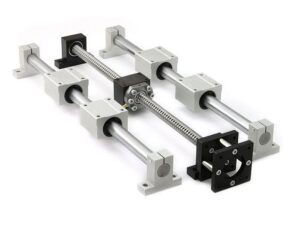
Linear motion rails, often referred to as linear guideways, consist of a stationary rail and a moving block or carriage equipped with recirculating ball bearings or rollers. The design allows for smooth, precise motion while supporting both static and dynamic loads.
Their main function is to:
Ensure precise movement
Reduce friction
Maintain high stiffness
Carry heavy loads
When integrated into mechanical systems, they enhance performance, reduce maintenance needs, and extend service life.

Structure and Working Principle of Linear Motion Rails
A linear motion rail system typically includes:
Guide Rail: A precision-ground steel rail that defines the path.
Carriage/Block: Houses rolling elements (balls or rollers).
Rolling Elements: Enable low-friction movement.
End Caps and Seals: Prevent contamination and retain lubrication.
Working Principle:
As the carriage moves along the rail, the rolling elements (balls or rollers) circulate in an endless loop, providing consistent contact and minimal friction between moving and stationary parts.
Key Components of Linear Motion Systems
Rails – Provide a track for linear travel.
Carriages (Sliders) – Move smoothly along the rails.
Rolling Elements – Minimize friction and wear.
End Caps and Scrapers – Prevent dust and debris ingress.
Lubrication Systems – Ensure consistent, smooth motion.
Types of Linear Motion Rails
Linear motion rails can be categorized based on their rolling mechanism and design structure:
Ball-Type Linear Motion Rails
These use recirculating steel balls between the rail and carriage. They offer:
High precision
Low friction
High-speed capability
Applications: CNC machining centers, 3D printers, robotics, and semiconductor equipment.
Roller-Type Linear Motion Rails
Instead of balls, these systems use cylindrical rollers, which increase contact area and stiffness.
Advantages:
High load-bearing capacity
Greater rigidity
Superior performance under vibration
Applications: Heavy-duty automation, presses, and injection molding machines.
Plain Linear Motion Rails
These rails use sliding contact surfaces rather than rolling elements, suitable for:
Dirty or corrosive environments
Low-speed, high-load applications
Advantages:
Resistant to dust and shock
Easy maintenance
Materials and Surface Treatments
Linear motion rails are typically made from:
High-carbon bearing steel (GCr15, SUJ2) for strength and hardness.
Stainless steel for corrosion resistance.
Aluminum alloy for lightweight, low-load systems.
Surface treatments like chrome plating, black oxide, or nickel coating enhance wear resistance and corrosion protection.
Installation and Alignment Guidelines
Proper installation is crucial for ensuring smooth motion and longevity:
Prepare the mounting surface – It must be flat, clean, and free of burrs.
Align the rail accurately – Use precision instruments to minimize misalignment.
Tighten evenly – Avoid introducing stress by tightening bolts progressively.
Test motion – Move the carriage manually to check for smoothness.
Lubrication and Maintenance
Lubrication reduces friction and prevents wear. Most manufacturers recommend:
Grease or oil application at regular intervals.
Automatic lubrication systems for continuous operation.
Always use manufacturer-approved lubricants to maintain performance and prevent contamination.
Understanding Load Ratings and Durability
Each linear rail has two primary ratings:
Static load rating – Maximum load the rail can bear without permanent deformation.
Dynamic load rating – Load the rail can handle during continuous operation.
Selecting the correct rail based on load and moment requirements ensures optimal durability.
Precision and Repeatability
Linear motion rails deliver micron-level precision. High-end models achieve positional accuracies under ±0.002 mm.
Their stiffness and minimal deflection make them suitable for applications requiring tight tolerances.
Linear Rails vs. Linear Shafts
| Feature | Linear Motion Rails | Linear Shafts |
|---|---|---|
| Accuracy | Very High | Moderate |
| Load Capacity | High | Medium |
| Friction | Very Low | Moderate |
| Maintenance | Requires lubrication | Easier |
| Best Use | Precision machines | Light automation |

Applications of Linear Motion Rails
Linear motion rails are indispensable in:
CNC machines: Precision cutting and milling.
Robotics: Stable, repeatable positioning.
Packaging systems: Fast linear movements.
Medical devices: Imaging and diagnostic tools.
Automated warehouses: Guided motion platforms.
Choosing the Right Linear Motion Rails
When selecting rails, consider:
Load capacity
Travel length
Accuracy requirements
Operating environment
Maintenance frequency
Always match the rail type to the system’s load and precision needs.
Maintenance Tips and Common Issues
Maintenance Best Practices:
Keep rails clean and lubricated.
Avoid contamination by using seals or covers.
Replace damaged bearings promptly.
Check preload regularly to maintain stiffness.
Common Issues:
Misalignment causing uneven wear.
Insufficient lubrication leading to noise and vibration.
Contamination causing motion roughness.
Advantages of Linear Motion Rails
Exceptional accuracy and stability
Low friction and noise
High rigidity and load-bearing capacity
Long lifespan with proper care
Compact design ideal for automation
Smart Linear Rail Technology and Industry 4.0
The future of linear motion technology lies in smart mechatronic systems.
Modern rails now integrate:
Built-in sensors for load and position feedback
IoT connectivity for predictive maintenance
Self-lubrication systems for extended service life
These innovations make linear motion systems more efficient, sustainable, and reliable than ever.
Frequently Asked Questions
What are linear motion rails used for?
They guide mechanical movement with high precision in CNCs, robots, and automation systems.
How long do linear motion rails last?
With proper maintenance, they can last tens of thousands of operational hours.
Can linear motion rails be reused?
Yes, if inspected for wear and properly cleaned before reinstallation.
Are linear motion rails noisy?
No, they operate quietly when properly lubricated and aligned.
How do I select the right rail type?
Base your choice on load, precision, and environmental conditions.
Can I use linear rails in corrosive environments?
Yes, stainless-steel rails or coated variants are ideal for such environments.
Conclusion
Linear motion rails are indispensable in precision engineering, ensuring smooth, controlled, and accurate linear movement across a vast range of industries. Their combination of rigidity, precision, and efficiency makes them the go-to choice for modern automation systems.
As technology advances, integrating smart sensors, predictive analytics, and self-lubricating features will push the boundaries of performance—making linear motion rails more efficient, intelligent, and durable than ever before.
Suggested Inbound Links:
Suggested Outbound Links: