

Outline
| Headings & Subheadings | LSI / Related Keywords |
|---|---|
| Introduction to CNC Linear Guide Rail | linear motion, machine precision |
| What Is a CNC Linear Guide Rail | guide rail, linear bearing system |
| Design and Structure of CNC Linear Guide Rail | rail, carriage, rolling elements |
| How CNC Linear Guide Rails Work | rolling contact, recirculating balls |
| Different Types of CNC Linear Guide Rails | profile rail, round rail, roller guide |
| Key Benefits of CNC Linear Guide Rail | stability, precision, low friction |
| CNC Linear Guide Rail vs. Linear Bearing | comparison, rigidity, load capacity |
| Materials and Coatings | hardened steel, stainless steel, aluminum |
| Applications in CNC Machinery | milling, engraving, turning, laser cutting |
| Installation and Setup Tips | alignment, preload, torque |
| Maintenance Practices | lubrication, inspection, cleaning |
| Common Problems and Solutions | noise, misalignment, wear |
| Choosing the Right CNC Linear Guide Rail | load, accuracy, environment |
| CNC Linear Guide Rails in Robotics and Automation | versatility, repeatability |
| Future Trends in CNC Linear Guide Rail Design | smart monitoring, IoT integration |
| Top Global Manufacturers | YH Linear, HIWIN, THK, Bosch Rexroth |
| FAQs | lifespan, lubrication, precision |
| Conclusion | performance, reliability, innovation |
Introduction to CNC Linear Guide Rail
In the world of modern machining, CNC linear guide rail systems stand as the silent force behind precision and stability. They form the backbone of every CNC machine, ensuring smooth, accurate, and repeatable linear movement across multiple axes.
These mechanical marvels guide motion with micrometer-level precision, reducing friction and vibration — the two biggest enemies of machining accuracy. Whether in a small desktop CNC engraver or a high-speed machining center, linear guide rails ensure that each movement is consistent, controlled, and reliable.
Brands like YH Linear, THK, and HIWIN have perfected the design of these rails, delivering the kind of performance that transforms digital design into flawless physical components.

What Is a CNC Linear Guide Rail
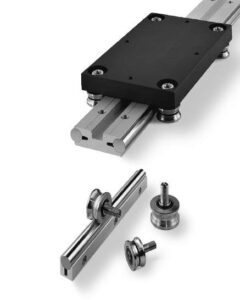
A CNC linear guide rail is a high-precision mechanical component that provides linear motion for machine elements such as spindles, tables, or gantries. It typically consists of two main parts: the guide rail and the bearing block (carriage).
Inside the carriage, steel balls or rollers circulate within hardened raceways on the rail. This rolling action replaces traditional sliding contact, drastically reducing friction and wear. The result? Consistent accuracy, smoother motion, and longer life even under heavy load conditions.
CNC linear guide rails are essential in milling, engraving, plasma cutting, and laser-cutting machines — where precision and durability cannot be compromised.
Design and Structure of CNC Linear Guide Rail
The robust design of a CNC linear guide rail ensures strength, precision, and longevity. Key structural elements include:
Guide Rail: The fixed track that defines the linear path.
Carriage / Bearing Block: The moving component that holds the rolling elements.
Rolling Elements: Steel balls or cylindrical rollers that reduce friction.
Seals and End Caps: Keep dust and chips out of the recirculating path.
Lubrication Ports: Allow easy application of grease or oil for smooth motion.
This design guarantees consistent accuracy and performance, even when operating continuously in high-speed or high-load environments.
How CNC Linear Guide Rails Work
The operating principle of a CNC linear guide rail lies in rolling contact motion. As the carriage moves, the rolling elements (balls or rollers) circulate within the raceways between the rail and carriage.
Because rolling friction is much lower than sliding friction, the system achieves:
Smoother motion at high speeds
Reduced heat generation
Longer component life
Higher positional accuracy
Recirculating ball designs allow the rolling elements to loop continuously, providing stable motion over the entire stroke length.
Different Types of CNC Linear Guide Rails
Profile Rail Guides: Rectangular cross-section rails offering superior stiffness and load-bearing capacity.
Round Shaft Rails: Lightweight and simple, suitable for light-load applications.
Roller Guide Rails: Utilize cylindrical rollers for greater rigidity and stability.
Miniature Guide Rails: Used in compact devices like desktop CNCs and 3D printers.
Wide-Type Rails: Designed for improved resistance to torsion and deflection.
Each type is optimized for specific operational environments, speeds, and precision demands.
Key Benefits of CNC Linear Guide Rail
Unmatched Precision: Maintains accurate movement even under heavy load.
Reduced Friction: Rolling elements minimize resistance and wear.
Improved Rigidity: Withstands vibration and torque effectively.
High Load Capacity: Supports both radial and axial loads with stability.
Long Lifespan: Hardened materials and lubrication systems extend usage life.
Energy Efficiency: Less friction means reduced power consumption.
Compact and Lightweight: Ideal for machines where space and efficiency matter.
The result is reliable, high-speed performance across demanding industrial applications.
CNC Linear Guide Rail vs. Linear Bearing
| Feature | CNC Linear Guide Rail | Linear Bearing |
|---|---|---|
| Motion Type | Rolling with recirculation | Sliding or non-recirculating |
| Precision | Micron-level | Millimeter-level |
| Load Capacity | High | Moderate |
| Rigidity | Excellent | Limited |
| Maintenance | Low | Moderate |
| Cost | Slightly higher | Lower |
| Ideal Use | CNC machines, robotics | Light automation, lab setups |
While both systems enable linear motion, CNC linear guide rails outperform traditional bearings in precision, durability, and load handling.

Materials and Coatings
The choice of material directly affects the performance and longevity of a CNC linear guide rail:
Hardened Steel: Standard choice for maximum strength and wear resistance.
Stainless Steel: Best for corrosion-prone environments or cleanrooms.
Aluminum: Lightweight option for low-load applications.
Ceramic Coated Rails: Reduce friction and enhance smoothness.
Composite or Polymer End Caps: Absorb shock and minimize noise.
These materials ensure durability even in extreme environments like high-humidity or high-vibration zones.
Applications in CNC Machinery
CNC linear guide rails are critical to precision in:
CNC Milling Machines: Maintain accuracy during high-speed cuts.
CNC Lathes: Enable smooth, accurate movement of the tool carriage.
CNC Routers: Provide stability for multi-axis operations.
CNC Plasma Cutters: Ensure smooth gantry motion.
Laser Engraving Machines: Offer precise, low-vibration movement.
Every high-quality CNC machine relies on the stability and consistency that only linear guide rails can provide.
Installation and Setup Tips
Installing CNC linear guide rails correctly ensures long-lasting performance:
Clean mounting surfaces thoroughly.
Ensure flatness and parallelism before installation.
Tighten bolts using calibrated torque.
Check for uniform preload across carriages.
Move the carriage manually to test smoothness.
Even minor installation errors can affect accuracy and shorten lifespan.
Maintenance Practices
Proper care extends both precision and life expectancy:
Lubricate at regular intervals using recommended grease.
Clean rails frequently to remove dust and debris.
Inspect ball circuits for smooth operation.
Replace worn seals or damaged end caps.
Store spares in clean, dry environments.
Following a preventive maintenance schedule minimizes downtime and ensures consistent machining quality.
Common Problems and Solutions
| Problem | Possible Cause | Solution |
|---|---|---|
| Excessive Noise | Dirt or misalignment | Clean and realign the system |
| Uneven Motion | Improper preload | Adjust preload to specification |
| Wear or Corrosion | Poor lubrication | Reapply lubricant regularly |
| Vibration | Loose mounting | Tighten bolts and inspect parallelism |
| Short Lifespan | Overloading | Reassess load capacity and rail type |
Early detection and correction prevent costly equipment failures.
Choosing the Right CNC Linear Guide Rail
| Criterion | Recommendation |
|---|---|
| Load Capacity | Match to static and dynamic loads |
| Speed and Acceleration | Choose rails suitable for feed rate |
| Precision Class | Select based on machining tolerance |
| Environment | Stainless or coated rails for harsh settings |
| Maintenance Needs | Opt for self-lubricating systems when possible |
Selecting the right rail ensures smooth performance and long-term savings.
CNC Linear Guide Rails in Robotics and Automation
Beyond CNC machines, CNC linear guide rails power automation and robotic systems. They enable precise pick-and-place movements, repetitive assembly operations, and synchronized robotic motion.
Their compactness, rigidity, and repeatability make them ideal for industrial robots, packaging systems, and semiconductor equipment — where accuracy defines productivity.
Future Trends in CNC Linear Guide Rail Design
Smart Sensor Integration: Monitors load, vibration, and temperature.
Self-Lubricating Technology: Reduces maintenance intervals.
Lightweight Composite Rails: Improve energy efficiency.
Corrosion-Resistant Coatings: Extend service life in wet environments.
Miniaturized Precision Guides: Enable compact automation and micromachining.
Innovation continues to push CNC linear guides toward smarter, more adaptive systems.
Top Global Manufacturers
YH Linear: High-precision CNC linear guide rail systems for industrial applications.
THK: Pioneer in linear motion technology.
HIWIN: Offers comprehensive motion control components.
Bosch Rexroth: Renowned for industrial-grade automation systems.
NSK Motion Systems: Precision solutions for linear and rotary motion.
Each brand delivers specialized products for distinct machining and automation requirements.
FAQs
What is a CNC linear guide rail used for?
It provides precise and stable linear motion in CNC machines and automation systems.
How long does a CNC linear guide rail last?
With proper lubrication and alignment, it can last millions of cycles.
Do CNC linear guide rails need lubrication?
Yes. Regular lubrication minimizes wear and ensures smooth motion.
Can CNC linear guide rails handle vertical loads?
Absolutely — with the correct preload and installation, they perform reliably in any direction.
Are CNC linear guide rails interchangeable between brands?
Some models are interchangeable, but it’s best to confirm dimensions and tolerances.
Conclusion
A CNC linear guide rail is the lifeline of any precision machine. Its stability, durability, and accuracy define the quality of every cut, carve, and contour.
By investing in premium-grade guide rails from trusted manufacturers like YH Linear, machinists can achieve smoother operation, tighter tolerances, and extended machine lifespan.
Precision isn’t optional in CNC machining — it’s engineered into every CNC linear guide rail that drives motion with perfection.