

Outline
| Headings & Subheadings | LSI / Related Keywords |
|---|---|
| Introduction to CNC Linear Guide Systems | CNC motion, linear rails |
| What Is a CNC Linear Guide | linear rail guide, ball bearing guide |
| How CNC Linear Guides Work | rolling elements, friction reduction |
| Design and Components of CNC Linear Guide | carriage, rail, balls, seals |
| Types of CNC Linear Guides | profile rail, round rail, miniature guides |
| Benefits of Using CNC Linear Guide | precision, speed, stability |
| CNC Linear Guide vs. Linear Bearing | difference, performance comparison |
| Materials and Construction | hardened steel, stainless steel |
| Installation and Alignment | mounting, preload, torque |
| CNC Linear Guide in Machine Tools | accuracy, rigidity, vibration control |
| Applications Beyond CNC Machines | robotics, automation, 3D printing |
| Common Challenges and Solutions | misalignment, noise, wear |
| Maintenance Best Practices | lubrication, cleaning, inspection |
| Tips for Choosing the Right CNC Linear Guide | load, speed, accuracy |
| Modern Innovations | self-lubrication, IoT sensors |
| Leading Brands and Manufacturers | YH Linear, THK, HIWIN |
| FAQs | lubrication, lifespan, use |
| Conclusion | reliability, innovation, performance |
Introduction to CNC Linear Guide Systems
In today’s high-precision manufacturing world, CNC linear guide systems have become indispensable components for motion control and accuracy. They allow machine tools to move smoothly and precisely, turning digital commands into flawless mechanical motion.
Whether used in milling, engraving, or laser-cutting machines, CNC linear guides form the backbone of every precise linear movement. They minimize friction, enhance stability, and ensure repeatability — qualities that define high-performance machining.
Manufacturers like YH Linear, THK, and HIWIN have revolutionized linear guide technology, providing unmatched reliability for industries where precision is everything.
What Is a CNC Linear Guide
A CNC linear guide is a motion control component designed to support and guide machine elements in a straight line with high accuracy. It typically consists of a guide rail and a carriage (also called a block) containing rolling elements such as steel balls or rollers.
As the carriage moves along the rail, the rolling elements circulate in precision-ground raceways, reducing friction and allowing for fast, stable motion. This design ensures long service life, smooth movement, and consistent load-bearing capacity.
These guides are essential in CNC milling machines, routers, laser cutters, and automation systems that demand micron-level accuracy.
How CNC Linear Guides Work
The working principle of a CNC linear guide is based on the rolling contact mechanism. Instead of sliding contact — which causes wear and heat — the system uses hardened steel balls or rollers that roll between the rail and the carriage.
This reduces friction to as little as one-fiftieth of traditional sliding systems, resulting in:
Higher precision under heavy load conditions.
Minimal wear and noise during continuous operation.
Longer lifespan even under high-speed motion.
Modern CNC linear guides are designed with recirculating ball paths, allowing the balls to loop through the carriage, ensuring uninterrupted rolling action.
Design and Components of CNC Linear Guide
| Component | Function |
|---|---|
| Guide Rail | The linear track providing precise movement direction |
| Carriage / Block | Holds the rolling elements and moves along the rail |
| Rolling Elements | Steel balls or rollers minimizing friction |
| End Caps | Contain recirculating channels for the rolling elements |
| Seals and Scrapers | Protect the system from dust and chips |
| Lubrication Ports | Maintain proper lubrication for long-term operation |
Together, these elements create a precision mechanism capable of supporting high-speed, high-accuracy motion — the essence of CNC machining.
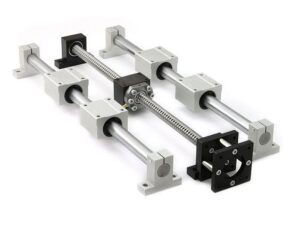
Types of CNC Linear Guides
Profile Rail Guides: Offer the highest precision and rigidity, ideal for heavy CNC machines.
Round Shaft Guides: Used in lighter systems with less demanding accuracy.
Miniature Linear Guides: Perfect for compact CNC engravers and medical instruments.
Roller Type Guides: Provide superior load capacity and reduced deformation.
Wide Type Guides: Enhance stability for multi-axis applications.
Each type serves unique industrial requirements — from micro-machining to heavy-duty cutting.
Benefits of Using CNC Linear Guide
Superior Precision: Delivers micron-level positioning accuracy.
Smooth Motion: Reduces vibration and mechanical noise.
High Load Capacity: Handles both vertical and horizontal loads effectively.
Increased Speed: Enables faster motion without sacrificing stability.
Durability: Designed for millions of cycles with minimal maintenance.
Energy Efficiency: Lower friction means less power consumption.
These advantages make CNC linear guides a cornerstone of modern high-precision equipment.
CNC Linear Guide vs. Linear Bearing
| Feature | CNC Linear Guide | Linear Bearing |
|---|---|---|
| Motion Type | Rolling with recirculating balls | Sliding or rolling without recirculation |
| Precision | Higher (micron-level) | Moderate |
| Rigidity | Very high | Low to moderate |
| Maintenance | Minimal | Moderate |
| Cost | Higher | Lower |
| Ideal Use | CNC machines, robotics | Light automation, lab equipment |
While linear bearings are simpler, CNC linear guides are engineered for accuracy, load, and speed — making them indispensable in machining environments.
Materials and Construction
CNC linear guides are built using premium-grade materials to ensure strength, stability, and wear resistance:
Hardened Steel: Offers rigidity and long service life.
Stainless Steel: Prevents corrosion and is ideal for cleanroom or wet environments.
Aluminum Alloy Carriages: Reduce overall system weight.
Ceramic or Coated Balls: Lower noise and resist corrosion.
The combination of these materials ensures that CNC linear guides operate flawlessly even under heavy-duty industrial conditions.
Installation and Alignment
To guarantee smooth operation, proper installation is essential:
Ensure flatness and parallelism of mounting surfaces.
Tighten screws with specified torque values.
Use preload adjustments to achieve optimal stiffness.
Check alignment using dial indicators.
Perform test runs to verify smooth travel.
Even minor misalignments can reduce accuracy and cause premature wear.
CNC Linear Guide in Machine Tools
In CNC machining centers, linear guides determine the accuracy and efficiency of every operation. They ensure that cutting heads, spindles, and tables move precisely under heavy loads.
Key benefits include:
High Rigidity: Essential for precision milling and turning.
Repeatable Accuracy: Maintains performance over millions of cycles.
Reduced Vibration: Enhances surface finish and tool life.
Without precision CNC linear guides, machine tools simply cannot achieve consistent accuracy or speed.

Applications Beyond CNC Machines
Beyond machining, CNC linear guides are used in:
Robotics: Enabling repeatable and controlled linear movements.
Automation Systems: Providing consistent motion for assembly lines.
3D Printers: Ensuring smooth travel for print heads and platforms.
Medical Equipment: Delivering precision motion in diagnostic and surgical devices.
Semiconductor Manufacturing: Supporting high-accuracy wafer handling.
Their adaptability across industries reflects their unmatched engineering quality.
Common Challenges and Solutions
| Problem | Cause | Solution |
|---|---|---|
| Excessive Noise | Contamination or poor lubrication | Clean and re-lubricate |
| Uneven Motion | Improper preload | Adjust preload or alignment |
| Shortened Lifespan | Overloading or vibration | Reassess load capacity |
| Rust Formation | Exposure to moisture | Use stainless or coated rails |
| Backlash | Wear in rolling elements | Replace worn components |
Preventive maintenance ensures optimal performance and reduces downtime.
Maintenance Best Practices
Clean rails regularly with soft, lint-free cloths.
Apply fresh lubrication through designated ports.
Inspect preload and screw torque periodically.
Replace seals when they show signs of wear.
Avoid exposure to dust, oil mist, and corrosive environments.
With proper care, a CNC linear guide can last tens of thousands of operating hours with consistent precision.
Tips for Choosing the Right CNC Linear Guide
| Criterion | Recommendation |
|---|---|
| Load Capacity | Match static and dynamic load ratings |
| Speed | Verify maximum feed rate compatibility |
| Accuracy | Choose precision class based on need |
| Environment | Select stainless or coated rails for harsh settings |
| Maintenance Needs | Consider self-lubricating types |
Selecting the correct guide ensures optimal system longevity and precision.

Modern Innovations
Recent advancements in CNC linear guide technology include:
Self-Lubricating Systems: Reduced downtime and cleaner operation.
Smart Sensors: Real-time load and temperature monitoring.
Corrosion-Resistant Coatings: Enhanced life in challenging environments.
Miniaturization: Compact, high-precision designs for micro-machines.
Noise Reduction Technologies: Smoother and quieter performance.
The future of CNC linear guides lies in smarter, more efficient, and eco-friendly designs.
Leading Brands and Manufacturers
YH Linear: Known for precision-engineered CNC linear guide systems.
THK: Global leader in motion control technology.
HIWIN: Offers versatile linear motion components.
Bosch Rexroth: Renowned for durable industrial automation solutions.
NSK Motion Systems: Specializes in precision linear rail technology.
When selecting a manufacturer, consider support, precision ratings, and component interchangeability.
FAQs
What is a CNC linear guide used for?
It ensures precise and smooth linear motion in CNC and automation equipment.
How long does a CNC linear guide last?
With proper maintenance, it can operate reliably for tens of millions of cycles.
Do CNC linear guides need lubrication?
Yes. Regular lubrication prevents wear and maintains accuracy.
Can CNC linear guides be replaced easily?
Yes, as long as the mounting dimensions match the original rail system.
What affects CNC linear guide accuracy?
Misalignment, dirt, vibration, and lack of lubrication are key factors.
Conclusion
A CNC linear guide is far more than a motion component — it’s the foundation of precision machining. Its design, material quality, and installation directly impact every cut, movement, and product dimension.
Investing in high-quality systems, like those offered by YH Linear, ensures smoother performance, greater accuracy, and longer service life for your CNC machinery. In an industry where precision is power, CNC linear guides are the silent heroes behind every perfect part.