

Outline
| Headings & Subheadings | LSI / Related Keywords |
|---|---|
| Introduction to Bearing Rails | linear motion, precision components |
| What Are Bearing Rails | linear rails, linear bearings, motion guides |
| Design and Construction of Bearing Rails | guideways, carriages, raceways |
| Working Mechanism of Bearing Rails | rolling motion, friction control |
| Types of Bearing Rails | profile rails, round rails, miniature rails |
| Advantages of Bearing Rails | stability, precision, durability |
| Bearing Rails vs. Linear Guides | differences, performance comparison |
| Common Materials Used in Bearing Rails | steel, stainless steel, aluminum |
| Applications in Automation and Robotics | CNC, semiconductor, packaging |
| Choosing the Right Bearing Rails | load, speed, alignment, environment |
| Installation Guidelines and Tips | torque, preload, alignment |
| Maintenance and Longevity | lubrication, inspection, cleaning |
| Common Problems and Fixes | noise, vibration, misalignment |
| Bearing Rails in CNC Machines | rigidity, repeatability, performance |
| Bearing Rails in Robotics | compactness, flexibility, control |
| Future Trends in Bearing Rail Technology | smart monitoring, self-lubrication |
| Top Manufacturers | YH Linear, THK, HIWIN, Bosch Rexroth |
| FAQs | lubrication, usage, lifespan |
| Conclusion | reliability, accuracy, innovation |
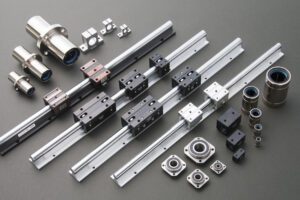
Introduction to Bearing Rails
In the realm of precision motion systems, bearing rails serve as the foundation for smooth, controlled, and accurate movement. These mechanical components are widely used in CNC machines, automation lines, robotics, and semiconductor manufacturing.
By combining high stiffness with minimal friction, bearing rails deliver exceptional linear motion performance. They allow heavy loads to move effortlessly and precisely, even in complex multi-axis systems.
Manufacturers like YH Linear, THK, and HIWIN have refined these components to meet the exacting standards of modern industry — where accuracy and reliability are paramount.
What Are Bearing Rails
Bearing rails are linear motion components that guide and support moving elements along a straight path. The system typically consists of a rail and a carriage (bearing block) equipped with rolling elements such as balls or rollers.
As the carriage moves, the rolling elements reduce friction and allow for smooth, controlled travel. Unlike sliding mechanisms, which rely on surface contact, bearing rails use rolling contact — minimizing wear and energy loss while ensuring precision.
This makes them ideal for high-speed, high-load, and high-precision applications in industrial automation and robotics.
Design and Construction of Bearing Rails
The performance of bearing rails depends heavily on their structural design. Key components include:
Guide Rail: A hardened steel or stainless steel track that defines the linear path.
Carriage / Bearing Block: The moving unit that contains rolling elements.
Rolling Elements: Balls or rollers that facilitate smooth movement.
Seals and End Caps: Protect the system from dust, chips, and debris.
Lubrication System: Maintains proper friction levels for long-lasting operation.
Together, these components ensure that the bearing rail system performs consistently and efficiently, even under heavy mechanical loads.
Working Mechanism of Bearing Rails
The bearing rails operate based on the principle of rolling motion. As the carriage slides along the rail, the rolling elements rotate within precision-ground raceways, reducing friction and enabling a smooth linear path.
This rolling motion provides several advantages over traditional sliding mechanisms — including higher speed, reduced wear, and improved energy efficiency.
Many modern bearing rails include recirculating ball or roller designs, where the rolling elements loop back inside the carriage, enabling continuous operation without displacement or loss of accuracy.
Types of Bearing Rails
Profile Bearing Rails: Offer high rigidity and precision with a rectangular cross-section.
Round Shaft Bearing Rails: Used for lighter-duty applications and easier alignment.
Miniature Bearing Rails: Designed for compact devices like medical and semiconductor tools.
Flanged Bearing Rails: Simplify mounting and alignment.
Wide Bearing Rails: Provide increased load capacity and stability.
Selecting the right rail type ensures optimal motion control and longevity for each specific application.
Advantages of Bearing Rails
Exceptional Precision: Maintains accurate linear motion even under dynamic loads.
Low Friction: Rolling elements minimize resistance, enhancing efficiency.
High Load Capacity: Distributes forces evenly for better durability.
Rigidity and Stability: Supports heavy loads with minimal deflection.
Compact Design: Saves space while maximizing strength.
Low Maintenance Requirements: Lubrication and cleaning are simple.
Versatility: Adaptable for horizontal, vertical, and inclined motion.
These features make bearing rails essential for any industry that values accuracy and reliability.
Bearing Rails vs. Linear Guides
| Feature | Bearing Rails | Linear Guides |
|---|---|---|
| Contact Type | Rolling contact | Rolling or sliding contact |
| Load Capacity | High | Moderate to high |
| Precision Level | Very high | High |
| Rigidity | Excellent | Moderate |
| Maintenance Needs | Low | Moderate |
| Cost | Slightly higher | Moderate |
| Ideal Use | High-precision machinery | General automation systems |
While both offer linear motion, bearing rails deliver higher rigidity, smoother operation, and better performance under dynamic stress.
Common Materials Used in Bearing Rails
Hardened Steel: Standard choice for strength and durability.
Stainless Steel: Corrosion-resistant and ideal for cleanroom environments.
Aluminum: Lightweight and suitable for low-load applications.
Polymer Coatings: Provide noise reduction and smooth movement.
Ceramic Balls or Rollers: Improve wear resistance and reduce vibration.
Material choice directly influences the system’s load rating, corrosion resistance, and operating life.
Applications in Automation and Robotics
CNC Machines: Ensures precise tool and gantry positioning.
Industrial Robots: Provides reliable axis motion and arm stability.
Packaging Machinery: Enables fast, repeatable motion cycles.
3D Printers: Ensures smooth print head movement.
Medical Equipment: Offers silent, clean, and precise operation.
Semiconductor Fabrication: Ensures accuracy in wafer transport and alignment.
From automation to robotics, bearing rails drive modern motion with unmatched consistency.
Choosing the Right Bearing Rails
| Criteria | Key Considerations |
|---|---|
| Load Capacity | Match to static and dynamic requirements |
| Speed and Acceleration | Ensure compatibility with motion profile |
| Precision Level | Choose based on tolerance and repeatability needs |
| Environmental Conditions | Consider dust, moisture, and temperature |
| Mounting Configuration | Flat, side, or flanged mounting |
| Maintenance Requirements | Choose self-lubricating models for minimal upkeep |
Proper selection maximizes operational performance and minimizes long-term costs.
Installation Guidelines and Tips
Ensure flatness and parallelism of mounting surfaces.
Use torque-controlled fasteners for even pressure.
Apply uniform preload for stiffness and precision.
Check smoothness of travel before operation.
Avoid contamination during installation.
A precisely aligned setup guarantees consistent, friction-free motion.
Maintenance and Longevity
Clean rails regularly with lint-free cloths.
Apply fresh grease or oil via the lubrication ports.
Inspect preload and roller/ball condition periodically.
Replace seals if they show wear.
Avoid using the system in unprotected outdoor environments.
Proper maintenance ensures smooth operation and extends the lifespan of your bearing rails.
Common Problems and Fixes
| Issue | Possible Cause | Solution |
|---|---|---|
| Noise or Vibration | Contamination or misalignment | Clean and realign |
| Uneven Motion | Improper preload | Adjust or reinstall |
| Rapid Wear | Lack of lubrication | Reapply lubricant |
| Sticking or Binding | Foreign debris | Clean and inspect |
| Corrosion | Poor environmental protection | Use stainless or coated rails |
Preventive care is key to maintaining performance and minimizing downtime.
Bearing Rails in CNC Machines
In CNC machining, bearing rails ensure accurate movement of cutting tools and worktables. Their rigidity eliminates chatter, while the smooth rolling motion maintains micron-level precision.
They are integral to maintaining surface finish quality and dimensional accuracy in high-speed machining processes.
Bearing Rails in Robotics
In robotics, bearing rails enable precise, repeatable movements along linear axes. Compact, lightweight designs reduce inertia, improving speed and control. They allow robots to perform complex tasks with agility and accuracy — from assembly to pick-and-place operations.
Systems by YH Linear and similar manufacturers provide exceptional rigidity and longevity for industrial robots.

Future Trends in Bearing Rail Technology
Self-Lubricating Systems: Reduce downtime and maintenance costs.
Embedded Sensors: Monitor temperature, load, and vibration.
Lightweight Composites: Improve energy efficiency and mobility.
Anti-Corrosion Coatings: Increase lifespan in harsh environments.
Precision Smart Rails: Enable predictive maintenance using IoT integration.
The future of bearing rails lies in smarter, lighter, and more sustainable designs.
FAQs
What are bearing rails used for?
They provide precise linear motion in CNC machines, robots, and automation systems.
Do bearing rails need lubrication?
Yes, lubrication minimizes friction and extends the system’s lifespan.
Can bearing rails operate vertically?
Yes, provided they are properly preloaded and secured.
What is the lifespan of bearing rails?
High-quality rails can last for tens of millions of cycles with proper maintenance.
Which industries use bearing rails the most?
Automation, robotics, medical, semiconductor, and manufacturing sectors.
Conclusion
Bearing rails are the heart of modern linear motion technology. Their superior precision, durability, and adaptability make them indispensable in automation and robotics.
For consistent performance and reliability, investing in quality systems from YH Linear ensures your machinery delivers exceptional results — day after day, cycle after cycle.