

Outline
| Headings & Subheadings | LSI / Related Keywords |
|---|---|
| Introduction to Ball Bearing Linear Guide | linear motion systems, precision components |
| What Is a Ball Bearing Linear Guide | linear rails, guide block, ball recirculation |
| Design and Construction of Ball Bearing Linear Guide | guideways, carriage, raceways |
| Working Principle of Ball Bearing Linear Guide | rolling friction, smooth motion |
| Key Components and Their Roles | block, rail, balls, seals |
| Types of Ball Bearing Linear Guides | miniature, wide, flanged, low-profile |
| Benefits of Using Ball Bearing Linear Guide | precision, stability, durability |
| Ball Bearing Linear Guide vs. Roller Guide | accuracy, cost, rigidity |
| Industrial Applications | CNC, robotics, semiconductor, automation |
| Installation Tips and Best Practices | alignment, preload, torque |
| Maintenance and Lubrication | cleaning, oiling, inspection |
| Common Problems and Solutions | noise, vibration, binding |
| Materials and Coating Options | stainless steel, carbon steel, nickel plating |
| Innovations in Ball Bearing Linear Guide Technology | self-lubrication, smart sensors |
| How to Select the Right Model | load, accuracy, speed, environment |
| Top Global Manufacturers | YH Linear, THK, HIWIN, NSK |
| FAQs | maintenance, installation, lifespan |
| Conclusion | reliability, performance, innovation |
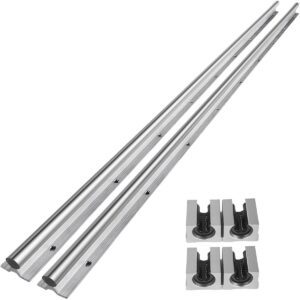
Introduction to Ball Bearing Linear Guide
The ball bearing linear guide is a critical component in modern precision machinery. It ensures smooth, precise, and low-friction linear motion, making it indispensable in CNC machines, robotics, medical instruments, and automation equipment.
These systems revolutionized linear motion by replacing sliding friction with rolling friction — dramatically increasing speed, accuracy, and lifespan. A properly designed ball bearing linear guide ensures consistent performance and stability, even under heavy loads or harsh environments.
Manufacturers like YH Linear, THK, and HIWIN have continued refining this technology, offering advanced models that meet the growing demand for ultra-precision and long-term reliability.
What Is a Ball Bearing Linear Guide
A ball bearing linear guide consists of a rail and a block (or carriage) that houses multiple recirculating ball bearings. As the carriage moves, these balls roll along the raceways, converting sliding friction into smooth rolling motion.
This design ensures high rigidity, precise movement, and exceptional load-bearing capacity. It’s the preferred choice for applications requiring repeatable accuracy and minimal vibration, such as CNC machining, robotics, and semiconductor assembly.
Design and Construction of Ball Bearing Linear Guide
The efficiency of a ball bearing linear guide lies in its well-engineered structure:
Guide Rail: A hardened steel track with precision-ground grooves.
Carriage (Block): Houses the ball circuits that recirculate during movement.
Ball Bearings: Provide smooth, low-friction rolling contact.
End Caps: Guide the ball bearings through their recirculation path.
Seals: Prevent contamination from dust or metal particles.
Lubrication Port: Enables regular oil or grease application.
Together, these elements deliver rigidity, accuracy, and durability.
Working Principle of Ball Bearing Linear Guide
In operation, the balls inside the block roll along the rail grooves. When the carriage moves, the balls rotate, travel along the track, and recirculate through end caps back to their original position.
This rolling contact motion eliminates sliding friction, resulting in extremely low resistance and wear. The linear guide thus provides smooth movement with consistent accuracy over millions of cycles.
Additionally, preloaded designs remove backlash and enhance rigidity — ideal for dynamic, high-precision applications.
Key Components and Their Roles
| Component | Function |
|---|---|
| Guide Rail | Provides a path for the block to travel |
| Carriage / Block | Houses ball bearings and transmits load |
| Ball Bearings | Enable smooth rolling movement |
| End Caps | Guide balls during recirculation |
| Seals | Protect against contaminants |
| Lubrication Ports | Maintain proper lubrication flow |
Each component plays a role in achieving superior motion precision and load distribution.
Types of Ball Bearing Linear Guides
Standard Type: Suitable for general automation and CNC applications.
Wide Type: Offers higher rigidity and load-bearing capacity.
Flanged Type: Simplifies mounting with integrated flanges.
Low-Profile Type: Compact design for space-limited systems.
Miniature Type: Ideal for semiconductor and medical applications.
Double-Block Type: Enhances stability for long stroke operations.
Selecting the right configuration ensures optimal performance and longevity.
Benefits of Using Ball Bearing Linear Guide
High Precision: Achieves repeatable accuracy over long distances.
Low Friction: Rolling contact minimizes resistance and wear.
Excellent Rigidity: Withstands axial and radial forces effectively.
Durability: Hardened materials and precision grinding ensure longevity.
Compact Design: Enables lightweight yet robust construction.
Energy Efficiency: Reduces power consumption in motor-driven systems.
Easy Maintenance: Simple lubrication and inspection procedures.
These advantages make ball bearing linear guides the gold standard for precision motion control.
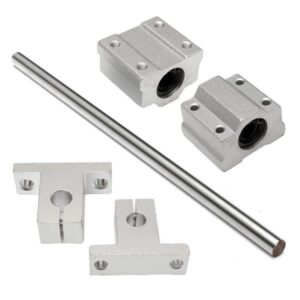
Ball Bearing Linear Guide vs. Roller Guide
| Feature | Ball Bearing Linear Guide | Roller Guide |
|---|---|---|
| Contact Type | Point contact | Line contact |
| Friction Level | Very low | Low |
| Rigidity | Medium to high | Very high |
| Speed Capability | Excellent | Moderate |
| Load Capacity | Medium | High |
| Smoothness | Extremely smooth | Slightly stiffer feel |
| Cost | Lower | Higher |
For applications prioritizing speed and smoothness, ball bearing guides are ideal; roller guides are better for ultra-heavy loads.
Industrial Applications
CNC Machines: For precise tool head and gantry movement.
3D Printers: Ensures consistent print head accuracy.
Robotics: Enables repeatable, high-speed arm movements.
Medical Devices: Provides smooth operation in imaging and diagnostics.
Semiconductor Manufacturing: Used for wafer alignment and assembly lines.
Packaging Equipment: Ensures efficient, linear product transport.
The adaptability of ball bearing linear guides has made them indispensable across industrial sectors.
Installation Tips and Best Practices
Mount rails on a flat, rigid surface.
Check parallelism between dual rails for smooth motion.
Use proper torque when tightening mounting bolts.
Apply preload to increase stiffness and reduce vibration.
Always perform a manual travel test before full operation.
A carefully aligned installation ensures minimal friction and long-term reliability.
Maintenance and Lubrication
Apply grease or oil through built-in lubrication ports regularly.
Clean the rail surface with lint-free cloths.
Replace seals if worn or contaminated.
Inspect preload and ball condition during scheduled maintenance.
Avoid over-lubrication, which can attract dust and cause sticking.
Proper care extends both accuracy and service life significantly.
Common Problems and Solutions
| Issue | Possible Cause | Solution |
|---|---|---|
| Noise or Vibration | Dust contamination | Clean and re-lubricate |
| Uneven Movement | Misalignment | Reinstall and adjust preload |
| Wear on Rail Surface | Overload or lack of lubrication | Reduce load or reapply grease |
| Excessive Play | Worn balls or block | Replace carriage |
| Binding Motion | Tight preload or debris | Readjust preload and clean system |
Early diagnosis and maintenance prevent major operational issues.
Materials and Coating Options
Hardened Carbon Steel: Standard for general-purpose applications.
Stainless Steel: Resists corrosion and moisture.
Nickel-Plated Rails: Ideal for cleanroom and food industry environments.
Ceramic Balls: Reduce weight and increase corrosion resistance.
Composite Blocks: Lightweight and quiet operation.
Material selection depends on load, environment, and precision requirements.
Innovations in Ball Bearing Linear Guide Technology
Self-Lubricating Systems: Reduce downtime and maintenance.
Integrated Sensors: Monitor wear, load, and temperature.
Anti-Corrosion Coatings: Extend service life in humid or chemical environments.
Hybrid Ceramic Designs: Combine strength with reduced weight.
Noise-Dampening Blocks: Enhance smoothness for high-speed operation.
These innovations have made ball bearing linear guides smarter and more efficient than ever before.

How to Select the Right Model
| Selection Criteria | Description |
|---|---|
| Load Rating | Must handle static and dynamic forces |
| Precision Level | Match to required positional accuracy |
| Speed and Acceleration | Choose bearings that support operational limits |
| Environment | Consider temperature, humidity, and contaminants |
| Mounting Type | Flanged, top, or bottom mounting based on design |
| Material and Coating | Select for durability and corrosion resistance |
Consulting experts like YH Linear ensures optimal selection and integration.
FAQs
What is a ball bearing linear guide used for?
It provides smooth and precise linear motion in mechanical systems such as CNC machines and automation equipment.
How do I maintain a ball bearing linear guide?
Keep it clean, lubricated, and aligned. Regular inspection ensures smooth performance.
Can I install it vertically?
Yes, but ensure proper preload and lubrication to maintain stability.
How long does it last?
With proper care, a high-quality guide can last tens of thousands of operational hours.
Which industries use ball bearing linear guides the most?
Automation, robotics, CNC machining, semiconductor, and medical industries.
Conclusion
The ball bearing linear guide represents the perfect balance between speed, precision, and durability. Its low-friction design ensures flawless performance in any direction, making it indispensable for engineers who demand consistency and accuracy.
For best results, opt for quality components from trusted manufacturers like YH Linear, where engineering excellence meets innovation — guaranteeing your machines perform at their peak every single time.