

Outline
| Headings & Subheadings | LSI / Related Keywords |
|---|---|
| Introduction to Rollers and Rails | linear guide systems, precision movement |
| Understanding Rollers and Rails | linear roller guides, track systems |
| Core Structure and Design | guideways, bearings, linear rails |
| Working Mechanism of Rollers and Rails | rolling motion, friction control |
| Types of Rollers and Rails | cross rollers, track rollers, cam followers |
| Advantages of Rollers and Rails | precision, rigidity, low maintenance |
| Rollers and Rails vs. Linear Guides | friction, cost, performance |
| Applications in Automation and Robotics | CNC, medical, packaging, semiconductor |
| Selecting the Right Rollers and Rails | load, speed, alignment, lubrication |
| Materials and Coatings | stainless steel, carbon steel, polymer |
| Installation Guidelines | preload, alignment, torque |
| Troubleshooting Common Issues | binding, noise, contamination |
| Maintenance and Longevity | lubrication, inspection, cleaning |
| Future Innovations in Rollers and Rails | hybrid systems, smart motion, self-lubrication |
| Benefits of Using Rollers and Rails in Robotics | compactness, control, efficiency |
| Cost-Performance Balance | lifespan, ROI, industrial standards |
| Leading Manufacturers | YH Linear, THK, HIWIN, IGUS |
| FAQs | usage, lubrication, lifespan |
| Conclusion | precision, reliability, performance |

Introduction to Rollers and Rails
In the fast-paced world of automation and precision engineering, rollers and rails play a critical role in ensuring smooth, accurate, and repeatable linear motion. They are the backbone of countless mechanical systems — from CNC machines and industrial robots to semiconductor and medical devices.
The combination of rollers and rails provides stable, low-friction movement while supporting significant loads. These systems not only improve efficiency but also enhance the longevity and reliability of motion equipment.
Brands like YH Linear, THK, and HIWIN are pioneers in manufacturing advanced roller and rail systems that meet the demanding standards of modern automation.
Understanding Rollers and Rails
Rollers and rails refer to a linear motion system that enables precise movement along a fixed path. The rail acts as the guiding structure, while rollers move smoothly along its surface, reducing friction and improving stability.
Unlike sliding bearings that rely on surface contact, roller-based systems use rolling elements — which allows for smoother motion, less wear, and higher load capacity. This makes them ideal for applications requiring both precision and durability.
Core Structure and Design
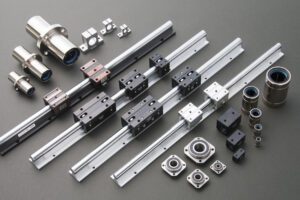
The design of rollers and rails integrates multiple elements engineered for stability, smoothness, and endurance:
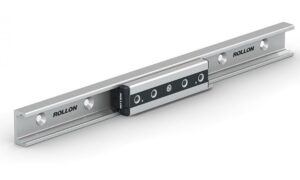
Guide Rail: The stationary base providing a defined linear path.
Roller Carriage or Block: The moving unit equipped with rolling elements.
Rollers or Cylindrical Bearings: Reduce friction and support the moving load.
End Caps and Seals: Protect against dust, debris, and lubricant leakage.
Mounting Base: Ensures the entire assembly is rigidly fixed to the machine structure.
This structure distributes load evenly, ensuring smooth linear movement even under heavy loads or dynamic conditions.
Working Mechanism of Rollers and Rails
The operating principle of rollers and rails is based on rolling contact. As the carriage moves, the rollers rotate along the rail, converting sliding friction into rolling motion.
This significantly reduces resistance and energy loss, allowing the system to handle heavy loads at higher speeds with exceptional precision. Proper lubrication further reduces wear and extends service life.
By minimizing stick-slip motion, roller-based systems ensure uniform movement — a must-have in CNC machining and robotic automation.
Types of Rollers and Rails
Cross Roller Guides: Cylindrical rollers arranged in a crossed pattern for ultra-precise movement.
Cam Rollers: Ideal for high-speed and high-load conditions in automation lines.
Track Rollers: Heavy-duty rollers designed for conveyors and material-handling systems.
V-Groove Rollers: Compact design suited for linear positioning systems.
Ball Rollers: Lightweight, smooth, and commonly used in compact motion assemblies.
Each type is tailored to specific environments, motion speeds, and load requirements.
Advantages of Rollers and Rails
Superior Precision: Maintains accurate linear movement.
High Load Capacity: Distributes loads efficiently over multiple rollers.
Low Friction and Noise: Rolling contact minimizes wear and vibration.
Extended Service Life: Hardened materials and advanced coatings enhance durability.
Compact and Lightweight: Ideal for modern automation setups.
Easy Maintenance: Requires minimal downtime for inspection and cleaning.
Corrosion Resistance: Stainless and treated steel resist environmental damage.
These benefits make rollers and rails indispensable in demanding industrial environments.
Rollers and Rails vs. Linear Guides
| Feature | Rollers and Rails | Linear Guides |
|---|---|---|
| Motion Type | Rolling cylindrical contact | Ball recirculation |
| Load Capacity | Higher load-bearing | Moderate load capacity |
| Speed Range | High-speed operation | Medium to high speed |
| Friction Level | Extremely low | Low |
| Rigidity | High | Moderate |
| Maintenance | Less frequent | More frequent lubrication |
| Cost | Slightly higher | Cost-effective for standard applications |
Both systems provide linear motion, but rollers and rails outperform when load, precision, and stiffness are crucial.
Applications in Automation and Robotics
CNC Machinery: Ensures precision cutting and tool movement.
Robotics: Provides controlled motion for arms and gantries.
Semiconductor Manufacturing: Enables sub-micron accuracy.
Packaging Equipment: Ensures rapid, consistent linear motion.
Medical Devices: Allows precise table and scanner positioning.
3D Printing: Maintains accuracy in print head movement.
The adaptability of rollers and rails has made them a cornerstone in virtually all modern motion systems.
Selecting the Right Rollers and Rails
| Criterion | Considerations |
|---|---|
| Load and Force | Match capacity with application requirements. |
| Speed and Acceleration | Evaluate for operational efficiency. |
| Precision Needs | Consider positional accuracy and repeatability. |
| Environmental Factors | Temperature, dust, and chemical exposure. |
| Lubrication Preference | Grease, oil, or self-lubricating systems. |
| Material Type | Steel for heavy-duty; aluminum or polymer for light motion. |
Proper selection ensures optimal balance between performance and lifespan.
Materials and Coatings
The performance of rollers and rails depends heavily on their materials:
Hardened Steel: Delivers superior strength and wear resistance.
Stainless Steel: Corrosion-resistant for cleanroom and medical use.
Aluminum Rails: Lightweight for compact motion designs.
Polymer Rollers: Quiet operation and self-lubricating properties.
Ceramic Coatings: Improve surface hardness and longevity.
These options enable customization for specific operational and environmental conditions.
Installation Guidelines
Mount rails on a flat, stable surface to prevent deflection.
Ensure perfect parallel alignment for dual-rail systems.
Use torque-controlled fasteners for consistent preload.
Apply proper lubrication during installation.
Perform trial runs to verify smooth, even motion.
Precision during installation directly influences long-term performance.
Troubleshooting Common Issues
| Problem | Cause | Solution |
|---|---|---|
| Noise or Vibration | Contamination, wear | Clean and re-lubricate |
| Sticking Motion | Misalignment | Realign and verify preload |
| Short Lifespan | Overload or corrosion | Recalculate load and apply protection |
| Roller Damage | Poor lubrication | Use quality grease or oil |
| Uneven Wear | Loose mounting | Tighten and recheck alignment |
Regular monitoring prevents minor problems from escalating into costly downtime.
Maintenance and Longevity
Clean the rail and roller surfaces periodically.
Reapply lubricant as per operational hours.
Check preload and roller rotation periodically.
Replace worn seals to prevent contamination.
Store spare parts in dry, controlled conditions.
Proactive maintenance extends service life and ensures consistent accuracy.
Future Innovations in Rollers and Rails
Smart Sensors: For predictive maintenance and load monitoring.
Magnetic Roller Systems: Offer frictionless, contact-free movement.
Self-Lubricating Materials: Reduce maintenance intervals.
Hybrid Ceramic Rollers: Enhance speed and temperature resistance.
Sustainable Coatings: Eco-friendly and wear-resistant finishes.
These advancements will define the next era of rollers and rails in industrial motion systems.
FAQs
What are rollers and rails used for?
They provide smooth, precise linear motion in machines and automation systems.
Do rollers and rails need lubrication?
Yes, although self-lubricating options are available for maintenance-free use.
Can rollers and rails be mounted vertically?
Yes, with correct preload and secure mounting.
How long do rollers and rails last?
Depending on usage and maintenance, they can operate efficiently for millions of cycles.
What materials are best for rollers and rails?
Hardened or stainless steel for durability; polymer or aluminum for lightweight applications.
Conclusion
Rollers and rails are vital components in achieving precision linear motion across multiple industries. Their strength, stability, and ability to handle dynamic loads make them indispensable in robotics, manufacturing, and automation.
Choosing premium-quality solutions — such as those from YH Linear — ensures smoother operation, longer service life, and optimal performance under demanding conditions.