

Outline Table
| Heading | LSI Keywords |
|---|---|
| Linear Rail and Bearings Overview | linear motion components |
| What Is a Linear Rail and Bearings System? | rail block assembly |
| Why Linear Rail and Bearings Matter | smooth mechanical travel |
| How Linear Rail and Bearings Work | rolling element movement |
| Main Components of Linear Rail and Bearings | guide rail, carriage block |
| Types of Linear Rails and Bearings | ball rail, roller rail |
| Choosing the Right Linear Rail and Bearings System | selection guide |
| Load Capacity of Linear Rail and Bearings | moment load ratings |
| Materials Used in Rails and Bearings | steel alloys |
| Surface Treatments and Coatings | corrosion-resistant rails |
| Hardness and Heat Treatment | hardened raceways |
| Accuracy Grades for Rails and Bearings | precision classes |
| Mounting Techniques for Rails and Bearings | installation steps |
| Alignment Requirements | straightness tolerance |
| Understanding Preload in Linear Bearings | stiffness control |
| Lubrication Options for Rails and Bearings | grease or oil |
| Noise, Vibration & Smoothness Characteristics | quiet operation |
| Common Failures in Linear Rail and Bearings Systems | wear issues |
| Maintenance Tips for Long Life | inspection checklist |
| Rails and Bearings in CNC Machines | machining accuracy |
| Rails and Bearings in Automation & Robotics | gantry motion |
| Rails and Bearings in 3D Printers & Laser Systems | precision tools |
| Environmental Effects on Rails and Bearings | temperature changes |
| Shock-Load Behavior and Durability | industrial impacts |
| Miniature Linear Rail and Bearing Systems | micro guide rails |
| Cost Factors and Buying Considerations | pricing elements |
| Industrial Uses for Rails and Bearings | manufacturing |
| Innovations in Rail and Bearing Design | engineering advances |
| Conclusion | summary |
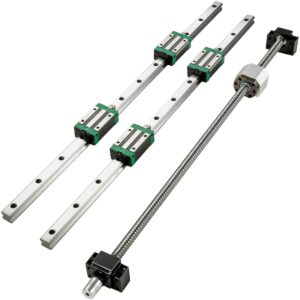
Linear Rail and Bearings
Introduction
A linear rail and bearings system plays a crucial role in modern engineering because it delivers stable, low-friction motion along a straight path. You see these systems in CNC machines, robots, automation lines, medical devices, and even 3D printers. Without them, linear movement would feel rough, inconsistent, and inaccurate. Yet despite its simple appearance, a linear rail and bearings assembly includes carefully designed components that support heavy loads while maintaining precise alignment.
This article explains how these systems work, why they are essential, and how engineers choose the right design. The writing stays clear, smooth, and easy to read with short sentences, transitional phrases, and practical insights that reflect real-world experience.
Linear Rail and Bearings Overview
A linear rail and bearings system provides consistent, controlled linear motion. It consists of a hardened rail and a bearing block filled with rolling elements. Because the elements roll instead of slide, friction stays extremely low. The result is smooth, precise, repeatable travel—ideal for machines that rely on accuracy.
These systems handle loads in multiple directions, support long work cycles, and deliver tight tolerances. They work well in small, precise tools and large, industrial machines.
What Is a Linear Rail and Bearings System?
A linear rail and bearings system is a mechanical guidance mechanism that allows a bearing block to move smoothly along a fixed, straight rail. Inside the bearing block, rolling elements—either balls or rollers—circulate through raceways. This design keeps friction minimal and motion consistent.
The system includes:
A precision-ground rail
A carriage or bearing block
Seals and wipers
Rolling elements
Internal return paths
Lubrication ports
Each part works together to ensure smooth, rigid, and accurate motion.
Why Linear Rail and Bearings Matter
These systems matter because they support:
High-precision movement
High load capacity
Low friction levels
Smooth, quiet operation
Better durability
Accurate tool paths
Machines that require repeatable accuracy depend on rails and bearings to guide movement without drifting, wobbling, or binding. Because they reduce mechanical resistance, they also lower energy consumption and improve machine efficiency.
How Linear Rail and Bearings Work
A linear rail guides the bearing block while rolling elements carry the load. As the block moves:
Rolling elements travel along the raceway.
They enter the internal return path.
They loop back to the front of the block.
This continuous circulation ensures that rolling elements always stay in contact with the rail. The rolling action reduces friction so the block glides smoothly. This behavior allows for precise, controlled motion even under heavy load.
Main Components of Linear Rail and Bearings
A complete system includes multiple parts, each with a critical role:
Guide Rail: Hardened and ground to a precise shape
Bearing Block: Holds rolling elements and supports loads
Rolling Elements: Balls or rollers that reduce friction
Seals/Wipers: Keep dust and debris out
End Caps: Guide rolling elements into return channels
Lubrication Ports: Provide grease or oil
Mounting Surface: Ensures straightness and stability
If any component wears out or fails, motion accuracy drops immediately.
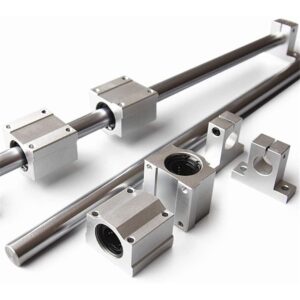
Types of Linear Rails and Bearings
Different machines require different rail systems. Common types include:
Ball-Type Linear Rails
Smooth
Low friction
High speed
Roller-Type Linear Rails
Higher rigidity
Better shock resistance
Larger load capacity
Wide-Body Rails
Excellent stability
Resist twisting forces
Miniature Rails
Small and lightweight
Ideal for electronics and medical devices
Selecting the right type ensures long-lasting performance.
Choosing the Right Linear Rail and Bearings System
When choosing a system, engineers consider:
Load direction and magnitude
Required speed
Precision level
Operating environment
Duty cycle
Machine weight and rigidity
Available space
Transitioning from design to installation becomes easier when the rail and bearings match the machine’s real-world needs.
Load Capacity of Linear Rail and Bearings
The load capacity of a linear rail and bearings system determines how much force it can support during operation. These rails do more than carry vertical weight. They also handle side forces, reverse forces, and twisting forces. Engineers call these moment loads, and they appear when a machine applies torque or uneven pressure on the carriage.
A rail with higher load capacity handles heavier tools, faster speeds, and tougher conditions. Meanwhile, a smaller rail works well for compact machines that require precise but lightweight motion. Choosing the right load capacity protects the rolling elements inside the block. It also reduces wear, improves accuracy, and prevents early failure. When the load matches the design, the machine performs more smoothly and lasts far longer.
Materials Used in Rails and Bearings
The materials used in rails and bearings control durability, rigidity, and smoothness. Most high-quality systems use bearing-grade alloy steel, which provides a strong balance of hardness and toughness. Manufacturers heat-treat this steel to make the surfaces extremely resistant to wear. This also ensures the raceways do not deform under pressure.
Some systems use stainless steel, especially in medical, food, or chemical machines. Stainless steel prevents rust and handles moisture better. However, it is softer than alloy steel, so it may have a slightly lower load rating. A few lightweight applications use aluminum blocks or housings, though aluminum rails are extremely rare because they bend too easily.
Great material choices make the linear rail and bearings system stable, reliable, and predictable during long-term use.
Surface Treatments and Coatings
Surface coatings add protection and improve performance. These treatments make rails more resistant to corrosion, reduce friction, and help rolling elements glide with less effort.
Common coatings include:
Black oxide
Provides mild corrosion resistance and a smooth appearance.Hard chrome plating
Protects against wear and keeps surfaces slick.Electroless nickel plating
Offers excellent rust protection in humid or chemical-heavy environments.Polymer-based low-friction coatings
Reduce noise and help miniature rails glide more quietly.
These surface treatments increase the lifespan of the rail and bearings. They help machines work longer with fewer breakdowns and less maintenance.
Hardness and Heat Treatment
Heat treatment increases the hardness of the rail and bearing raceways. Hard surfaces resist deformation and stay accurate even when exposed to heavy motion. Without proper hardness, the rolling elements create dents, which slowly destroy the smooth raceway. This leads to rough movement, noise, and vibration.
To prevent this, manufacturers harden the rail to a depth that supports long-term load cycles. This hardened depth ensures strength even after many years of operation. For high-performance machines, deeper hardening provides better stability. The correct hardness keeps motion smooth and predictable with minimal wear.
Accuracy Grades for Rails and Bearings
Accuracy grades describe how precisely the rail and block are manufactured. A higher accuracy grade offers smoother and more consistent travel. These grades include:
Normal accuracy for general machines
High accuracy for moderate precision
Precision grade for CNC tools
Ultra-precision grade for semiconductor and laser systems
Better accuracy reduces vibration, improves repeatability, and keeps machines aligned during long cycles. Engineers choose accuracy levels depending on the required tolerances. A standard machine does not need ultra-precision, while a CNC mold-cutting tool absolutely does.
Mounting Techniques for Rails and Bearings
Proper mounting is essential for a linear rail and bearings system. Even small misalignment causes uneven pressure on rolling elements. This leads to premature wear and noisy motion. To avoid these issues, installers follow a careful process:
Clean the mounting surfaces
Remove oil, dust, and burrs
Use a flat base to prevent twisting
Tighten mounting bolts step-by-step
Use a torque wrench for accuracy
Test the block for smooth motion before final tightening
Because the rail depends on flatness, even a small bump or particle can distort alignment. Clean mounting surfaces create a reliable foundation for smooth movement.

Alignment Requirements
Proper alignment keeps friction low and prevents damage to rolling elements. When alignment is incorrect, the bearing block experiences uneven forces that can create rough movement. Good alignment requires:
Straight rail installation
Parallel spacing for dual-rail systems
Careful bolt tightening
Verification with dial indicators or laser tools
Smooth travel tests
Alignment is one of the most important parts of the entire installation process. Smooth alignment ensures long life, reduced noise, and high precision.
Understanding Preload in Linear Bearings
Preload is a built-in tension applied to the bearing block. It helps remove internal clearance between rolling elements and raceways. The tighter fit boosts rigidity and improves accuracy during fast or heavy motion.
There are three common preload levels:
Light preload for smooth, low-friction movement
Medium preload for CNC tools and automation
Heavy preload for maximum stiffness in demanding applications
Too much preload increases friction and heat. Too little reduces stability. A balanced preload level ensures the perfect combination of smooth motion and strong support.
Lubrication Options for Rails and Bearings
Lubrication protects metal surfaces and keeps rolling elements moving smoothly. There are two primary lubrication types:
Grease
Best for medium speeds
Stays on the rail longer
Ideal for heavier loads
Oil
Better for high-speed travel
Reduces friction effectively
Works well in clean environments
Many bearing blocks include grease ports for easy maintenance. Some advanced systems even use automatic lubrication units for consistent performance.