

Introduction
Linear rails are essential components in modern mechanical systems where accurate, smooth, and repeatable linear motion is required. From CNC machine tools and industrial automation to robotics and precision equipment, linear rails play a critical role in ensuring stability, load capacity, and motion accuracy.
With multiple designs available, understanding the different types of linear rails is key to selecting the right solution for your application. Each type offers unique advantages in terms of load handling, precision, rigidity, speed, and environmental resistance.
This article provides a comprehensive overview of the main types of linear rails, explaining how they work, their strengths, limitations, and typical applications.
What Are Linear Rails?
Linear rails, also known as linear guide rails, are mechanical components that guide moving parts along a straight path. They are typically used in combination with linear bearing blocks or carriages to support loads while minimizing friction.
A linear rail system generally consists of:
A precision rail mounted to a base
A moving carriage or block
Rolling or sliding elements that allow smooth movement
The primary purpose of linear rails is to deliver controlled linear motion with high accuracy and stability.
Why Different Types of Linear Rails Exist
Different applications place different demands on linear motion systems. Factors such as:
Load magnitude and direction
Speed and acceleration
Required precision
Installation space
Environmental conditions
all influence which type of linear rail is most suitable. As a result, manufacturers offer various rail designs optimized for specific performance requirements.
Main Types of Linear Rails
1. Ball-Type Linear Rails
Ball-type linear rails use recirculating steel balls between the rail and the carriage. The balls roll along precision raceways, providing smooth and low-friction movement.
Key Characteristics:
Point contact between balls and rail
Low friction and high speed capability
Good precision and repeatability
Advantages:
Smooth motion
Suitable for high-speed applications
Lower cost compared to roller rails
Typical Applications:
CNC machining centers
Automation equipment
Pick-and-place machines
Packaging machinery
2. Roller-Type Linear Rails
Roller-type linear rails use cylindrical rollers instead of balls. The rollers create line contact, resulting in higher rigidity and load capacity.
Key Characteristics:
Line contact for improved stiffness
High load and moment capacity
Excellent resistance to deformation
Advantages:
Superior rigidity
Ideal for heavy loads and shock
High positioning accuracy
Typical Applications:
Heavy-duty CNC machines
Gantry systems
Presses and forming machines
Industrial automation with high loads
3. Square Linear Rails (Profiled Linear Rails)
Square linear rails feature a rectangular or square carriage block, allowing them to handle loads from multiple directions.
Key Characteristics:
Multi-directional load support
High rigidity and stability
Compact and modular design
Advantages:
Excellent moment load capacity
Easy installation and alignment
Wide industry acceptance
Typical Applications:
CNC machine tools
Robotics
Automated production lines
Precision positioning systems
4. Round Linear Rails
Round linear rails consist of cylindrical shafts paired with linear bearings.
Key Characteristics:
Simple design
Moderate load capacity
Lower rigidity than profiled rails
Advantages:
Cost-effective
Easy installation
Suitable for light-duty applications
Typical Applications:
Light machinery
3D printers
DIY automation projects
Office and consumer equipment
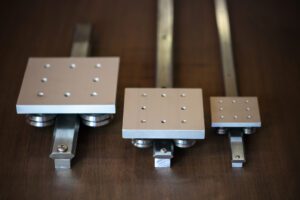
5. Miniature Linear Rails
Miniature linear rails are compact versions of profiled rails, designed for small-scale and high-precision applications.
Key Characteristics:
Small size with high accuracy
Low mass for fast acceleration
Precision-ground raceways
Advantages:
Ideal for limited spaces
High precision despite compact size
Smooth and quiet operation
Typical Applications:
Medical devices
Semiconductor equipment
Optical instruments
Laboratory automation
6. Heavy-Duty Linear Rails
Heavy-duty linear rails are designed for extreme loads and harsh operating conditions.
Key Characteristics:
Large rail and carriage dimensions
High load and shock resistance
Enhanced durability
Advantages:
Excellent strength and rigidity
Long service life
Suitable for industrial environments
Typical Applications:
Steel processing equipment
Large gantry machines
Material handling systems
Heavy industrial machinery
7. Cross Roller Linear Rails
Cross roller linear rails use rollers arranged at 90-degree angles, enabling them to support loads in multiple directions with exceptional stiffness.
Key Characteristics:
Ultra-high rigidity
Extremely smooth motion
High precision
Advantages:
Minimal deflection
Excellent positioning accuracy
Compact design
Typical Applications:
Robotics
Precision measuring equipment
Optical and inspection systems
High-end automation
8. V-Groove Linear Rails
V-groove rails use wheels or bearings that run along a V-shaped track.
Key Characteristics:
Self-aligning design
Resistant to debris
Flexible installation
Advantages:
Tolerant of misalignment
Suitable for long travel distances
Cost-effective for large systems
Typical Applications:
Gantry systems
Material transport systems
Automation frames
Warehouse equipment
Comparison of Linear Rail Types
| Type | Load Capacity | Precision | Rigidity | Cost |
|---|---|---|---|---|
| Ball-Type | Medium | High | Medium | Low |
| Roller-Type | High | Very High | Very High | High |
| Square | High | High | High | Medium |
| Round | Low | Medium | Low | Low |
| Miniature | Low–Medium | Very High | Medium | Medium |
| Heavy-Duty | Very High | High | Very High | High |
| Cross Roller | Medium–High | Extremely High | Extremely High | High |
| V-Groove | Medium | Medium | Medium | Medium |
How to Choose the Right Type of Linear Rail
When selecting a linear rail, consider:
Load magnitude and direction
Required accuracy and repeatability
Operating speed and acceleration
Available installation space
Environmental conditions
Maintenance requirements
Budget constraints
Matching the rail type to your application ensures optimal performance and long-term reliability.

Installation and Maintenance Considerations
Install rails on flat, rigid mounting surfaces
Ensure proper alignment to avoid uneven wear
Apply recommended lubrication
Inspect rails and carriages regularly
Replace worn components promptly
Good installation and maintenance practices significantly extend service life and accuracy.
Frequently Asked Questions (FAQs)
1. What is the most commonly used type of linear rail?
Ball-type square linear rails are the most widely used due to their balance of cost, precision, and performance.
2. Which linear rail is best for heavy loads?
Roller-type or heavy-duty linear rails are best suited for high-load applications.
3. Are round linear rails suitable for CNC machines?
They are suitable for light-duty CNC machines but not ideal for high-precision or heavy-load systems.
4. Do linear rails require lubrication?
Yes, most linear rails require lubrication to reduce friction and wear.
5. Can different types of linear rails be mixed in one system?
Generally not recommended, as different rail types have different stiffness and load characteristics.
Conclusion
Understanding the types of linear rails is essential for designing reliable and efficient linear motion systems. From ball-type and roller-type rails to miniature and heavy-duty designs, each type serves a specific purpose based on load, precision, and operating conditions.
Choosing the correct linear rail ensures smooth motion, high accuracy, long service life, and optimal system performance across CNC machining, automation, robotics, and industrial equipment.