

Introduction to Linear Motion Bearings
What Are Linear Motion Bearings?
Linear motion bearings are mechanical components designed to provide smooth, low-friction movement along a straight path. Unlike traditional rotary bearings that allow circular motion, linear motion bearings support movement in a single direction—forward and backward along a rail or shaft.
These components are essential in modern machinery where precision and efficiency are required. They are widely used in automation systems, CNC machines, robotics, and medical equipment.
Why They Are Essential in Modern Engineering
In today’s high-tech industries, precision is everything. Linear motion bearings play a crucial role by:
- Ensuring smooth and accurate movement
- Reducing mechanical wear
- Improving machine efficiency
Without linear motion bearings, many modern automated systems would experience excessive friction, reduced accuracy, and faster wear.
Working Principle of Linear Motion Bearings
How Linear Motion is Achieved
Linear motion bearings work by guiding a load along a straight path using rolling or sliding elements. These elements minimize direct contact between moving parts, allowing smooth motion.
Role of Rolling Elements
Most linear motion bearings use balls or rollers that circulate within a housing. These rolling elements reduce friction and distribute loads evenly.
Friction Reduction Mechanism
The key advantage of linear motion bearings is friction reduction. Instead of metal sliding on metal, rolling elements create a cushion-like motion, significantly reducing resistance.
Types of Linear Motion Bearings
Ball Type Linear Bearings
Ball-type linear motion bearings use small steel balls that circulate within a cylindrical housing. They are widely used for precision applications.
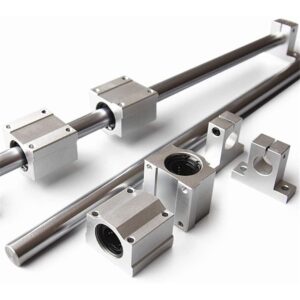
Roller Linear Bearings
Roller bearings use cylindrical rollers instead of balls, offering higher load capacity and rigidity.
Plain Linear Bearings
Plain bearings operate without rolling elements. Instead, they rely on a sliding surface, often made of polymer or composite materials.
Comparison of Bearing Types
| Type | Load Capacity | Precision | Friction |
|---|---|---|---|
| Ball Bearings | Medium | High | Low |
| Roller Bearings | High | High | Very Low |
| Plain Bearings | Low–Medium | Moderate | Moderate |
Key Components of Linear Motion Bearings
Bearing Housing
The housing holds all internal components and ensures structural stability.
Rolling Elements
These include balls or rollers that enable smooth movement.
Shaft or Rail
The shaft or rail provides the guiding surface for motion.
Lubrication System
Lubrication reduces wear and extends the lifespan of the bearing system.
Advantages of Linear Motion Bearings
High Precision Movement
Linear motion bearings ensure extremely accurate and repeatable motion, which is critical in automation systems.
Reduced Friction and Wear
By replacing sliding friction with rolling motion, these bearings significantly reduce wear.
High Load Capacity
Certain types, especially roller bearings, can handle heavy loads while maintaining smooth motion.
Applications of Linear Motion Bearings
CNC Machines
Linear motion bearings are essential in CNC machines for precise tool movement.
Robotics and Automation
Robotic arms rely on linear motion bearings for smooth and controlled motion.
Medical Equipment
Devices like MRI machines and surgical robots use linear bearings for accuracy.
Automotive Industry
Used in assembly lines and testing equipment for precise motion control.
Materials Used in Linear Motion Bearings
Stainless Steel
Provides durability and corrosion resistance.
Polymer Materials
Lightweight and low-friction materials used in specialized applications.
Ceramic Components
Offer high wear resistance and performance in extreme conditions.
Installation Guidelines
Proper Alignment Techniques
Accurate alignment is critical to prevent uneven wear and performance issues.
Mounting Procedures
Proper mounting ensures smooth operation and long lifespan.
Common Installation Mistakes
- Misalignment
- Over-tightening
- Improper lubrication
Maintenance and Troubleshooting
Lubrication Practices
Regular lubrication reduces friction and prevents premature wear.
Wear and Failure Detection
Signs include noise, vibration, and reduced smoothness.
Extending Service Life
Proper maintenance and environmental protection significantly extend lifespan.

Linear Motion Bearings vs Other Motion Systems
Linear Bearings vs Plain Bushings
Linear bearings offer lower friction and higher precision compared to bushings.
Linear Bearings vs Sliding Systems
Sliding systems have higher friction, while linear bearings ensure smooth motion.
Performance Comparison
Linear motion bearings outperform traditional systems in speed, efficiency, and accuracy.
Factors to Consider When Choosing Linear Motion Bearings
Load Capacity
Ensure the bearing can handle operational loads.
Speed Requirements
Higher speeds require precision-engineered bearings.
Environmental Conditions
Temperature, dust, and moisture affect performance.
Future Trends in Linear Motion Bearings
Smart Bearings with Sensors
Future bearings will include sensors for real-time monitoring.
Advanced Materials Development
New composites will improve durability and reduce friction.
Industry 4.0 Integration
Linear motion bearings will integrate with smart manufacturing systems.
Frequently Asked Questions (FAQs)
1. What are linear motion bearings used for?
They are used to enable smooth and precise straight-line motion in machines.
2. How do linear motion bearings work?
They use rolling elements like balls or rollers to reduce friction and guide movement.
3. What are the types of linear motion bearings?
Ball, roller, and plain linear bearings are the main types.
4. Where are linear motion bearings commonly used?
They are used in CNC machines, robotics, medical equipment, and automation systems.
5. What materials are used in linear motion bearings?
Common materials include stainless steel, polymers, and ceramics.
6. How do you maintain linear motion bearings?
Regular cleaning, lubrication, and alignment checks are essential.
Conclusion
Linear motion bearings are a fundamental component of modern mechanical systems. Their ability to deliver smooth, precise, and efficient linear movement makes them indispensable in industries ranging from manufacturing to robotics.
As technology advances, linear motion bearings will continue to evolve with smarter designs, better materials, and improved integration into automated systems. Investing in high-quality bearings and maintaining them properly ensures long-term performance, accuracy, and reliability.