

Outline
| Headings & Subheadings | LSI / Related Keywords |
|---|---|
| Introduction to Linear Guide Ball Bearing | linear motion, bearing systems |
| What Is a Linear Guide Ball Bearing | linear guide rail, ball slide |
| Components of Linear Guide Ball Bearing | carriage, ball retainer, raceway |
| Working Principle of Linear Guide Ball Bearing | rolling motion, friction reduction |
| Advantages of Using Linear Guide Ball Bearings | precision, load capacity |
| Types of Linear Guide Ball Bearing Systems | miniature, heavy-duty, high-speed |
| Materials Used in Linear Guide Ball Bearings | stainless steel, chrome steel |
| Applications of Linear Guide Ball Bearings | CNC, automation, robotics |
| How to Select the Right Linear Guide Ball Bearing | preload, accuracy, load |
| YH Linear: Leading Supplier of Linear Guide Ball Bearings | OEM, customization, quality |
| Installation and Maintenance Tips | lubrication, alignment, cleaning |
| Comparison Between Ball Bearing and Roller Guide Systems | linear roller vs. ball guide |
| Common Problems and Troubleshooting | noise, vibration, misalignment |
| Global Standards and Certifications | ISO, JIS, RoHS compliance |
| Future Innovations in Linear Guide Ball Bearing Design | IoT, self-lubricating, smart sensors |
| FAQs | lubrication, lifespan, selection |
| Conclusion | durability, efficiency, performance |
Introduction to Linear Guide Ball Bearing
In the world of precision motion systems, the linear guide ball bearing is an unsung hero. These compact yet powerful components enable machines to move with incredible accuracy and minimal friction. Found in CNC machines, industrial robots, 3D printers, and medical equipment, they ensure every motion is smooth, repeatable, and precise.
A reliable linear guide ball bearing system transforms the way parts slide and interact. Instead of metal surfaces rubbing together, tiny hardened steel balls roll between rails and carriages, creating motion so smooth it almost feels effortless.

What Is a Linear Guide Ball Bearing
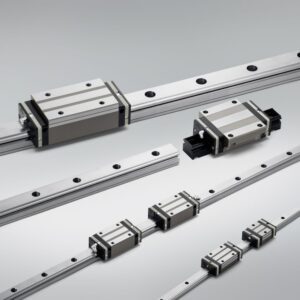
A linear guide ball bearing is a mechanical device that supports linear motion by converting sliding friction into rolling friction. It typically consists of a guide rail and a bearing block (or carriage) filled with precision steel balls.
As the carriage moves along the rail, the steel balls circulate within a recirculation channel, reducing resistance and wear. This design ensures stable movement even under heavy loads or high-speed conditions.
In short, linear guide ball bearings are the heart of modern automation—enabling machines to move with unmatched smoothness and control.
Components of Linear Guide Ball Bearing
A linear guide ball bearing is a sophisticated assembly made up of:
Guide Rail: The hardened, precision-ground track on which the bearing block moves.
Bearing Block / Carriage: Houses the recirculating ball system.
Steel Balls: Roll between the rail and carriage, reducing friction.
Ball Retainer: Keeps the balls in position and ensures smooth motion.
End Caps & Seals: Protect against dust and contamination.
Together, these components create a reliable, low-friction system that delivers precise motion over millions of cycles.
Working Principle of Linear Guide Ball Bearing
The linear guide ball bearing works on a simple but effective principle — rolling friction instead of sliding friction.
As the carriage slides along the rail, steel balls rotate and circulate through return paths inside the block. This rolling movement minimizes resistance, reduces wear, and maintains precision alignment.
Because the contact area is small and the balls roll smoothly, the system can handle high speeds and maintain positioning accuracy of a few microns — ideal for CNC machining and robotics applications.
Advantages of Using Linear Guide Ball Bearings
Choosing linear guide ball bearings offers numerous performance advantages:
Exceptional Accuracy: Maintains linear motion with minimal deviation.
Low Friction: Enables smooth movement and reduces power consumption.
High Load Capacity: Handles radial and axial forces efficiently.
Compact Design: Saves space while improving structural rigidity.
Long Service Life: Hardened materials and precise manufacturing enhance durability.
Easy Maintenance: Grease fittings simplify lubrication.
In demanding applications, these benefits translate into higher productivity, smoother operation, and longer machine lifespan.
Types of Linear Guide Ball Bearing Systems
Linear guide ball bearings come in several designs tailored for specific needs:
Miniature Linear Guides: Compact and lightweight, ideal for electronics and 3D printers.
Standard Linear Guides: Balanced load and precision for automation systems.
Heavy-Duty Linear Guides: High load-bearing capacity for CNC and industrial use.
High-Speed Linear Guides: Optimized for dynamic performance and reduced vibration.
Wide-Block Linear Guides: Increased stability for heavy equipment.
Each type offers unique characteristics to match the precision and load requirements of its intended application.
Materials Used in Linear Guide Ball Bearings
Material selection determines the bearing’s performance and longevity. Common materials include:
Bearing Steel (SUJ2): Offers hardness, wear resistance, and strength.
Stainless Steel (440C): Corrosion-resistant for humid or cleanroom environments.
Ceramic Balls (Si3N4): Lightweight, high-speed, and non-magnetic.
Surface Treatments: Chrome plating and black oxide for enhanced durability.
These high-grade materials allow linear guide ball bearings to perform reliably under demanding industrial conditions.
Applications of Linear Guide Ball Bearings
The versatility of linear guide ball bearings makes them suitable for:
CNC Machines: Ensures stable tool paths and precise cuts.
Robotics: Enables accurate arm movement and positioning.
3D Printers: Provides smooth, quiet, and precise motion.
Medical Equipment: Facilitates clean and precise instrument movement.
Semiconductor Devices: Supports ultra-precise positioning.
Packaging and Assembly Lines: Improves efficiency and repeatability.
Their widespread use highlights their importance in today’s automation-driven world.

How to Select the Right Linear Guide Ball Bearing
Selecting the perfect linear guide ball bearing involves considering:
| Criteria | Description |
|---|---|
| Load Capacity | Choose a bearing that handles static and dynamic loads. |
| Preload | Ensures rigidity and eliminates vibration. |
| Accuracy Grade | Higher grades (C3–C5) for precision machining. |
| Environment | Select corrosion-resistant models for humid conditions. |
| Speed Requirements | Match design to desired feed rates. |
| Mounting Style | Choose top or side mount to fit design constraints. |
A supplier like YH Linear can help tailor your selection to specific operational needs.
YH Linear: Leading Supplier of Linear Guide Ball Bearings
YH Linear stands at the forefront of linear guide ball bearing manufacturing, offering a full range of precision motion components.
With years of engineering experience, YH Linear specializes in customized linear guides, bearing rails, and motion assemblies built to global standards.
Why engineers trust YH Linear:
100% Quality Inspection before shipment
OEM and ODM Services for flexible customization
Fast Global Delivery and responsive after-sales support
Competitive Pricing with uncompromising performance
From miniature designs to heavy-duty rails, YH Linear ensures smooth motion and exceptional reliability for industrial applications.
Installation and Maintenance Tips
Proper installation and maintenance ensure your linear guide ball bearing performs at its best:
Clean Before Assembly: Remove dust or particles from the rail and carriage.
Lubricate Regularly: Use manufacturer-recommended grease.
Ensure Alignment: Misalignment can cause uneven load distribution.
Protect from Contaminants: Install seals or wipers for harsh environments.
Inspect Periodically: Check preload and noise levels.
Following these steps extends lifespan and maintains motion accuracy.
Comparison Between Ball Bearing and Roller Guide Systems
| Feature | Ball Guide | Roller Guide |
|---|---|---|
| Friction | Lower | Moderate |
| Load Capacity | Medium to High | Very High |
| Speed | Excellent | Good |
| Rigidity | Moderate | Higher |
| Cost | More Affordable | More Expensive |
Linear guide ball bearings are ideal for applications needing high speed and precision, while roller guides excel in heavy-load conditions.
Common Problems and Troubleshooting
Even the best linear guide ball bearings require care:
Noise or Vibration: Often due to contamination or misalignment.
Uneven Motion: Indicates preload or lubrication issues.
Corrosion: Prevented by using stainless steel or protective coatings.
Short Service Life: May result from overload or improper installation.
Regular maintenance prevents these issues and ensures consistent performance.
Global Standards and Certifications
Top suppliers like YH Linear comply with global standards:
ISO 9001: Quality management system
JIS & DIN Standards: Dimensional accuracy
RoHS Compliance: Environmentally safe materials
These certifications guarantee reliability, interchangeability, and long-term durability.
Future Innovations in Linear Guide Ball Bearing Design
The next generation of linear guide ball bearings focuses on:
Smart Bearings: IoT sensors for real-time wear monitoring.
Self-Lubricating Systems: Maintenance-free operation.
Lightweight Alloys: Improved energy efficiency.
Sustainable Manufacturing: Eco-friendly processes.
Innovation continues to redefine precision motion technology.
FAQs
What is the main benefit of using linear guide ball bearings?
They offer smooth, precise linear motion with minimal friction and wear.
How often should linear guide bearings be lubricated?
Typically every 3–6 months, depending on operating conditions.
Are ball guides interchangeable between brands?
Many follow ISO standards, making them interchangeable.
What causes vibration in linear guides?
Misalignment, contamination, or insufficient preload.
Can linear guide ball bearings handle heavy loads?
Yes, especially high-precision, heavy-duty models with larger ball diameters.
Conclusion
The linear guide ball bearing is the foundation of precision motion — quietly enabling machines to operate with unmatched smoothness, accuracy, and reliability.
For manufacturers seeking consistent performance and global-standard quality, YH Linear delivers innovative linear motion solutions designed for long life and exceptional value.