

Introduction
Modern machinery depends on precise, smooth, and repeatable linear motion. Whether in CNC machines, industrial automation, robotics, medical equipment, or packaging systems, one component plays a critical role in enabling this movement: the linear bearing.
A linear bearing allows a machine component to move in a straight line with minimal friction, while supporting loads and maintaining alignment. Compared with traditional sliding surfaces, linear bearings significantly improve accuracy, efficiency, and service life.
This article explains what a linear bearing is, how it works, its main types, advantages, applications, selection considerations, and maintenance practices.
What Is a Linear Bearing?
A linear bearing is a mechanical component designed to support and guide linear motion along a shaft, rail, or track. Its primary function is to reduce friction between moving parts while maintaining precise alignment and load support.
Unlike rotary bearings that allow rotational motion, linear bearings enable straight-line movement. They are commonly used in combination with:
Linear shafts
Linear rails
Guide tracks
Linear bearings are essential wherever controlled, smooth linear motion is required.
How Does a Linear Bearing Work?
A linear bearing works by minimizing friction between the moving component and its guide surface:
The bearing is mounted inside a housing or carriage.
A shaft or rail passes through the bearing.
Rolling elements (balls or rollers) or low-friction surfaces reduce resistance.
Load is distributed evenly across the bearing.
Smooth, controlled linear motion is achieved.
Depending on the design, the motion may be supported by rolling contact or sliding contact.
Main Components of a Linear Bearing
1. Bearing Housing
Holds internal elements in position
Provides structural support
2. Rolling or Sliding Elements
Steel balls, cylindrical rollers, or polymer liners
Reduce friction and distribute loads
3. Retainers or Cages
Keep rolling elements evenly spaced
Ensure smooth circulation
4. Seals and Wipers
Prevent contamination from dust and debris
Extend bearing life
5. Lubrication System
Grease or oil channels
Reduce wear and friction
Types of Linear Bearings
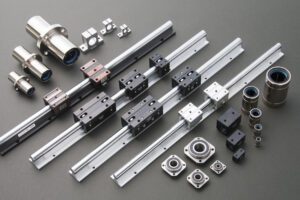
1. Ball Linear Bearings
Use recirculating steel balls
Low friction and smooth movement
Suitable for high-speed applications
Common Applications: CNC machines, automation equipment

2. Roller Linear Bearings
Use cylindrical rollers
Higher load capacity and rigidity than ball bearings
Better shock resistance
Common Applications: Heavy machinery, gantry systems
3. Plain Linear Bearings (Sliding Bearings)
Use low-friction materials instead of rolling elements
Simple design and low maintenance
Common Applications: Dusty or wet environments, light loads
4. Linear Bushings
Cylindrical bearings designed for round shafts
Easy to install and cost-effective
Common Applications: 3D printers, light automation
5. Profiled Linear Bearings
Used with precision linear rails
High accuracy and multi-directional load support
Common Applications: CNC machining centers, robotics
6. Miniature Linear Bearings
Compact size with high precision
Designed for limited spaces
Common Applications: Medical devices, electronics, laboratory equipment
Materials Used in Linear Bearings
Hardened Steel – High strength and durability
Stainless Steel – Corrosion resistance
Aluminum – Lightweight housings
Engineering Plastics – Low friction and chemical resistance
Material selection depends on load, environment, and operating speed.
Advantages of Linear Bearings
Low Friction – Smooth and energy-efficient motion
High Precision and Repeatability
High Load Capacity – Especially roller-type designs
Compact Design
Long Service Life
Reduced Maintenance Compared to Sliding Systems
Applications of Linear Bearings
CNC Machines – Linear axes and positioning systems
Industrial Automation – Assembly lines and transfer units
Robotics – Linear actuators and motion stages
Medical Equipment – Diagnostic and laboratory devices
Packaging Machinery – High-speed motion systems
Material Handling Equipment – Conveyors and lifting systems
Linear Bearings vs. Sliding Bearings
| Feature | Linear Bearings | Sliding Bearings |
|---|---|---|
| Friction | Very Low | Higher |
| Precision | High | Moderate |
| Load Capacity | High | Medium |
| Maintenance | Moderate | Low |
| Speed Capability | High | Low–Medium |
Linear bearings are preferred for precision and speed, while sliding bearings suit simple or harsh environments.
How to Choose the Right Linear Bearing
Load Type and Magnitude – Static, dynamic, and moment loads
Required Accuracy – Positioning precision and repeatability
Speed and Acceleration
Guide Type – Shaft or rail
Environmental Conditions – Dust, moisture, temperature
Maintenance Requirements
Available Installation Space
Selecting the correct linear bearing ensures optimal performance and durability.
Installation and Maintenance Tips
Installation
Ensure proper alignment of shafts or rails
Avoid excessive force during installation
Apply recommended lubrication
Maintenance
Clean regularly to remove contaminants
Re-lubricate as needed
Inspect for wear or abnormal noise
Proper maintenance extends bearing life and motion accuracy.
Future Trends in Linear Bearing Technology
Maintenance-free linear bearings
Self-lubricating materials
Higher load capacity with compact designs
Smart bearings with condition monitoring
Eco-friendly materials and coatings
Frequently Asked Questions (FAQs)
1. What is a linear bearing used for?
It allows smooth, accurate linear motion while supporting loads and maintaining alignment.
2. What is the difference between a linear bearing and a rotary bearing?
Linear bearings enable straight-line motion, while rotary bearings allow rotational motion.
3. Do linear bearings require lubrication?
Most rolling linear bearings require lubrication; some plain bearings are self-lubricating.
4. Can linear bearings handle heavy loads?
Yes, especially roller-type linear bearings designed for high-load applications.
5. Where are linear bearings commonly used?
They are used in CNC machines, automation systems, robotics, medical devices, and packaging machinery.
Conclusion
Understanding what a linear bearing is helps engineers and designers select the right components for precise, efficient, and reliable linear motion systems. With various types available—ranging from ball and roller bearings to plain and profiled designs—linear bearings play a vital role in modern machinery.
Proper selection, installation, and maintenance ensure smooth operation, long service life, and high positioning accuracy across a wide range of industrial and automation applications.