

Introduction
In modern industrial machinery, automation systems, and material handling equipment, linear motion accuracy and load capacity are essential for efficient operation. A rail with rollers—also known as a roller linear guide—is a critical component that allows smooth, precise, and repeatable linear motion, even under heavy loads and high-speed conditions.
Rails with rollers are widely used in CNC machines, gantry systems, industrial automation, robotics, and heavy-duty transport equipment. By combining a precision rail with rolling elements, they provide low-friction, high-rigidity motion that traditional sliding systems cannot match.
This article provides a comprehensive guide to rails with rollers, including their design, working principles, types, advantages, applications, selection criteria, installation, and maintenance.
What Is a Rail with Rollers?
A rail with rollers is a linear motion system consisting of:
Rail: A hardened, precision-machined track
Roller block or carriage: A component that moves along the rail
Rollers (cylindrical or needle): Rolling elements that reduce friction and carry loads
Unlike ball-type linear guides, roller-based rails provide line contact instead of point contact, offering higher rigidity, superior load distribution, and improved resistance to deformation.
This combination ensures smooth, precise linear motion in demanding industrial applications.
How Rails with Rollers Work
Rails with rollers operate on the principle of rolling contact:
The roller block slides along the precision rail.
Cylindrical or needle rollers within the block roll along the rail surface.
Load is distributed evenly across the rollers’ contact lines.
Friction is significantly reduced compared to sliding surfaces.
The system maintains high rigidity, stability, and repeatable motion.
This makes rails with rollers ideal for heavy loads, high-speed linear motion, and precise positioning.
Key Components of Rails with Rollers
1. Rail
Precision-ground and hardened steel or aluminum
Provides a rigid, straight path
Can support heavy static and dynamic loads
2. Roller Block / Carriage
Houses rollers and distributes load evenly
Supports multi-directional forces
Maintains smooth linear movement
3. Rolling Elements
Cylindrical or needle rollers
Line contact improves rigidity
Circulate within the block to provide smooth motion
4. Retainers and End Caps
Maintain roller spacing and alignment
Enable continuous circulation within the block
5. Seals and Wipers
Protect against dust, debris, and liquids
Extend lifespan of rollers and rails
6. Lubrication System
Grease or oil channels reduce wear
Required for high-speed or heavy-load applications
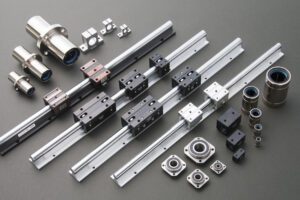
Types of Rails with Rollers
1. Roller Linear Guides
Integrated rail and block system with cylindrical rollers
High load capacity and rigidity
Common in CNC machines, gantry systems, and industrial automation
2. Cross-Roller Rails
Rollers arranged at 90-degree angles
Exceptional stiffness and precision
Suitable for robotics, precision stages, and metrology equipment
3. Heavy-Duty Roller Rails
Reinforced rails and large rollers
Designed for high-load, shock-resistant applications
Used in presses, steel machinery, and large gantry systems
4. Compact Roller Rails
Space-saving design with smaller rollers
High precision in limited installation space
Ideal for medical devices, laboratory automation, and small CNC machines
Materials and Surface Treatments
Hardened Steel – High strength and wear resistance
Stainless Steel – Corrosion resistance in wet or clean environments
Aluminum Alloy – Lightweight, modular design
Surface Treatments – Chrome plating, black oxide, or induction hardening
Advanced Seals – Protect against contaminants and extend service life
Advantages of Rails with Rollers
High Load Capacity – Can handle heavy static and dynamic loads
Superior Rigidity – Minimal deflection under load
High Precision and Repeatability – Accurate linear positioning
Low Friction – Smooth, energy-efficient motion
Shock and Vibration Resistance – Ideal for industrial applications
Long Service Life – Reduced wear and maintenance needs
Applications of Rails with Rollers
CNC Machine Tools – Milling machines, lathes, and gantry systems
Industrial Automation – Assembly lines, material transfer, and processing equipment
Robotics – Linear axes and high-precision robotic stages
Material Handling Systems – Heavy carts, lifts, and conveyors
Presses and Forming Machines – High-load shock-resistant applications
Packaging Machinery – High-speed motion and accuracy
Laboratory and Medical Equipment – Compact precision motion systems
Rail with Rollers vs. Linear Ball Guides
| Feature | Rails with Rollers | Linear Ball Guides |
|---|---|---|
| Contact Type | Line contact | Point contact |
| Load Capacity | Very high | Moderate |
| Rigidity | Very high | Medium |
| Shock Resistance | High | Moderate |
| Precision | High | High |
| Cost | Higher | Lower |
Rails with rollers are chosen for heavy loads, high rigidity, and shock-prone environments, while ball guides are used for high-speed, lighter-load applications.
How to Choose the Right Rail with Rollers
Load Capacity – Static, dynamic, and moment loads
Precision Requirements – Accuracy and repeatability
Travel Length – Stroke distance and rail size
Speed and Acceleration – Motion requirements
Environment – Dust, moisture, temperature, chemicals
Space Constraints – Mounting and alignment considerations
Maintenance Needs – Lubrication and inspection frequency
Proper selection ensures optimal performance, durability, and accuracy.
Installation Best Practices
Mount rails on flat, rigid, and aligned surfaces
Use correct fasteners and torque settings
Ensure carriages are aligned parallel to each other
Apply initial lubrication to rollers
Test under light load before full operation
Correct installation maximizes precision, load distribution, and service life.
Maintenance Tips
Clean rails and roller blocks regularly
Inspect rollers, seals, and wipers for wear
Lubricate rollers according to manufacturer guidelines
Replace damaged or worn components promptly
Regular maintenance ensures long-lasting, smooth, and accurate motion.
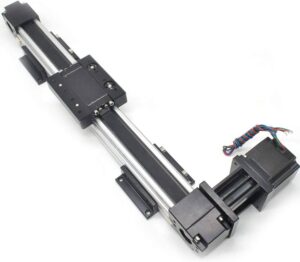
Future Trends in Rail with Rollers Technology
Heavy-duty, high-load compact designs
Maintenance-free or sealed roller systems
Advanced surface coatings for corrosion and wear resistance
Integration with sensors for predictive maintenance
Smart factory and Industry 4.0-ready solutions
These trends enhance durability, reliability, and automation efficiency in industrial environments.
Frequently Asked Questions (FAQs)
1. What is a rail with rollers?
A rail with rollers is a linear motion system that combines a precision rail and a roller-based carriage for smooth, high-load linear motion.
2. How is it different from a ball-type linear guide?
Roller rails use line contact instead of point contact, providing higher rigidity and load capacity.
3. Do rails with rollers need lubrication?
Yes, lubrication is essential for smooth motion, reducing wear, and extending service life.
4. Can rails with rollers handle heavy loads?
Yes, they are designed for heavy static and dynamic loads, as well as shock conditions.
5. Where are rails with rollers commonly used?
They are used in CNC machines, automation systems, robotics, heavy machinery, presses, and material handling systems.
Conclusion
Rails with rollers are critical components in high-load, high-precision linear motion systems. Their cylindrical roller design provides superior rigidity, load capacity, and accuracy, making them ideal for CNC machines, automation equipment, robotics, and industrial machinery.
Proper selection, installation, and maintenance ensure long-lasting, smooth, and precise motion, contributing to higher efficiency and reliability in industrial applications.